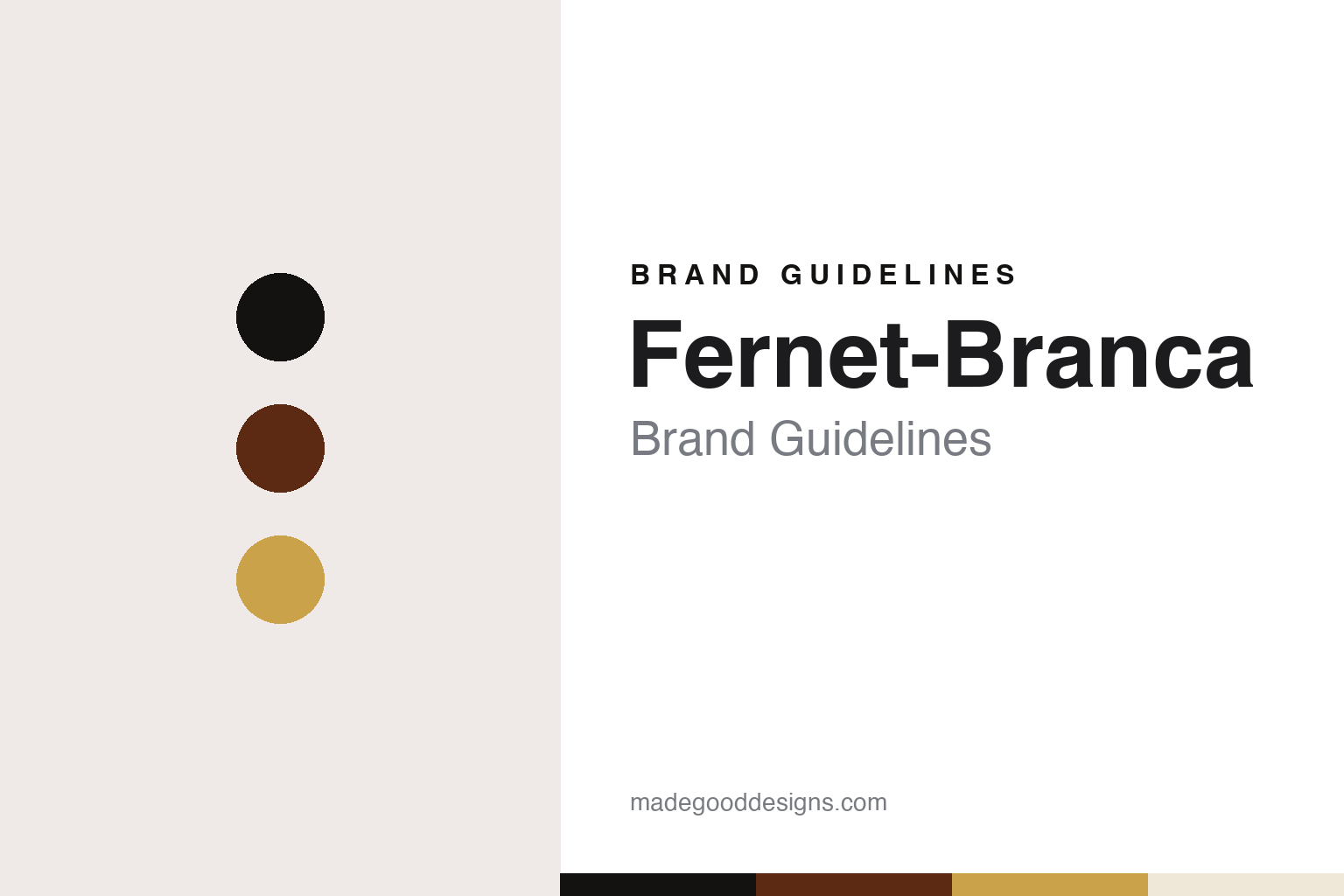
Fernet-Branca Brand Guidelines
The Milan amaro of the eagle over the globe.
Aa
Two constants: a Fernet-Branca black, brown and gold palette and a Liberty-era serif register. Abstract homage — not a Fernet-Branca product or mark; no bottle, label or logo is reproduced.
Porta Nuova, 1845
A self-taught herbalist and a small workshop in Milan.
Fernet-Branca dates from 1845, when Bernardino Branca, described by English Wikipedia as a self-taught herbalist and by Italian Wikipedia as a self-taught pharmacist, worked out the recipe in Milan. Italian Wikipedia, drawing on the Italian state archive’s business-history records, says he began making it in a small laboratory in the Porta Nuova district and set up a family partnership, Fratelli Branca, whose first market was Milan and a few other northern Italian cities. Born in Pallanza on Lake Maggiore, he had run a café and a weaving business before moving to Milan, the same source says.
His sons Luigi, Giuseppe and Stefano joined the firm and built up its distribution in Italy and abroad. Italian Wikipedia lists a gold medal at the national exhibition in Florence in 1861 and further awards at the international exhibitions of London in 1862, Paris in 1867 and Vienna in 1873; by the 1870s the drink was selling in Europe and across the Atlantic, especially in the United States and Argentina, the countries to which most Italian emigrants were heading.
In 1891 Stefano Branca’s wife, Maria Branca Scala, took charge of a business that Italian Wikipedia says then had about fifty office staff and more than three hundred workers. In June 1917 the founder’s grandson, also named Bernardino Branca, took over the direction of the company, which became a joint-stock company in January 1918. He modernised the factory on Via Resegone, built early in the century to replace the Porta Nuova workshop, and widened the range to hundreds of products, among them the Vieux Cognac Supérieur that became Brandy Stravecchio Branca after the war.
Colour
Calendars, posters and an eagle.
Branca advertised early. The company says its first recorded advertisement ran on 14 February 1865 in the Milan daily La Perseveranza, and that from 1886 it issued illustrated calendars for Italian and foreign markets, signed by artists including Giuseppe Amisani, Plinio Codognato, Osvaldo Ballerio, Achille Luciano Mauzan and Leopoldo Metlicovitz.
Metlicovitz, a Liberty-era painter and one of the founders of modern Italian poster design, is credited with the mark that still defines the brand: an eagle with spread wings gripping a bottle above the globe. The company says the eagle first appeared in Branca calendars in 1895 and that the trademark was officially registered on 27 November 1905; English Wikipedia, citing the Roanoke Times in 2019, dates the design to 1893. An earlier Fernet-Branca trade mark, filed in 1887 and describing the brothers as suppliers to the King of Italy, survives in the Italian state archives.
After the First World War Branca commissioned posters from Italian and French illustrators, the company says, working with agencies such as Les Affiches Maga of Bologna and Umberto Notari’s Agenzia III; Italian Wikipedia adds Leonetto Cappiello and the Frenchman Jean d’Ylen to the 1930s campaigns. The Milan plant was bombed in August 1943, and after the war, Italian Wikipedia says, the company added radio and cinema to its printed advertising.
On television, Fernet-Branca appeared in Carosello, the evening advertising slot, with clay animation by Fusako Yusaki in the 1960s, Italian Wikipedia says. The company lists its slogans by year, among them “Sopra tutto, Fernet Branca” in 1981 and “Pregio e privilegio” in 1990; Brancamenta, the mint version made since 1965, had its own campaign built around a glass carved from ice.
Typography
Amaro and the Italian bitter tradition.
The seven brands in this group are all Italian amaro and liqueur names: Fernet-Branca, Averna, Ramazzotti, Montenegro, Cynar, Strega and Galliano. Italian amaro and liqueur brands in general sit at many different points in the trade, from family firms that still carry a founder’s name to names that now belong to much larger drinks groups, and a single brand can be sold everywhere from a neighbourhood bar to a supermarket shelf.
A drinks brand’s identity is usually carried less by a single product than by a bottle, a label, a name and the ritual it promises, because the company behind the name may have changed hands, moved its production or grown far beyond the town where it started. That makes the questions behind each name worth asking plainly: who started it, who owns it now, and where its drinks are actually made and bottled.
Each guide separates what independent sources record from what the company says about itself — its founding story, its owners over time, where its drinks are made and how its bottles and labels have changed — and marks plainly what rests only on the company’s own word.
Aa
A high-contrast serif in the spirit of Liberty-era posters. (Specimen set in Playfair Display, a serif STAND-IN; NOT the Fernet-Branca logo or lettering.)
Fernet-Branca
Novare serbando: renewing while preserving.
Fernet-Branca went abroad early and built its own factories there. Italian Wikipedia, again drawing on the state archive’s records, says a plant at Saint-Louis in Alsace was completed in 1926 to supply France; that the same year Hofer & C., the exclusive South American agent in Buenos Aires, was allowed to make the drink from extract shipped from Milan — the Argentine company dates that licence to 1925; and that a Stuttgart plant followed in 1927, and a Swiss company at Chiasso and Fratelli Branca Inc., with a plant in New York, in 1932. In 1940 Branca took over the Buenos Aires plant from its agent. Argentina, where fernet con coca is a popular mix, remains home to the company’s plant at Tortuguitas, Italian Wikipedia says.
The business has stayed with the family. In 1955 Bernardino Branca handed the presidency and management to his sons Stefano, Pierluigi, Giuseppe and Carlo, Italian Wikipedia says. Today Fratelli Branca Distillerie sits, with Branca Real Estate and the Centro Studi Fratelli Branca, under the holding company Branca International, controlled by the Branca family, with Niccolò Branca as president and chief executive. In 2001 the group bought the rights to Punt e Mes from the Carpano family of Turin, English Wikipedia reports, citing Chianti Classico Magazine. Its motto is “Novare serbando”, roughly “renewing while preserving.”
Italian Wikipedia says production of Fernet-Branca has always stayed in Milan; the brand’s website calls Milan its home town and describes a secret formula of 27 herbs, roots and spices. Since 4 June 2009 the historic production site on Via Resegone has housed the Collezione Branca, a museum of stills, mortars, calendars from 1886 to 1913 and advertising sketches from the 1960s and 1970s, which the company says was added in 2025 to Lombardy’s register of corporate museums. The lettering is covered in our guide What Font Does Fernet-Branca Use?
For a design guide, Fernet-Branca shows how one illustrated mark, kept for more than a century, can carry a family brand across continents. Compare Ramazzotti, another Milan amaro, and Unicum, a family-owned Hungarian bitter. For this guide we use black, a deep brown and an eagle gold with a serif, an unofficial interpretation; no product or logo is reproduced.
Explore & save
Keep Fernet-Branca’s identity on hand — save it to a board in the Made Good inspiration library.
Fernet-Branca identity set
Pin the Fernet-Branca black, brown and gold palette and the Liberty-era serif register to your own board.