Unicum Brand Guidelines
The Zwack family’s round-bottled Budapest bitter.
Aa
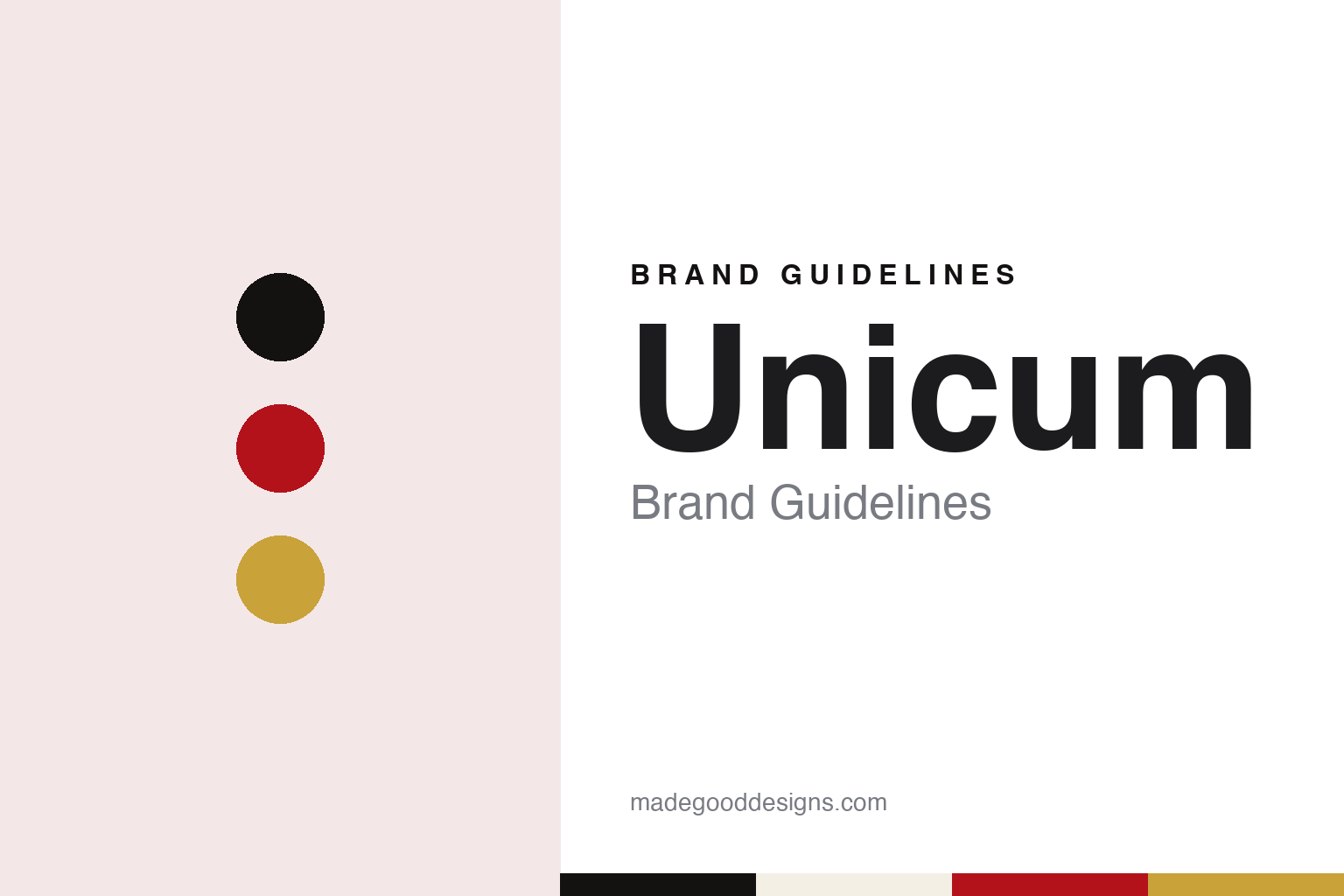
Two constants: a bitter black, Unicum red and cross gold palette and a classic display serif register. Abstract homage — not a Unicum product or mark; no bottle, label, poster or logo is reproduced.
Zwack and the emperor
A court legend, a Pest distillery and an 1883 trade mark.
Unicum is a Hungarian herbal bitter liqueur made by Zwack Unicum in Budapest, and the company tells its origin as a story. In 1790, it says, a Dr Zwack, physician to the Habsburg court, offered Emperor Joseph II his herbal liqueur, and the emperor answered, “Dr. Zwack, das ist ein Unikum!” — “this is unique” — giving the drink its name. Hungarian Wikipedia notes that no historical source confirms a court physician named Zwack, and that Joseph II’s personal physician from 1776 was Joseph Barth, citing the Austrian biographical dictionary.
The documented business begins with József Zwack. The company says he set up his first distillery in Pest in 1840, in the Marokkó courtyard outside the old city wall, and moved to larger premises in Terézváros in 1850. On 22 May 1883 the Unicum name was registered as a trade mark; the company says the drink then came in its original round bottle, with a red cross on the label, and Hungarian Wikipedia adds that the cross stood on a white ground. József’s son Lajos became a partner in 1886, and the firm traded as Zwack J. és Társai.
In 1892 the family took over a new site on the Danube bank in Ferencváros. After the streets were rearranged in 1906 it received the address Soroksári út 26, which the company says is still its home. The company says Zwack became a supplier to the imperial and royal court in 1895. Hungarian Wikipedia says that from 1899 the firm paid the Hungarian Red Cross for the use of its cross and later, to avoid a dispute, changed the symbol to a gold cross on a red ground; the company dates the payments to 1899–1922.
Colour
A drenched man, a false recipe and two Unicums.
Unicum’s best-known image is the “vizesember” — the drenched man — a poster by Viktor Pachl that Hungarian Wikipedia dates to 1909 and the company to the early 1900s. In the 1930s an animated advertising film by Gyula Macskássy, A szerencsés flottás, also became well known, Hungarian Wikipedia says. It adds that between the wars the family made light bulbs and neon tubes under the Zeta name, so that Unicum neon signs lit the capital’s streets. The round bottle has its own explanation: the company says the sphere stood for perfection in Platonic philosophy. Hungarian Wikipedia records that the bottle and label have changed several times, most recently in the 2000s, when the bottle again got a longer neck and the label became a clear film; the company says Unicum was redesigned in 2009.
The Second World War and its aftermath split the brand in two. Hungarian Wikipedia says the factory was hit by three bombs in 1944; the company says it was nationalised without compensation in 1948. In the family’s account, Lajos’s son János Zwack left for the United States with the recipe, while his brother Béla, who stayed behind, gave the state a false one. Hungarian Wikipedia says the family then had Unicum made in small quantities in Milan by a family friend, while the state-owned Budapest plant went on making its own version. János went to court to protect the family trade marks; the company says the result was that Budapest-made Unicum could no longer be exported to the West under the name.
János’s son Péter Zwack moved back to Europe in 1970 to run production and marketing in Italy, the company says, and returned to Hungary with his family in 1987–88.
Typography
Design and documentation.
The seven brands in this group all make food or drink, and all of them come from Hungary: Szamos, Tibi, Sport, Dreher, Borsodi, Unicum and Pöttyös. Hungarian food and drink brands in general sit at many different points in the trade, from family firms that still carry a founder’s surname to names that now belong to much larger food or drinks groups, and a single brand can be sold everywhere from a corner shop to a supermarket shelf.
A food or drink brand’s identity is usually carried less by a single product than by a pack, a name and the treat or the drink it promises, because the company behind the name may have changed hands, moved its factory or grown far beyond the town where it started. That makes the questions behind each name worth asking plainly: who started it, who owns it now, and where its products are actually made and packed.
Each guide separates what independent sources record from what the company says about itself — its founding story, its owners over time, where its products are made and how its packaging has changed — and marks plainly what rests only on the company’s own word.
Aa
A classic display serif for a bitter with a two-century story. (Specimen set in Playfair Display, a serif STAND-IN; NOT the Unicum logo.)
Unicum
A family buy-back, Underberg and Diageo.
Unicum came home in stages. On 10 July 1989, the company says, Peter Zwack & Consorten AG — set up by Péter Zwack with the German drinks maker Emil Underberg, Hungarian Wikipedia says — founded a joint venture, Zwack Unicum Budapest Kft. In 1992, during privatisation, it bought back the state’s Budapesti Likőripari Vállalat and formed Zwack Unicum Rt. Hungarian Wikipedia says the drinks group IDV, later part of Diageo, became a partner with a 26% stake, and that the shares were listed on the Budapest Stock Exchange in 1993. In 2008 Péter Zwack handed over to his son Sándor Zwack, as chairman, and his daughter Izabella Zwack, as a board member — the sixth generation, the company says. He died in 2012, the news site Index reported.
That structure still stands. Zwack Unicum’s 2025–26 annual report shows a holding company ultimately owned by members of the Zwack and Underberg families with 50% plus one share, Diageo Holdings Netherlands with 26% and the public with the rest. The report says Unicum production and its first barrel ageing take place at Soroksári út, while the company’s Dunaharaszti plant carries out further ageing and bottling. Hungarian Wikipedia says Unicum is made from more than 40 herbs and spices, part macerated and part distilled, and aged in oak casks in cellars beneath the Budapest site, and that it has been counted as a Hungarikum since 2015. The range has grown to include Unicum Szilva, made with plums, in 2012, Unicum Riserva in 2017 and Unicum Barista in 2021; the annual report says Unicum Orange Bitter reached shops in April 2025.
For a design guide, Unicum shows how a round bottle, a cross on red and a century-old poster can carry a brand through nationalisation, exile and return. Compare it with Hungary’s Borsodi and Dreher, two Hungarian beers. For this guide we use bitter black, Unicum red and cross gold with a classic serif, an unofficial interpretation; no product or logo is reproduced.
Explore & save
Keep Unicum’s identity on hand — save it to a board in the Made Good inspiration library.
Unicum identity set
Pin the Unicum bitter black, Unicum red and cross gold palette and the classic display serif register to your own board.