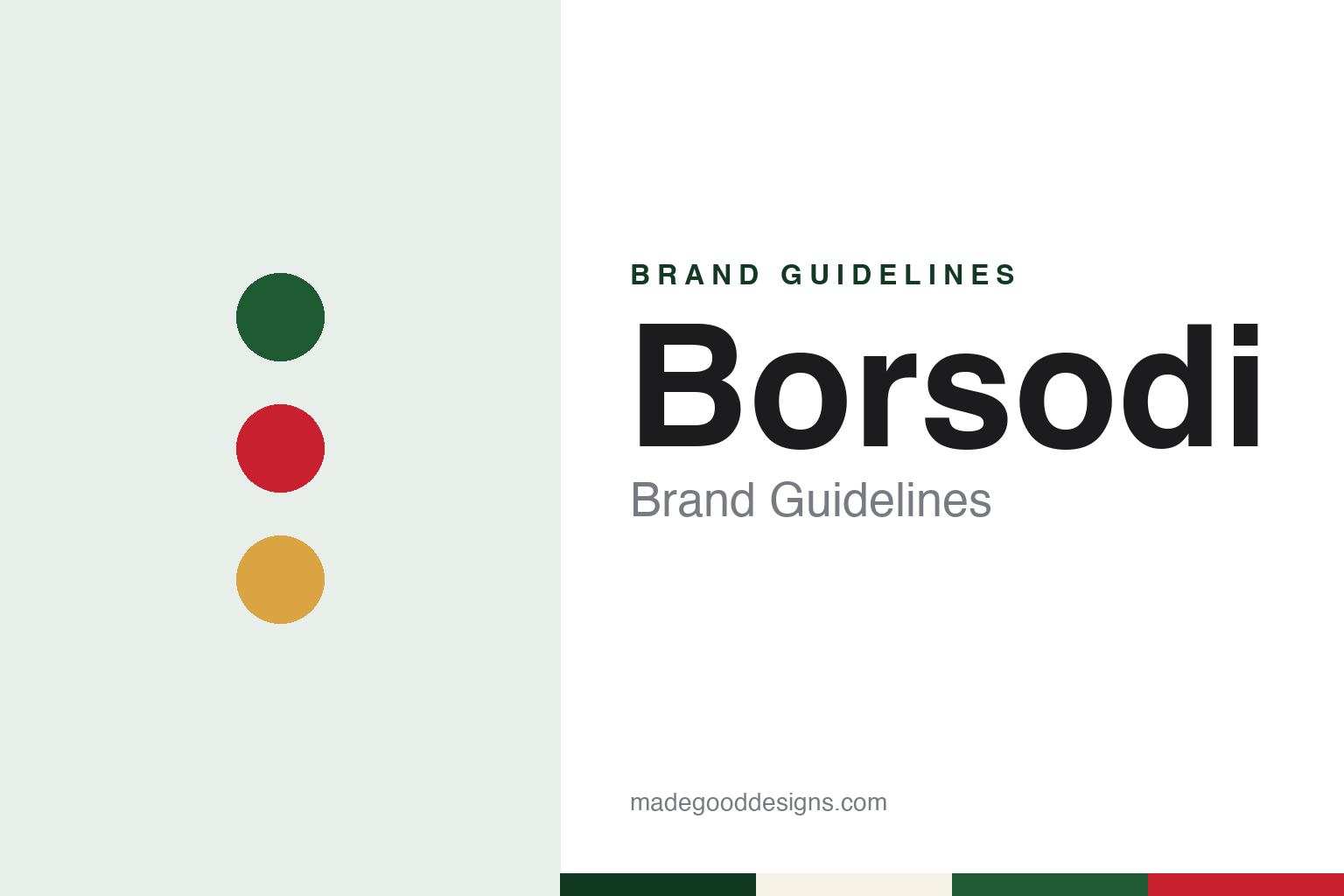
Borsodi Brand Guidelines
The Bőcs lager that changed its label with every owner.
Aa
Two constants: a bottle green, label red and malt gold palette and a condensed lager sans register. Abstract homage — not a Borsodi product or mark; no bottle, label or logo is reproduced.
A brewery at Bőcs
A planned-economy plant built to serve the east of Hungary.
Borsodi is brewed at Bőcs, a village near Miskolc in Borsod-Abaúj-Zemplén county, in north-eastern Hungary, and takes its name from the historic county of Borsod. English Wikipedia says construction of the brewery began in 1969; it began brewing in 1973, the year the company gives as its founding. Hungarian Wikipedia, citing the company’s own history, says the site was chosen for its water supply — the Hernád river runs nearby — and for its transport links, including the railway.
Borsodi did not begin as a private brand. Hungarian Wikipedia says the brewery was part of the national brewing enterprise, the Magyar Országos Söripari Vállalat, and at first made two beers: Borsodi Világos, a pale lager, and the stronger Borsodi Kinizsi. English Wikipedia explains that in the socialist period each Hungarian brewery was assigned a region instead of competing for drinkers, and that Borsod supplied the east of the country; after privatisation in the early 1990s the breweries became competitors across the whole market.
From the 1980s the brewery also made the German Spaten beer under licence, Hungarian Wikipedia says. In 1987, the company says, Borsodi was the first in Hungary to put an alcohol-free beer on the market, Borsodi Póló; Hungarian Wikipedia adds that Póló was known for its blue label and was phased out in the late 2010s. English Wikipedia dates Póló’s introduction to 1996, so the sources differ.
Colour
Beige and brown, metallic green, a crest and a horse.
The look of Borsodi has changed several times. Hungarian Wikipedia, citing the company’s history, says that in the mid-1990s the brewery dropped its earlier beige and brown colour scheme for metallic green, set its brand names in red and placed a crest made of brewing equipment on the label; canned beer arrived at about the same time. The original lager, sold as Borsodi Világos from 1973, has been sold as Borsodi Sör since 1996.
In the 2000s the design was refreshed again. Hungarian Wikipedia says Borsodi was the first in Hungary to sell a one-litre beer in a plastic bottle, and that the brewery added Borostyán, a semi-dark beer, in 2003. The stronger Borsodi Bivaly — the name means “buffalo” — came out in a returnable half-litre glass bottle in 2003 and in cans in 2004, Hungarian Wikipedia says, citing the brand’s website. In March 2005 a new brewhouse went into operation at Bőcs, the Budapest Business Journal reported. From 2005 to 2007 the top Hungarian football league carried the nickname Borsodi Liga after its sponsor, English Wikipedia says.
After the 2009 change of ownership, Hungarian Wikipedia says, the crest on the label gave way to a rearing horse, and the brewery launched Borsodi Friss, a family of alcohol-free beer-based drinks, in 2011. In 2016, the company says, it introduced a new green bottle design together with the slogan “Az élet habos oldala” — “the frothy side of life.” Hungarian Wikipedia says the new bottle has a distinctive shape. Later additions include Borsodi Mester, brewed from 2018 to a recipe by brewmaster András Németh, and the Borsodi Szitu line, which began in 2020 with a hoppy lager and an IPA in a markedly different design. Hungarian Wikipedia adds that in 2022 the brewery dropped maize grits from the Borsodi Sör recipe, and that in 2025 the Friss drinks lost the Borsodi name.
Typography
Design and documentation.
The seven brands in this group all make food or drink, and all of them come from Hungary: Szamos, Tibi, Sport, Dreher, Borsodi, Unicum and Pöttyös. Hungarian food and drink brands in general sit at many different points in the trade, from family firms that still carry a founder’s surname to names that now belong to much larger food or drinks groups, and a single brand can be sold everywhere from a corner shop to a supermarket shelf.
A food or drink brand’s identity is usually carried less by a single product than by a pack, a name and the treat or the drink it promises, because the company behind the name may have changed hands, moved its factory or grown far beyond the town where it started. That makes the questions behind each name worth asking plainly: who started it, who owns it now, and where its products are actually made and packed.
Each guide separates what independent sources record from what the company says about itself — its founding story, its owners over time, where its products are made and how its packaging has changed — and marks plainly what rests only on the company’s own word.
Aa
A condensed lager sans for a beer named after a county. (Specimen set in Oswald, a sans STAND-IN; NOT the Borsodi logo.)
Borsodi
From the state to Interbrew, CVC and Molson Coors.
Borsodi has had four kinds of owner in just over 50 years. The company says the brewery became a joint-stock company in 1990 and was privatised in 1991, when it was acquired by the Belgian brewer Interbrew; English Wikipedia dates Interbrew’s purchase to 1993. Interbrew later became part of Anheuser-Busch InBev, the company says. In 2009 the private equity firm CVC Capital Partners bought AB InBev’s breweries in Central and Eastern Europe — nine of them, Hungarian Wikipedia says — and ran them as StarBev, with its headquarters in Prague.
In April 2012 CVC sold StarBev to Molson Coors, the American-Canadian brewer, Hungarian Wikipedia says; the company says the acquisition was completed that year and the group was renamed Molson Coors Europe. The brewery’s website still links to Molson Coors in 2026. Under its foreign owners the plant has also brewed international beers under licence; Hungarian Wikipedia lists brands including Beck’s, Staropramen and Stella Artois. The company says it was the first Hungarian brewery to gain ISO 9001 certification, in 1996, and that it celebrated the brewery’s 50th anniversary in 2023. English Wikipedia, citing a 2008 book on restructuring in the new EU member states, says Borsodi has worked with the University of Miskolc on market research projects and that its staff are trained in a postgraduate programme there.
For a design guide, Borsodi shows a regional lager from a planned-economy brewery whose label has moved from beige and brown to metallic green, from a brewing crest to a rearing horse, and then to a new bottle and slogan. Compare it with Hungary’s Dreher, another Hungarian beer, and with Unicum, a Budapest spirit that stayed with its founding family. For this guide we use bottle green, label red and malt gold with a condensed sans, an unofficial interpretation; no product or logo is reproduced.
Explore & save
Keep Borsodi’s identity on hand — save it to a board in the Made Good inspiration library.
Borsodi identity set
Pin the Borsodi bottle green, label red and malt gold palette and the condensed lager sans register to your own board.