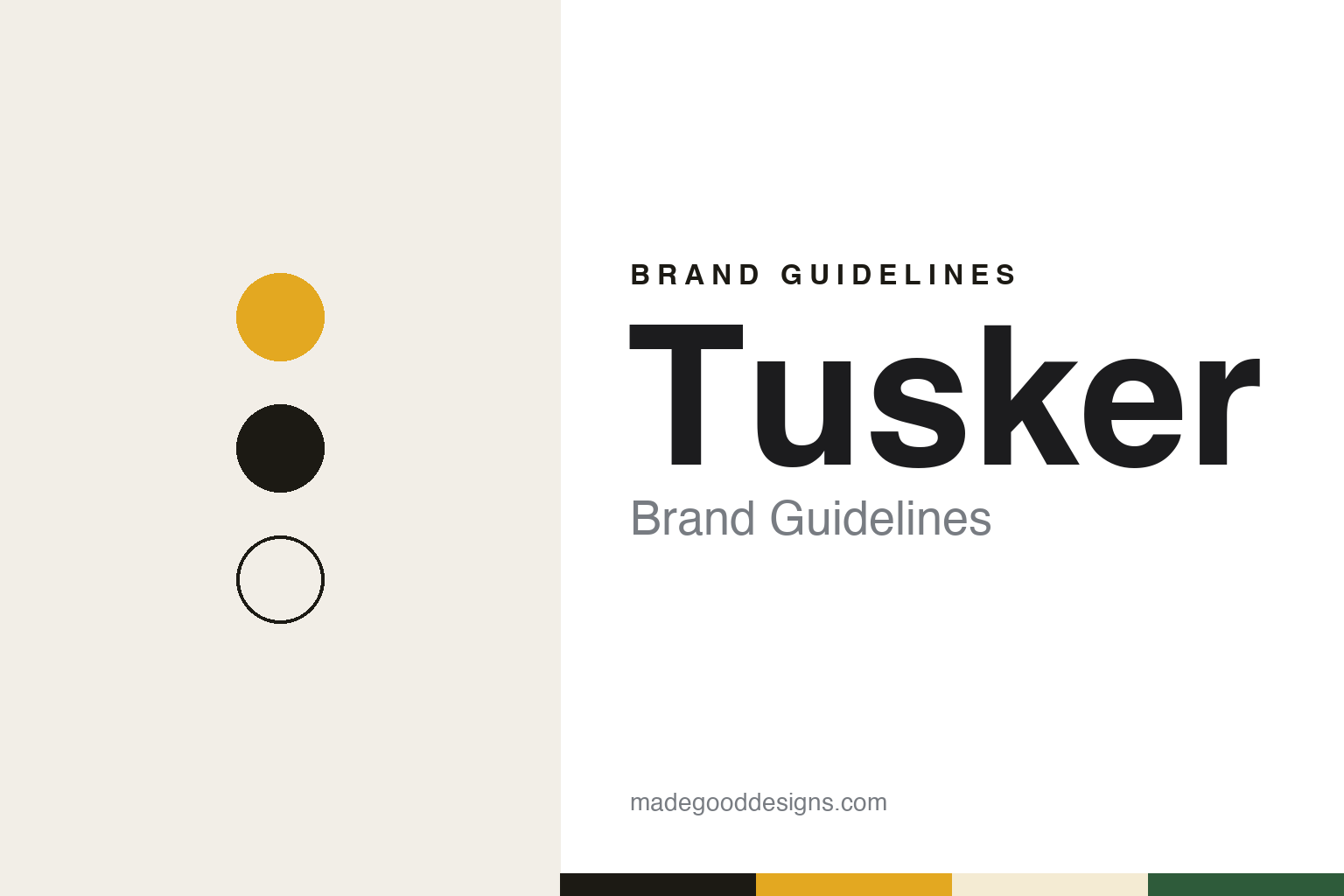
Tusker Brand Guidelines
The 1922 Nairobi lager named after an elephant.
Aa
Two constants: a gold, ink and cream palette and a condensed sans register. Abstract homage — not a Tusker product or mark; no bottle, label, elephant or logo is reproduced.
Kenya Breweries
Two brothers, copper vessels and a Nairobi hotel.
Tusker is the beer of Kenya Breweries, a company started in Nairobi in 1922 by two Welsh brothers, George and Charles Hurst, according to English Wikipedia. Kenya’s The Standard, in a 2013 article on the brand’s origins, described George as a settler with a love of hunting who began brewing and then went into partnership with Charles; the two registered the company in December 1922, the newspaper said, and the first beer was made that year in small copper vessels heated with firewood.
English Wikipedia dates the first brew to 15 December 1922 and says the first batch went to the Stanley Hotel in Nairobi, where it met a mixed reception. The Malindi-based website Malindikenya, in a 2022 centenary piece, also names the Stanley among the earliest customers.
The name came from a death. The Standard reported that George Hurst was killed by a charging elephant on a hunting expedition in 1923, and that Charles named the lager Tusker in his memory — “tusker” being the word for a large male elephant. The same article says the elephant logo was adopted in 1923, the year the beer was first marketed. Malindikenya gives 1924 as the year branding and advertising began, and says Tusker Lager in its 500 ml bottle was officially produced in 1929. In 1929, too, the board switched from imported malt extract to malted barley, English Wikipedia says.
Colour
From one Nairobi brewery to a regional group.
The brewery soon looked beyond Kenya. Kenya Breweries bought Tanganyika Breweries in 1935, and in 1936 the two were merged to form East African Breweries Limited, or EABL, according to English Wikipedia, citing the company’s own history. EABL was listed on the Nairobi stock exchange in 1954 and bought Uganda Breweries in 1959. The group later added listings in Kampala and Dar es Salaam, bought 51 percent of Tanzania’s Serengeti Breweries in October 2010, and in 2013 opened a depot in Juba to supply South Sudan, Wikipedia says, citing EABL’s 2015 information memorandum.
The beer’s packaging changed with the group. Wooden beer crates gave way to plastic ones in 1970, English Wikipedia says, and from 1987 Tusker bottles were made by Central Glass Industries, a glassworks EABL set up as a subsidiary that year and sold to South Africa’s Consol Glass in 2015.
Ownership moved to Britain at the turn of the century. Diageo, the maker of Guinness and Johnnie Walker, took majority control of EABL in 2000, and Wikipedia gives its holding as 65 percent. A period of competition with South African Breweries in East Africa ended in 2002 with a licensing deal and a swap of shares between the two groups’ Kenyan and Tanzanian brewers; as part of it, EABL handed its Tanzanian Kibo business to Tanzania Breweries and SAB left the Kenyan market, Wikipedia says.
Tusker is still brewed in Kenya by Kenya Breweries Limited, EABL’s wholly owned Kenyan subsidiary. EABL says the KBL brewery is at Ruaraka, near Nairobi, and that a second Kenyan plant, at Kisumu, was commissioned in 2018 to brew Senator Keg from locally grown sorghum; it calls Tusker Lager KBL’s flagship brand.
A new owner is in prospect. On 18 December 2025, BeverageDaily reported, Diageo agreed to sell its 65 percent stake in EABL, with its Kenyan spirits interests, to the Japanese brewer Asahi; the deal was expected to close in the second half of 2026, subject to regulatory approvals. The magazine described EABL as a business built around Tusker more than a century earlier. In June 2026 EABL reported that Kenya’s High Court had declined a bid to halt the transaction.
Typography
African and Middle Eastern drink brands.
The seven brands in this group are all drink names from Africa and the Middle East: Tusker, Maltina, Stoney, Almaza, Kassatly, Zamzam and Barbican. African and Middle Eastern drink brands in general sit at many different points in the trade, from family firms that still carry a founder’s name to names that now belong to much larger drinks groups, and a single brand can be sold everywhere from a corner shop to a supermarket shelf.
A drink brand’s identity is usually carried less by a single product than by a bottle, a can, a name and the refreshment it promises, because the company behind the name may have changed hands, moved its production or grown far beyond the place where it started. That makes the questions behind each name worth asking plainly: who started it, who owns it now, and where its drinks are actually made and bottled.
Each guide separates what independent sources record from what the company says about itself — its founding story, its owners over time, where its drinks are made and how its packaging has changed — and marks plainly what rests only on the company’s own word.
Aa
A tall condensed sans for a beer named after an elephant. (Specimen set in Oswald, a sans STAND-IN; NOT the Tusker logo.)
Tusker
“My beer, my country.”
Tusker’s best-known line is in Kiswahili: “Bia yangu, Nchi yangu,” or “My beer, my country,” as English Wikipedia translates it. The brand’s own website calls Tusker Lager “Kenya’s Finest Lager” and describes Tusker as a beer that Kenyans have “enjoyed for generations.”
The range has grown around the original pale lager. The website lists Tusker Lager, Tusker Lite, Tusker Malt and Tusker Cider, along with a draught beer and a lemon-flavoured beer. English Wikipedia lists gold awards at Monde Selection’s international quality awards.
The brand also runs events. Its website promotes Tusker OktobaFest, held each October, and the brand’s long association with rugby through the Safari Sevens tournament; it lists sponsorships of Team Kenya in 2024 and the Lewa Marathon in 2022.
Tusker has also travelled. The beer spread to Tanzania and other countries of the African Great Lakes region before being exported further, English Wikipedia says; in 2008 the British supermarket chains Tesco and Sainsbury’s began stocking it, the trade title Talking Retail reported. A separate Tusker beer is brewed in Vanuatu, in the South Pacific, by an unrelated company, so the name alone is not a guide to origin.
For a design guide, Tusker shows how a single story — a brother’s death and an elephant — can carry a beer’s name and mark for a century. Compare Dashen, an Ethiopian beer from elsewhere in East Africa, and Ketepa, a Kenyan tea brand. For this guide we use gold, ink and cream with a condensed sans, an unofficial interpretation; no product or logo is reproduced.
Explore & save
Keep Tusker’s identity on hand — save it to a board in the Made Good inspiration library.
Tusker identity set
Pin the Tusker gold, ink and cream palette and the condensed sans register to your own board.