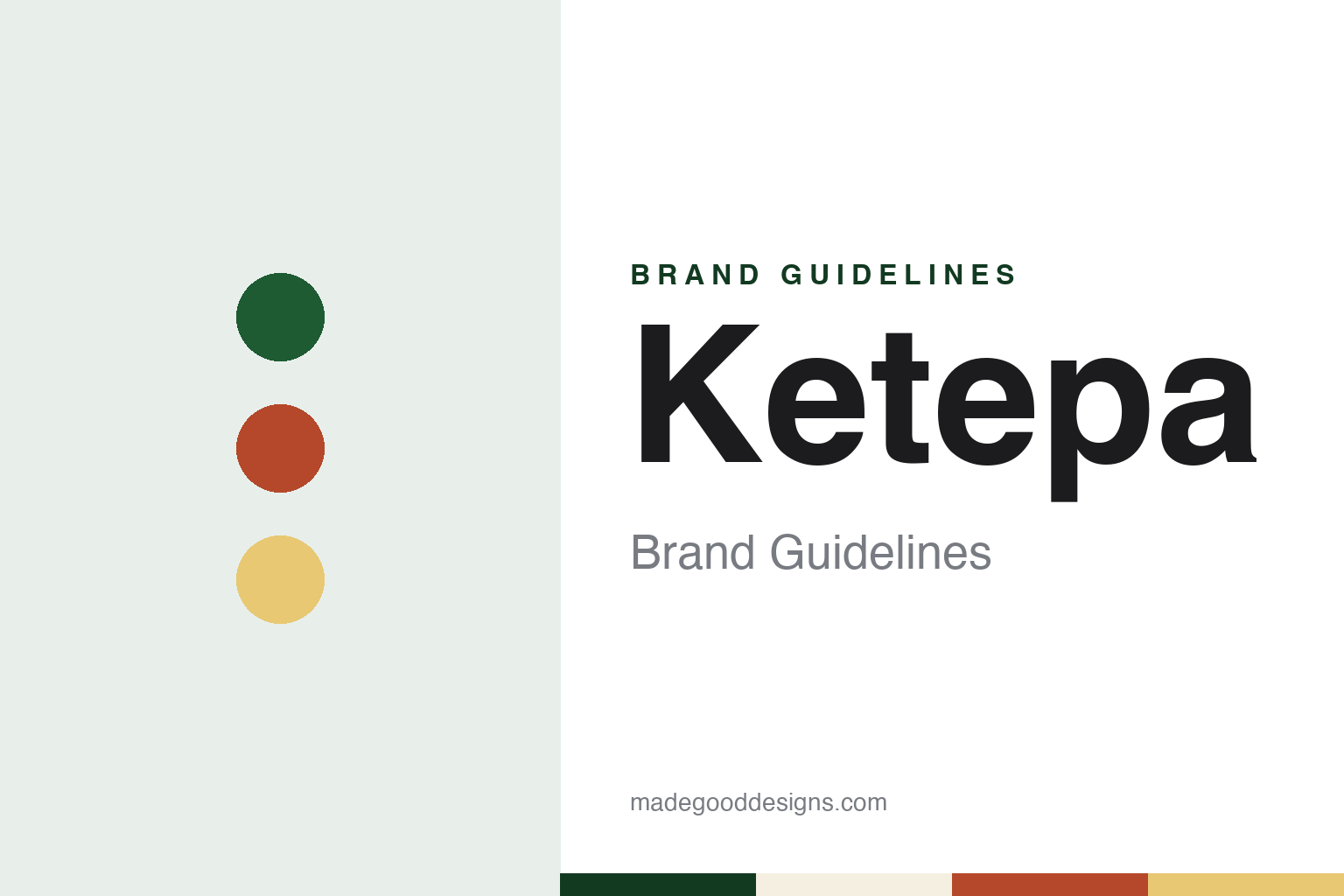
Ketepa Brand Guidelines
The tea of Kenya’s smallholders, packed in Kericho.
Aa
Two constants: a tea-leaf green, red earth and golden liquor palette and a warm editorial serif register. Abstract homage — not a Ketepa product or mark; no pack, logo or product is reproduced.
A packer for the smallholders
From a colonial-era ban to a farmer-owned packer.
Ketepa is short for Kenya Tea Packers, and the name explains the job: the company blends and packs Kenyan tea under its own brands for shops at home and abroad. It is based in Kericho, in Kenya’s western highlands, and it dates from 1978; both English Wikipedia and the company give that year. The company describes itself as “a proud arm of KTDA,” the Kenya Tea Development Agency, and its tea as coming from the farms of Kenya’s small-scale growers.
That relationship is the heart of the brand, and it has a history. English Wikipedia’s article on KTDA says tea production in Kenya began in 1903, with commercial farming from 1924 on settler-owned estates, and that the Kenya Tea Growers Association was formed in 1931. The colonial government, it says, long barred Africans in Kenya from growing cash crops, and only in 1960 created a Special Crops Development Authority to promote tea growing by Africans.
After independence, on 20 January 1964, the Kenya Tea Development Authority was established by statute and charged with developing tea among small-scale growers, Wikipedia says: running extension work, supplying planting material, collecting and paying for green leaf, and processing and marketing the made tea. Kenya Tea Packers followed in 1978. English Wikipedia names KTDA as Ketepa’s founder and the smallholder tea farmers of Kenya as its owners, and gives 1997 as the year of the company’s formal registration.
Colour
Ketepa Pride, Fahari, Jani and “Chai Halisi”.
The KTDA side of the business changed shape around the turn of the century. English Wikipedia says the agency took over the authority’s assets, liabilities and mandate and became Kenya Tea Development Agency Holdings, a company owned by the tea factory companies it manages, which are in turn owned by the growers who supply them. It lists Kenya Tea Packers among the holding company’s subsidiaries, alongside a tea-trading and warehousing arm, an insurance broker, a microfinance company and a power company, and describes Ketepa’s role as tea blending and packing for local and export markets. Under contract to the factory companies, Wikipedia says, the agency manages tea husbandry, collects, weighs and pays for the green leaf farmers deliver, manufactures it into made tea and markets the result, while also handling procurement, IT and staffing.
The company says KTDA is the world’s largest smallholder tea network, with more than 650,000 farmers, that it produces over 60% of Kenya’s tea, and that its tea is handpicked in highlands about 7,000 feet above sea level and processed in KTDA-owned factories and in factories belonging to members of the Kenya Tea Growers Association. English Wikipedia, in its KTDA article, puts the figure at more than 560,000 smallholders and 66 managed factories across 17 counties, with two more factories in Rwanda.
On the shelf, Ketepa sells more than 40 products, the company says, across black, green, purple, white, orthodox and flavoured teas and herbal infusions. Its named brands include Ketepa Pride, Fahari, the Jani green tea and a herbal line under the Pride name. The company’s Swahili slogan is “Chai Halisi”, authentic tea, and its English line is “From Our Farms to Your Cups.” It has also moved beyond tea leaves: the company sells Maisha purified drinking water, and English Wikipedia’s KTDA article mentions a Safari iced tea. English Wikipedia also says Ketepa won a Superbrands East Africa award in 2007.
Typography
Design and documentation.
The seven brands in this group all make food, and all of them come from Nigeria, Kenya or Egypt: Peak, Golden Morn, Dangote, Ketepa, Juhayna, Edita and Domty. Food brands from these countries in general sit at many different points in the trade, from family firms that still carry a founder’s surname to names that now belong to much larger food groups, and a single brand can be sold everywhere from a roadside kiosk to a supermarket shelf.
A food brand’s identity is usually carried less by a single product than by a pack, a name and the meal or snack it promises, because the company behind the name may have changed hands, moved its factory or grown far beyond the town where it started. That makes the questions behind each name worth asking plainly: who started it, who owns it now, and where its food is actually made and packed.
Each guide separates what independent sources record from what the company says about itself — its founding story, its owners over time, where its products are made and how its packaging has changed — and marks plainly what rests only on the company’s own word.
Aa
A warm editorial serif for a tea brand built on smallholder farms. (Specimen set in Fraunces, a serif STAND-IN; NOT the Ketepa logo.)
Ketepa
Kenyan tea, branded at home and sent abroad.
Ketepa blends and packs its tea in Kenya and sells it abroad under its own name. Its export page lists markets in East Africa and the Horn, including Uganda, Tanzania, Somalia, Sudan and South Sudan; in the Middle East, including the United Arab Emirates, Qatar, Kuwait and Saudi Arabia; and further afield in Egypt, Ghana, the United Kingdom, the United States, Australia, Mongolia and Japan.
The company presents that reach as the growers’ own story. Its mission, it says, is to become “a world-class food and beverage brand that brings joy to every home,” and it frames its history since 1978 as growing “from a vision into a legacy” while “exporting the soul of Kenyan tea” to local and international tables. The claim that the tea comes from smallholders is backed by the ownership structure that English Wikipedia describes: Ketepa sits inside KTDA Holdings, which is owned by factory companies whose shareholders are the farmers.
The brand also works at home. In Kenya, the company’s Fahari and Ketepa Pride lines sit alongside purple tea, white tea and green tea under the Jani name. The company says it publishes a food safety policy and a quality policy and lists sustainability compliance on its website.
For a design guide, Ketepa shows how a cooperative-style ownership story and a two-word Swahili promise can carry a national tea brand. Compare Joko, the Durban tea blended in South Africa, and Five Roses, another African tea blended by tea masters. For this guide we use tea-leaf green, red earth and golden liquor with a warm serif, an unofficial interpretation; no product or logo is reproduced.
Explore & save
Keep Ketepa’s identity on hand — save it to a board in the Made Good inspiration library.
Ketepa identity set
Pin the Ketepa tea-leaf green, red earth and golden liquor palette and the warm editorial serif register to your own board.