Juhayna Brand Guidelines
The Egyptian dairy that made packaged milk its cause.
Aa
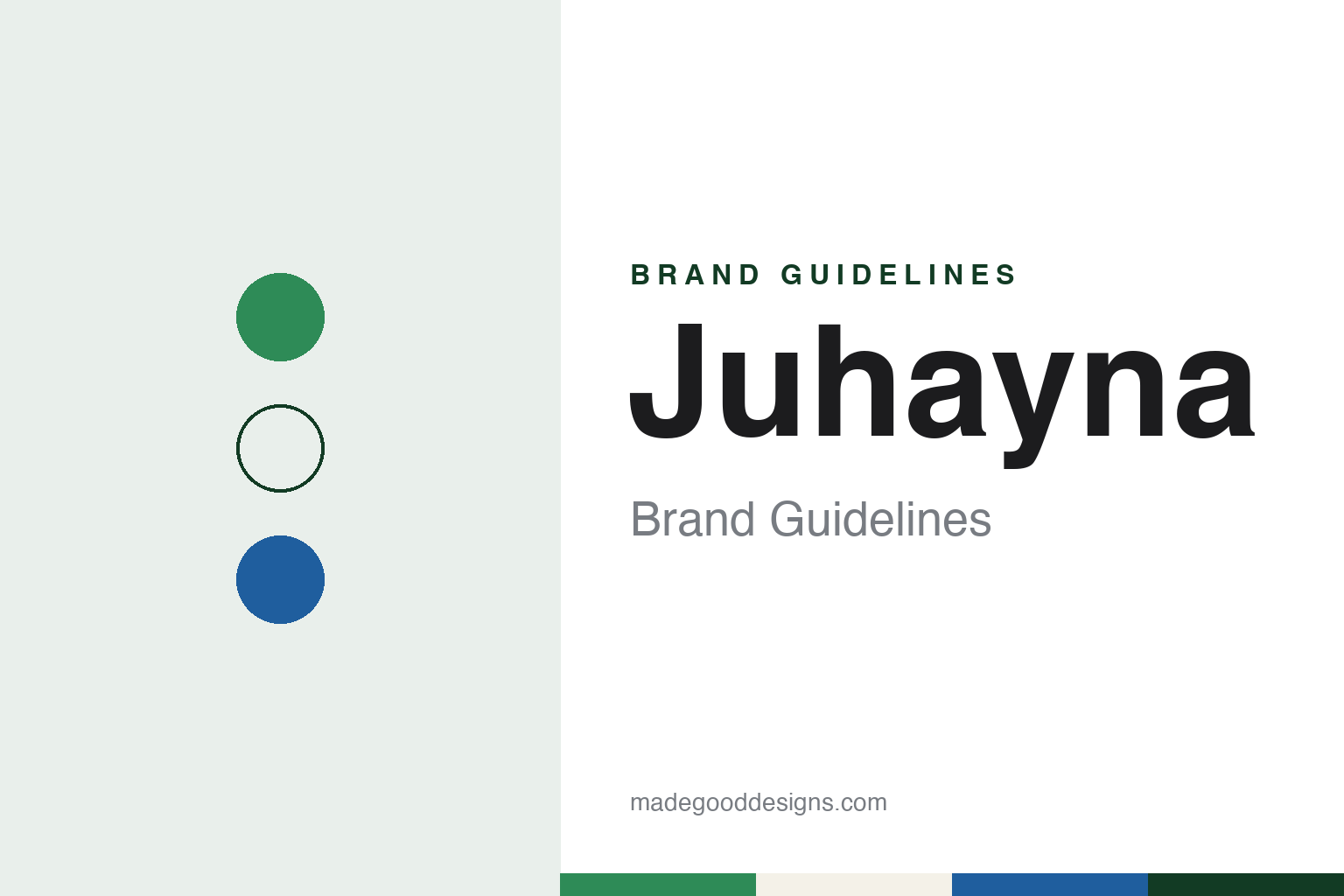
Two constants: a Juhayna green, white and blue palette and a rounded sans register. Abstract homage — not a Juhayna product or mark; no pack, logo or label is reproduced.
An engineer’s dairy
Founded in 1983, producing from 1987.
Juhayna Food Industries was founded in 1983 by the Egyptian engineer Safwan Thabet, according to English Wikipedia and the company’s own history. English Wikipedia says it began producing dairy products, yogurt and juice in April 1987, and that early in its development it reached a strategic agreement with the Swedish-founded packaging company Tetra Pak. In 2004, the same source says, Juhayna Dairy was merged into Juhayna Food Industries, bringing milk, dairy and juice into a single company.
Packaging sits at the centre of the company’s account of itself. Juhayna describes itself as the first to bring packaged milk to the Egyptian market, and says that with Tetra Pak it runs a continuing public-awareness campaign about loose, unpackaged milk; the company says the campaign has significantly reduced the share of consumers who buy milk loose. Those are the company’s statements.
The business grew through factories. Juhayna’s website lists four plants, each specialising in a line of products: El Marwa, established in 1998; El Masreya, acquired in 2005; El Dawleya, its flagship complex, operational since 2009; and the EgyFood yogurt plants, one of them in Assiut in Upper Egypt, where the Rayeb and Zabado yogurt drinks are made. The company says it set up its first fully owned dairy farm in 2008 and now runs a 600-feddan livestock farm with room for 7,500 milking cows, which it says covers a sizeable part of its raw-milk needs. In 2010 a fire destroyed a large part of its factory in 6th of October City, English Wikipedia says, citing Ahram Online.
Sources place the head office in two Cairo-area new towns: English Wikipedia gives 6th of October City, while the company’s website gives an address in Sheikh Zayed, in Giza governorate.
Colour
A listed company with many brands.
Juhayna listed its shares on the Egyptian Exchange in May 2010 and is a member of the benchmark EGX 30 index, English Wikipedia says. The same source describes five industrial subsidiaries alongside companies for sales and logistics and for agricultural and animal production; the company’s site names Tiba for Trade & Distribution as its commercial and distribution arm and lists El Marwa, a maker of concentrates with its own website, and Enmaa as affiliates.
The portfolio has grown well beyond the founding name. Alongside milk sold under the Juhayna name, the company’s website lists Bekhero, a range spanning juice and dairy; the Rayeb and Zabado yogurt drinks; and Classic and Pure juices, together with yogurts, labneh, puddings and a Happy Kitchen cooking range. Juhayna says it offers more than 200 products, employs more than 4,000 people and supplies more than 262,000 retail outlets in Egypt.
Partnerships have been reported in the Egyptian press. On 7 July 2015 the newspaper Youm7 reported that Juhayna had signed an agreement with the Danish-Swedish dairy co-operative Arla Foods to create a joint company, which English Wikipedia names Argo Food Industries. In June 2016 Amwal Al Ghad reported a deal with the Egyptian e-payment network Fawry. The company has also shown at trade fairs including Food Africa in Cairo in 2019 and Anuga in Cologne.
Exports are part of the plan. The company says its products have reached 62 countries, and that after its Egyptian and Middle Eastern markets it is pursuing growth in East and West Africa.
The founding family has also been in the news. Middle East Eye reported in March 2022 that Safwan Thabet was detained in December 2020, and his son Seif Thabet in February 2021, on charges that included funding terrorism; the Financial Times reported on 22 January 2023 that they had been released.
Typography
Dairy, juice and packaging.
The seven brands in this group all make food, and all of them come from Nigeria, Kenya or Egypt: Peak, Golden Morn, Dangote, Ketepa, Juhayna, Edita and Domty. Food brands from these countries in general sit at many different points in the trade, from family firms that still carry a founder’s surname to names that now belong to much larger food groups, and a single brand can be sold everywhere from a roadside kiosk to a supermarket shelf.
A food brand’s identity is usually carried less by a single product than by a pack, a name and the meal or snack it promises, because the company behind the name may have changed hands, moved its factory or grown far beyond the town where it started. That makes the questions behind each name worth asking plainly: who started it, who owns it now, and where its food is actually made and packed.
Each guide separates what independent sources record from what the company says about itself — its founding story, its owners over time, where its products are made and how its packaging has changed — and marks plainly what rests only on the company’s own word.
Aa
A rounded sans for a dairy register. (Specimen set in Nunito, a sans STAND-IN; NOT the Juhayna logo.)
Juhayna
From farm to fork, in the company’s words.
Juhayna tells its own story as a chain. Its website is organised under the heading “Farm to Fork”, in three steps: farming, with agriculture and livestock; manufacturing, which it calls “always at the heart of our operation”; and distribution through Tiba. The company says it began by maintaining affiliated dairy farms to secure raw milk before opening its own farm in 2008, and describes the arrangement as a strategy of vertical integration.
That framing carries into how the company presents its factories. Its site invites visitors on factory tours and a virtual tour, and describes El Dawleya as one of the largest industrial complexes in Egypt and the wider region; those are the company’s descriptions. Where products are made is stated plainly by the company: in its four Egyptian plants, with milk drawn partly from its own farm and partly through milk-collection centres it describes on its site.
The brand architecture is broad. The Juhayna name sits on milk, yogurts and cooking products, while Bekhero, Rayeb, Zabado and the juice ranges carry their own names under the company. Juhayna has not published a brand manual or official colour values, so the tones in this guide are an interpretation.
For a design guide, Juhayna shows how a dairy can build a brand around the move from loose to packaged milk. Compare Almarai, the Saudi dairy and juice maker, and Domty, another Egyptian dairy name. For this guide we use green, milk white and carton blue with a rounded sans, an unofficial interpretation; no product or logo is reproduced.
Explore & save
Keep Juhayna’s identity on hand — save it to a board in the Made Good inspiration library.
Juhayna identity set
Pin the Juhayna green, white and blue palette and the rounded sans register to your own board.