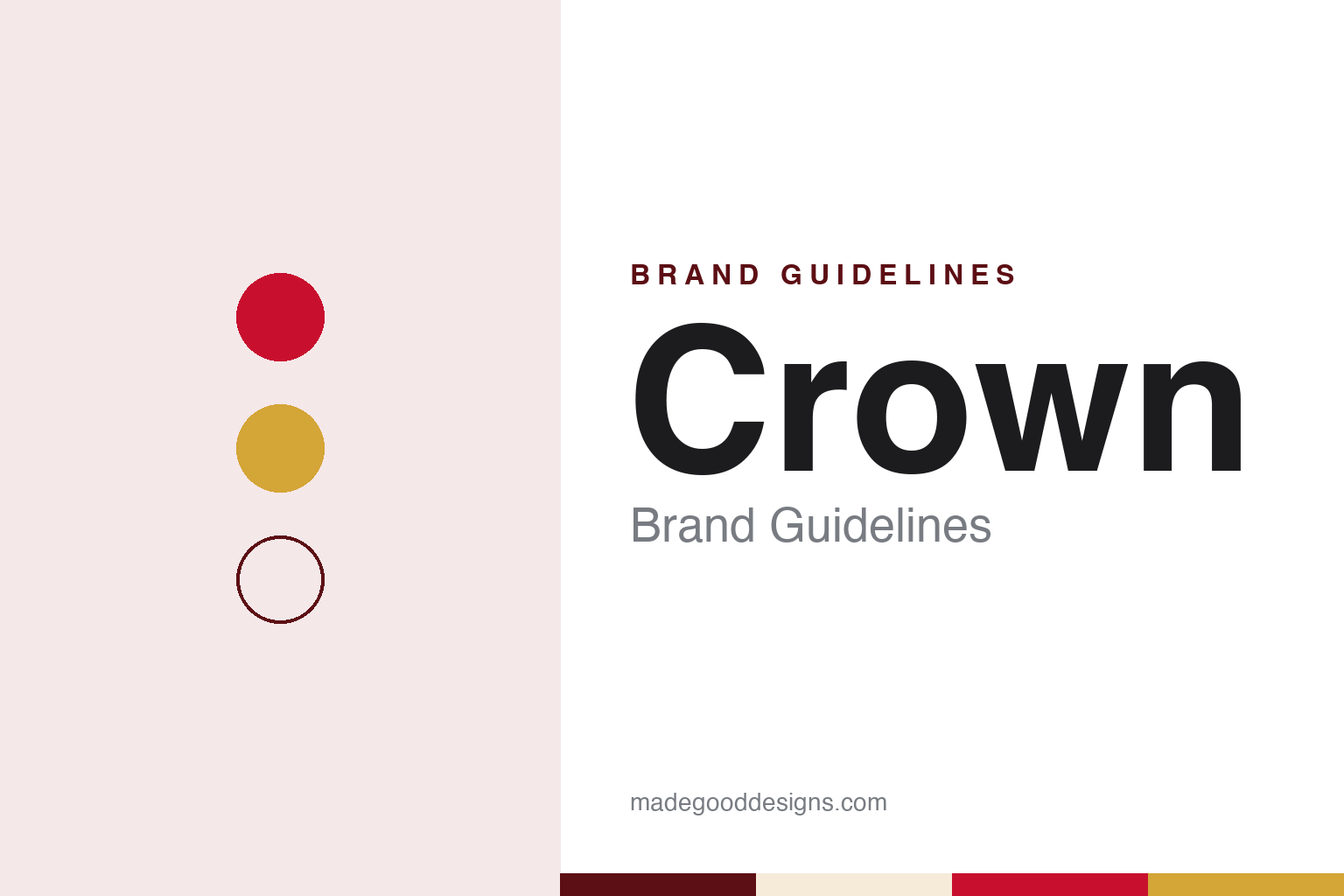
Crown Brand Guidelines
The 1947 Korean confectioner of Sando, Jolly Pong and Big Pie.
Aa
Two constants: a crown red, gold and cream palette and a regal display serif register. Abstract homage — not a Crown product or mark; no pack, logo or biscuit is reproduced.
Yeongildang
A Seoul bakery, a new name and a sandwich biscuit.
Crown is one of South Korea’s oldest confectioners. Korean Wikipedia says the company was founded in 1947 by Yoon Tae-hyun under the name Yeongildang Confectionery (영일당제과), and the company’s own history dates the founding to March 1947, in Seoul. In 1956 the business took the name Crown Confectionery (크라운제과), and on 18 September 1968 it was incorporated as a joint-stock company under that name, Korean Wikipedia says. In English the company and its packs use the single word Crown.
The product that made the name was a sandwich biscuit. Crown Sando (크라운산도) is dated to 1961 by Korean Wikipedia, citing a newspaper archive of 1963, while the company’s timeline gives its launch as March 1960; both dates are given here. Crown calls it Korea’s first sandwich biscuit, and English Wikipedia credits the company with inventing Sando and Big Pie. Korean Wikipedia says a factory was built in Muk-dong, in north-eastern Seoul, alongside the launch, and the company dates the completion of its factory there to 1969.
Crown’s first snack followed in 1972. Jolly Pong (죠리퐁), puffed grains coated in a sweet syrup, was developed by the company’s technical team from the principles used to make popcorn, Korean Wikipedia says. The company listed its shares in 1976, built a biscuit plant in Anyang in 1983 and a snack plant in Asan, in South Chungcheong province, in 1987, according to its timeline.
Colour
Biscuits, pies and a counting craze.
Crown’s range is built mostly around biscuits, cakes and snacks; English Wikipedia describes the company as making biscuits, cookies, crackers, chocolates and other snacks and confectionery. Its website, in 2026, sorts it into four groups. Among the biscuits are Couque d’Asse (쿠크다스), which it calls “the masterpiece of cookies”; Butter Waffle; Cheese Sand; and Sando. Among the cakes is Big Pie, which the company describes as “a pie wishing for victory.” The snacks include C Corn Chip and Jolly Pong, and the sweets include My Chew chewy candies, a peanut caramel it dates to 1982 and a soft peppermint it dates to 1981. Sando itself now comes in strawberry and cream versions, and the Couque d’Asse name has been carried over to a cake in the same range.
Some of these products have lives of their own outside the shop. Jolly Pong became the subject of a counting craze from 2001, Korean Wikipedia says, when listeners of the radio programme hosted by the musician Shin Hae-chul began counting the pieces in a single bag; the official Jolly Pong website, it adds, put the average at around 1,393 pieces. Crown also defended its marks in court: in 2005 the business daily Money Today reported that the company had protected its trademark rights in My Chew.
The company’s look has been redrawn at least once. Crown’s timeline records that in September 1997, the year of its 50th anniversary, it announced a new corporate identity. The anniversary year also marked a second start for the business under new leadership: Yoon Young-dal had become chief executive in September 1995, the company says, and its timeline calls this period its “second founding.” In 2017 the company celebrated its 70th anniversary.
Typography
Design and documentation.
The seven brands in this group all make food or drink, and they come from five countries: Alicorp, Noel, Postobón, Guaraná Antarctica, La Costeña, Crown and Maeil, from Peru, Colombia, Brazil, Mexico and South Korea. Food and drink brands in general sit at many different points in the trade, from family firms that still carry a founder’s name to names that now belong to much larger groups, and a single brand can be sold everywhere from a corner shop to a supermarket shelf.
A food or drink brand’s identity is usually carried less by a single product than by a pack, a name and the everyday meal or treat it promises, because the company behind the name may have changed hands, moved its factory or grown far beyond the town where it started. That makes the questions behind each name worth asking plainly: who started it, who owns it now, and where its products are actually made and packed.
Each guide separates what independent sources record from what the company says about itself — its founding story, its owners over time, where its products are made and how its packaging has changed — and marks plainly what rests only on the company’s own word.
Aa
A high-contrast display serif for a company named after a crown. (Specimen set in Playfair Display, a serif STAND-IN; NOT the Crown logo.)
Crown
Crisis, Haitai and a holding company.
The Asian financial crisis nearly ended the company. In January 1998, during what Koreans call the IMF crisis, Crown filed for court-supervised receivership and went through a composition procedure with its creditors, Korean Wikipedia says; it moved its head office from Muk-dong to Seocho-dong in Seoul, and it completed the court procedure and returned to normal operations in 2003.
Two years later the smaller company bought a larger one. Crown took over Haitai Confectionery & Foods, the confectioner founded in Seoul in 1945, in January 2005, according to Korean Wikipedia and the company’s own timeline; English Wikipedia gives 2004. Korean Wikipedia notes that this was the industry’s fourth-ranked company taking over the second-ranked. In 2005 Crown also completed a factory in Shanghai, followed by a plant in Daejeon in 2006, and in September 2007 it moved its head office to Namyeong-dong, in Yongsan, Haitai’s home district, the company says.
In March 2017 the group was reorganised under a holding company. The listed parent was renamed Crown Haitai Holdings, and a new Crown Confectionery was established as an operating company beneath it, alongside Haitai, Korean Wikipedia says; the new Crown listed its shares in April 2017. Korean Wikipedia lists Yoon Young-dal as chairman and Yoon Seok-bin as chief executive. Korean Wikipedia names its factories as Asan, Jincheon in North Chungcheong province and Daedeok-gu in Daejeon, and the company says it completed a new snack plant in Asan in April 2024.
For a design guide, Crown shows how a regal name and a single sandwich biscuit can carry a company from a 1947 bakery through a national crisis to the head of a two-brand confectionery group. Compare Haitai, its sister company since 2005, and Binggrae, the Korean dairy and ice-cream maker that bought Haitai’s ice-cream business. For this guide we use crown red, gold and cream with a display serif, an unofficial interpretation; no product or logo is reproduced.
Explore & save
Keep Crown’s identity on hand — save it to a board in the Made Good inspiration library.
Crown identity set
Pin the Crown red, gold and cream palette and the regal display serif register to your own board.