Binggrae Brand Guidelines
The Korean dairy that bottled banana milk in a jar.
Aa
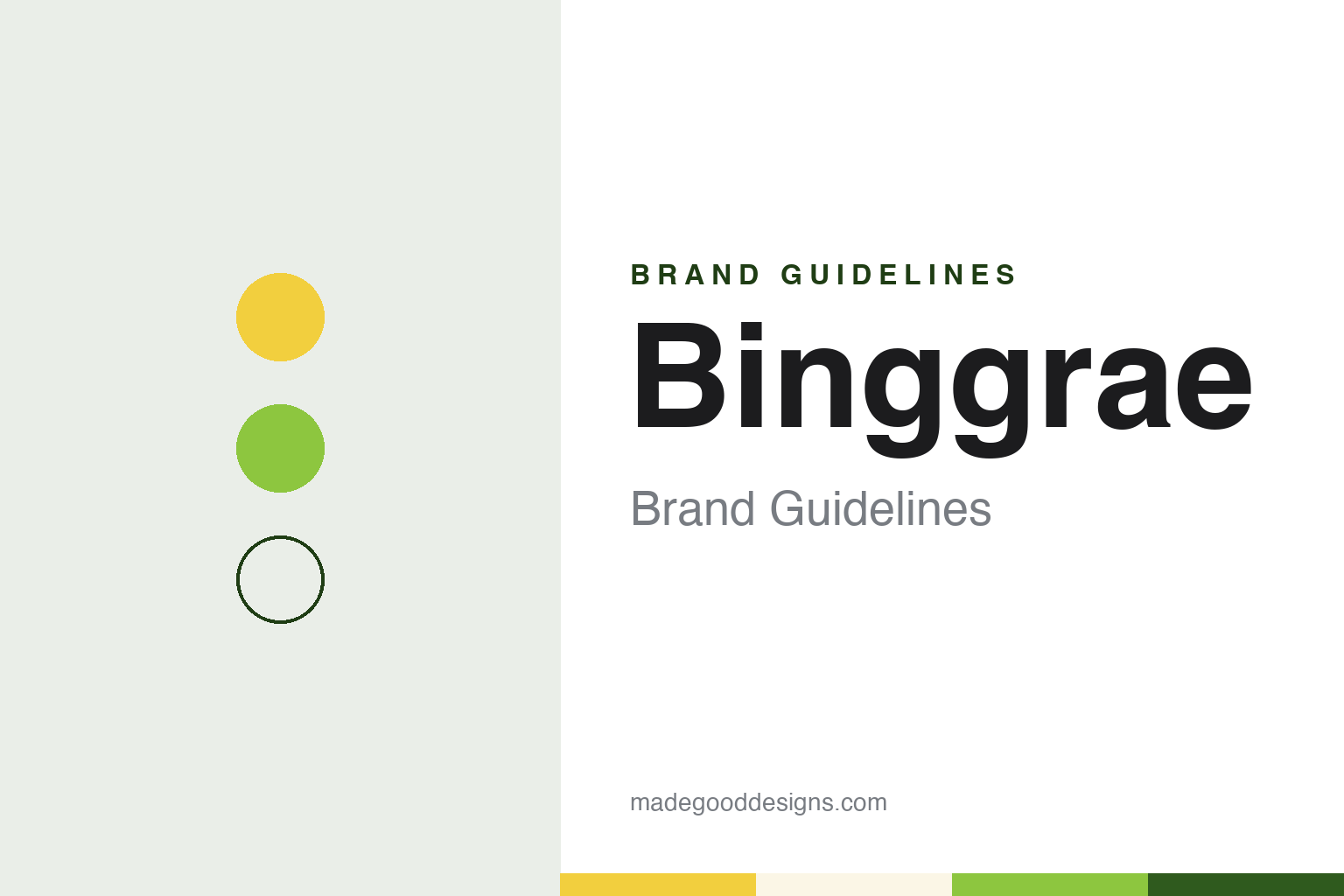
Two constants: a banana yellow, Melona green and milk white palette and a rounded friendly sans register. Abstract homage — not a Binggrae product or mark; no bottle, pack or logo is reproduced.
Daeil to Binggrae
A dairy, a conglomerate and a new Korean name.
Binggrae began in 1967. English and Korean Wikipedia, citing Barron’s and Naver’s encyclopedia, date the company to 13 September 1967, when Hong Soon-ji founded it as Daeil Corporation. In October 1971 it became Daeil Dairy, and in April 1972 it signed a technology agreement with the American dairy firm Foremost-McKesson, Korean Wikipedia says. In 1973, the Korea JoongAng Daily reported in 2018, the dairy was taken over by the Korea Explosives Group, the conglomerate later known as Hanwha; that same year its first plant opened in Namyangju, east of Seoul.
The products that still define the company arrived within months of each other. Together, which English Wikipedia describes as Korea’s first carton ice cream made from raw milk, went on sale in January 1974, and Banana Flavored Milk followed in June. The name came two years later. In June 1976, when the Foremost agreement expired, the company switched its trademark to Binggrae — Korean for “smile,” as English Wikipedia glosses it — as part of the Korean-language purification movement of the time, the Maeil Business Newspaper reported in 1976 and the Busan Ilbo recalled in 2019. The company itself took the name in February 1982, when Daeil Dairy became Binggrae Co., Ltd.
The 1980s widened the range. Korean Wikipedia lists a technology tie-up with France’s Sodima in 1981, which led in September 1983 to Yoplait, described there as Korea’s first spoonable yoghurt; a 1984 agreement with Japan’s Nissin Foods that took Binggrae into instant ramen from 1986; and the crab-shaped snack Kkotgerang the same year. In 1987 the company opened a food research centre and was named the official ice cream of the 1988 Seoul Olympics. Ice creams followed in quick succession: the Heat Hunt bar in 1989, the carp-shaped Ssamanco wafer in 1991 and Melona in January 1992. Binggrae left the ramen business in April 2003, transferring it to Pulmuone.
Colour
A jar of milk and a melon bar.
Binggrae’s best-known design is a bottle. Banana Flavored Milk was developed under a 1970s government policy to promote milk drinking, Korean Wikipedia says, citing Hankyung (2011); bananas were then a luxury fruit, and the one children most wanted. Arirang News made the same point on the drink’s 40th anniversary in 2014. Binggrae chose a squat container shaped like a jar rather than the glass bottles and plastic packs then common. Korea.net wrote in 2014 that the polystyrene bottle took its cue from the traditional Korean moon jar, with an overhanging lip, while Hankyung reported that the jar form was meant to call up thoughts of home, and that some inside the company had objected that it was hard to grip and to store. The shape earned the drink the nickname danji uyu, “jar milk.”
The drink has become a fixture. Hankyung reported in 2011 that it sold more than 800,000 bottles a day, and the Munhwa Ilbo put its 2011 sales at 150 billion won. Exports began in 2004, the Maeil Business Newspaper reported in 2012, by which time it was sold in about ten countries including the United States, Canada and China. In 1999 it was chosen for an exhibition of products that brightened Korea in the 20th century, according to the company history cited by English Wikipedia. Strawberry and melon versions sit beside the original, and limited flavours have included tangerine, which the Korea Herald reported in 2018.
Melona is the other export star. Korean Wikipedia, citing Newsis and Yonhap, says Binggrae noticed melons during market research in Southeast Asia in 1991, when the fruit was still rare in Korea, and spent months tasting melons and the Korean chamoe before launching the bar in January 1992; Yonhap credited the bar in 2021 to Kim Seong-taek of the company’s research laboratory. English Wikipedia, citing Thrillist, says it took 21 billion won in its first year. Melona went to Hawaii in 1995, its first export market, and Binggrae became the first Korean ice-cream maker to produce in the United States, Newsis reported. The bar reached Brazil in 2007, and a São Paulo subsidiary followed in 2014, the Maeil Business Newspaper and Hankyung reported. Today it comes in flavours from honeydew to mango and ube.
Typography
Design and documentation.
The seven brands in this group all make food, and all of them come from South Korea, Singapore and Southeast Asia: CJ CheilJedang, Haitai, Binggrae, Paldo, Khong Guan, Yeo’s and Ayam Brand. Food brands from this part of Asia in general sit at many different points in the trade, from family firms that still carry a founder’s name to names that now belong to much larger food groups, and a single brand can be sold everywhere from a neighbourhood shop to a supermarket shelf abroad.
A food brand’s identity is usually carried less by a single product than by a pack, a name and the meal or snack it promises, because the company behind the name may have changed hands, moved its factories or grown far beyond the city where it started. That makes the questions behind each name worth asking plainly: who started it, who owns it now, and where its food is actually made and packed.
Each guide separates what independent sources record from what the company says about itself — its founding story, its owners over time, where its food is made and how its packaging has changed — and marks plainly what rests only on the company’s own word.
Aa
A rounded friendly sans, in the spirit of the company’s own Banana Flavored Milk–based typeface. (Specimen set in Jua, a sans STAND-IN; NOT the Binggrae logo or a Binggrae font.)
Binggrae
An independent group, a font family and a merger.
Binggrae left the Hanwha group in 1992, English Wikipedia says, citing Naver’s encyclopedia. It is listed on the Korea Exchange, and its largest shareholder is Kim Ho-yeon, the younger brother of Hanwha chairman Kim Seung-youn and a former member of the National Assembly; Korean Wikipedia puts the holding of Kim and related parties at about 41%. Its plants are in South Korea: Naver’s encyclopedia, as cited by English Wikipedia, lists Namyangju, Gimhae, Gwangju in Gyeonggi province and Nonsan, where Korean Wikipedia says Binggrae took over Jinro’s dairy operation in 1994, and Korean Wikipedia adds a plant at Gyeongsan. The company has set up subsidiaries in Shanghai (2014), the United States (2016) and Vietnam (2019).
In 2020 Binggrae bought Haitai Ice Cream, whose bars include Babambar; the Korea Times reported in 2022 that the combined business held 40.7% of the South Korean ice-cream market. In January 2026 Binggrae’s board voted to absorb the wholly owned subsidiary, with the merger due on 1 April 2026, SBS reported. Marketing has leaned on idols and actors — the K-pop group Wanna One fronted Super Cone in 2018, the Korea Times reported — and on an invented mascot, Prince Binggraeus, whose costume is built from the company’s products; the Korea JoongAng Daily reported in 2022 that the campaign made Binggrae the first Korean food company to pass 100,000 YouTube subscribers.
Its type is unusually well documented. Since 2016 Binggrae has released a free family of Korean typefaces drawn from its own brands, its font website says. Binggrae-che (2016), with soft, rounded strokes, is based on the Banana Flavored Milk logotype; Binggrae-che II (2017) borrows the melting look of the Together logotype, with a semi-serif Latin and teardrop terminals in the bold; the Taom (2018) and Melona (2019) faces follow their product logos, the Melona one in squared, retro forms; and a Ssamanco face arrived in 2020. Each covers all 11,172 modern Hangul syllables plus 31 archaic characters from the preface to the Hunminjeongeum, the company says. Korean Wikipedia dates the current corporate identity to December 1994, and the slogan “Messenger of a bright smile” to 2000.
For a design guide, Binggrae shows how one jar-shaped bottle and a one-word name can anchor a whole company, right down to its typefaces. Compare Haitai, another long-running Korean confectionery name, and Glico, the Osaka company with which, Korean Wikipedia says, Binggrae launched its Excellent ice cream in 1988. For this guide we use banana yellow, Melona green and milk white with a rounded sans, an unofficial interpretation; no product or logo is reproduced.
Explore & save
Keep Binggrae’s identity on hand — save it to a board in the Made Good inspiration library.
Binggrae identity set
Pin the Binggrae banana yellow, Melona green and milk white palette and the rounded friendly sans register to your own board.