Paldo Brand Guidelines
The Korea Yakult ramen that became Russia’s word for noodles.
Aa
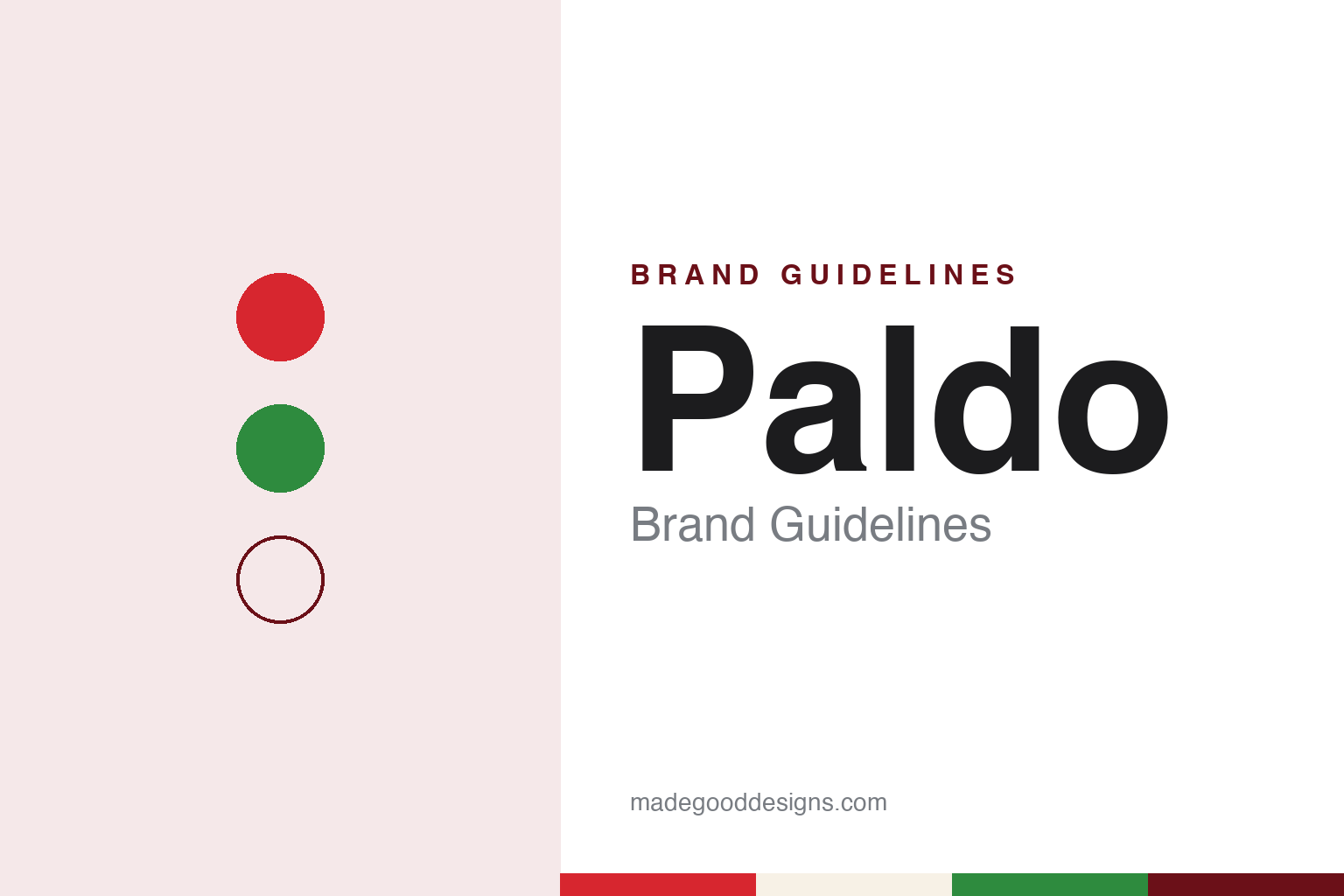
Two constants: a chili red, leaf green and noodle cream palette and a heavy display sans register. Abstract homage — not a Paldo product or mark; no cup, pack or logo is reproduced.
Korea Yakult’s ramen
A yoghurt-drink company and its noodle brand.
Paldo began inside a yoghurt-drink company. Korea Yakult was set up in 1969 as a joint venture between the Korean businessman Yoon Deok-byeong and Japan’s Yakult Honsha, the Korea Herald reported in 2014, and from 1971 it sold its drinks door to door through saleswomen long known as “Yakult ladies.” In August 1983, Paldo’s own timeline says, the company settled on Paldo as the umbrella brand for its new ramen, and Paldo Ramen went on sale that September. The name, written 八道 in Chinese characters, is the Korean term for the eight provinces of the Joseon era, Korean Wikipedia explains.
Two products from those first years still carry the brand. Paldo Bibimmyeon, launched in June 1984, is a brothless noodle: the cooked noodles are rinsed in cold water and mixed with a sauce based on gochujang, English Wikipedia says. Korean Wikipedia says it took its cue from the cold mixed noodles of Hamhung, and that because many buyers at first ate it hot or boiled it like ordinary ramen, Paldo made a jingle — “rub with the right hand, rub with the left” — to teach the method, citing Asia Economy (2017). The Dong-A Ilbo ranked it tenth among Korean ramen by sales in 2013, at 47 billion won.
The second was Dosirak, launched in April 1986. Its name is the Korean word for a packed lunch, and Korean Wikipedia, citing Yonhap (2013), says it stood out by using a square, lunch-box-shaped container instead of the round cups most instant noodles came in. Paldo’s timeline records ramen exports to Japan from October 1986, the cup noodle Wang Ttukkeong in July 1990 and the rice drink Birak Sikhye in June 1993; English Wikipedia, in its article on Korea Yakult, dates the start of overseas sales under the Paldo name to 1987.
Colour
Doshirak, the Russian word for instant noodles.
Dosirak’s biggest market turned out to be Russia. Korean Wikipedia, citing KOTRA (2020) and the JoongAng Ilbo (2018), says the noodles first reached Vladivostok and the Russian Far East in the early 1990s with traders and sailors passing through the port of Busan; Paldo dates its exports to Russia to November 1992. By 1997 supply had spread across the country along the Trans-Siberian Railway, Korean Wikipedia says. In Russia the name is spelled Doshirak, in Cyrillic Доширак.
Local production followed. In 2002 Korea Yakult opened its first Russian factory at Ramenskoye, in the Moscow region, and Russian Wikipedia records a second site near Ryazan from 2010. By 2009 sales in Russia averaged about a million cups a day, or 350 million a year, giving the brand the largest share of the Russian instant-noodle market, the Hankook Ilbo reported in 2010. Russian Wikipedia says Doshirak led the segment from the late 1990s until 2014, when the Rollton brand overtook it, and that “doshirak” became a generic Russian word for any instant noodle and, by extension, for anything cheap and quick. In 2021 Paldo won a court case over recognition of Doshirak as a well-known trademark in Russia, after an application filed in June 2019 had been rejected, Pulse, the English service of the Maeil Business Newspaper, reported.
The packs have also been a place for play. In February 2019 Paldo marked Bibimmyeon’s 35th anniversary with a limited edition spelled “Gwaldo Nenemtin”, a joke in the internet style known as yaminjeongeum, in which Korean letters are swapped for others that look alike. Made with jalapeño and, Korean Wikipedia says, five times as hot as the original, it proved popular enough to become a permanent product, renamed Paldo Bibimmyeon Spicy, in July 2019, IT Chosun reported. Paldo’s timeline also lists the ramen Kkokomen, launched in August 2011, which passed 100 million packs sold by January 2012.
Typography
Design and documentation.
The seven brands in this group all make food, and all of them come from South Korea, Singapore and Southeast Asia: CJ CheilJedang, Haitai, Binggrae, Paldo, Khong Guan, Yeo’s and Ayam Brand. Food brands from this part of Asia in general sit at many different points in the trade, from family firms that still carry a founder’s name to names that now belong to much larger food groups, and a single brand can be sold everywhere from a neighbourhood shop to a supermarket shelf abroad.
A food brand’s identity is usually carried less by a single product than by a pack, a name and the meal or snack it promises, because the company behind the name may have changed hands, moved its factories or grown far beyond the city where it started. That makes the questions behind each name worth asking plainly: who started it, who owns it now, and where its food is actually made and packed.
Each guide separates what independent sources record from what the company says about itself — its founding story, its owners over time, where its food is made and how its packaging has changed — and marks plainly what rests only on the company’s own word.
Aa
A heavy display sans for a brand of bold red ramen packs. (Specimen set in Black Han Sans, a sans STAND-IN; NOT the Paldo logo.)
Paldo
A separate company, a Yakult link and a Vietnamese plant.
Paldo became a company in its own right on 1 January 2012, when Korea Yakult split off its ramen business, Yonhap reported in December 2011; Paldo says it grew out of Korea Yakult’s ramen and beverage divisions. Korea Yakult renamed itself hy in March 2021. The two remain closely tied. English and Korean Wikipedia list Paldo as hy’s largest shareholder, with 40.83%, alongside Japan’s Yakult Honsha with 38.30%, citing the business site Newsprime, and Korean Wikipedia names Yoon Ho-jung as chairman of both; the Korea Herald described him in 2014 as Korea Yakult’s heir apparent. Both companies give the same head-office address in Seocho-gu, Seoul.
Paldo makes its products in Korea and abroad. Its timeline records a plant at Naju completed in May 2012. Its Vietnamese company, Paldo Vina, set up in March 2012, launched the Koreno noodle line the same year; a factory in Tay Ninh province was completed in December 2023 and began making noodles, and from May 2024 it also produced the Pororo children’s drink, which Paldo had imported into Vietnam since 2013, the company says. Paldo received the $100 million Export Tower award in December 2021, its timeline says, after the $70 million tower in 2020. It held the title sponsorship of the Korean professional baseball league in 2012.
Paldo states its identity in its own words. On its corporate site it says the logotype represents the moment a customer opens a Paldo product, the point at which anticipation of the taste is highest; the red, it says, stands for its passion and its promise of quality and value, and the green for clean nature and vitality. Its slogan, “색다른 즐거움,” translates roughly as “a different kind of pleasure.”
For a design guide, Paldo shows how a plain lunch-box shape and a short Korean name can travel from Busan to the Moscow region and become part of another language. Compare CJ CheilJedang, another South Korean food group, and Maggi, another instant-noodle name. For this guide we use a chili red and a leaf green with a heavy display sans, an unofficial interpretation; no product or logo is reproduced.
Explore & save
Keep Paldo’s identity on hand — save it to a board in the Made Good inspiration library.
Paldo identity set
Pin the Paldo chili red, leaf green and noodle cream palette and the heavy display sans register to your own board.