CJ CheilJedang Brand Guidelines
Samsung’s 1953 sugar mill that became bibigo.
Aa
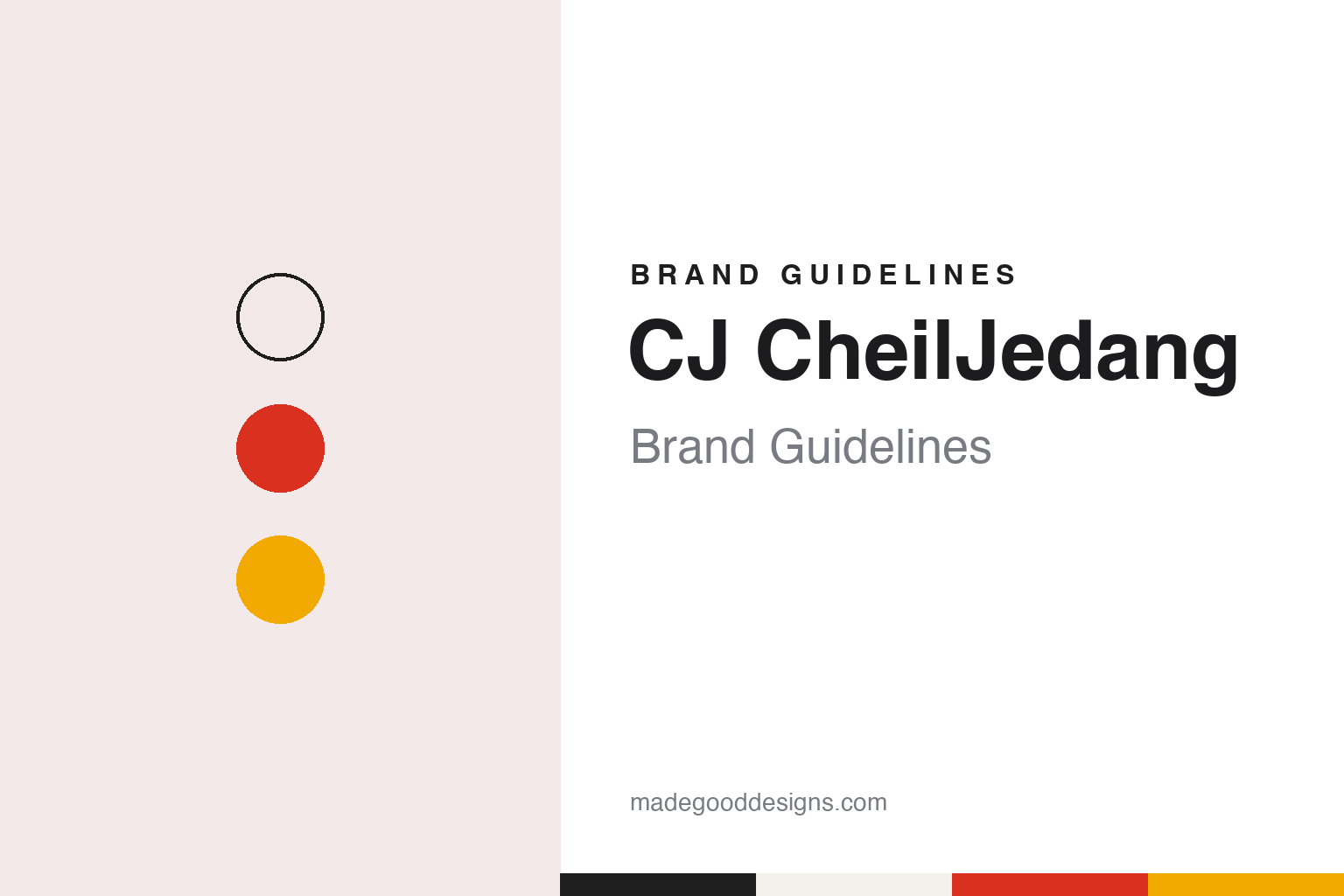
Two constants: a gochujang red, sugar white and sesame gold palette and a clean Korean sans register. Abstract homage — not a CJ CheilJedang product or mark; no pack, logo or dish is reproduced.
Samsung’s first factory
A sugar refinery, a flour mill and a seasoning war.
CJ CheilJedang began as Cheil Jedang, founded on 1 August 1953, days after the Korean War armistice, as a maker of sugar and later flour. Its founder was Lee Byung-chul, who had started the trading house Samsung Sanghoe in 1938, and English Wikipedia, citing the company, describes Cheil Jedang as the first manufacturing business of the Samsung group. Korean Wikipedia lists the textile maker Cheil Industries, founded the following year, as the next.
The company tells its own origin story through sugar. In a 2022 article in its CJ Heritage series, CJ says the first sugar was produced at Cheil Jedang’s Busan factory on 5 November 1953, with Lee pressing the switch on a machine that could make 25 tons a day, and it calls this Korea’s first domestic sugar production.
Flour and seasonings followed. English Wikipedia, drawing on the Korea Herald and the company’s own history, says Cheil Jedang opened South Korea’s first flour mill in 1958, began exporting sugar to Okinawa in 1962, and entered the seasoning market in 1963 with Mipoong, against Miwon, the market leader made by Daesang. In 1965 its sugar was branded Beksul, a name that means “white snow”; a 1970 slogan listed by Korean Wikipedia asked shoppers to look for “the Beksul mark of Cheil Jedang.”
The company was renamed CheilJedang Corp. in 1979, the year Beksul cooking oil appeared, and moved into frozen food, drinks and biotechnology in the 1980s. Korean Wikipedia says it began making Spam for the Korean market in 1987 under a technical agreement with Hormel Foods, a brand it still lists among its own.
Colour
Dasida, Hetbahn and bibigo.
Three products carry most of CJ CheilJedang’s consumer identity. The first is Dasida, a flavour-seasoning stock. Korean Wikipedia says it was developed at Lee Byung-chul’s request for a seasoning suited to Korean cooking, and was launched in 1975 in beef and fish versions. Its long-running television advertising made the actress Kim Hye-ja its face; a Korean interview site counted 27 years in the role.
The second is Hetbahn, aseptic packaged cooked rice, launched in 1996. English Wikipedia lists it, alongside the 1992 hangover drink Condition, among the products the company kept developing while it reshaped itself in the 1990s, and Korean Wikipedia notes that “Hetbahn” has become the everyday Korean word for instant rice of any brand, a sign of how thoroughly the product defined its category.
The third, and the one that now leads abroad, is bibigo, styled in lower case in the company’s own materials. Korean Wikipedia says the name joins bibim, as in bibimbap, with the English “to go,” and that it began as a restaurant brand of the group’s food-service company, CJ Foodville, whose first branch opened in Gwanghwamun, central Seoul, on 10 May 2010. The restaurants were later scaled back and bibigo became chiefly a CheilJedang packaged-food brand, best known for frozen mandu dumplings, along with kimchi, soups, cooked rice and seaweed snacks. In 2020, Korean Wikipedia says, bibigo received a Korean Intellectual Property Office award for trademarks that use attractive Korean words.
Overseas, the company describes a deliberate plan. A 2024 CJ Newsroom interview names seven bibigo “Global Strategic Products,” among them mandu, cooked rice and kimchi, and says that when CJ bought Schwan’s in 2019, bibigo in the United States was mainly a warehouse-club brand sold through Costco and Sam’s Club before being moved into Schwan’s direct-store-delivery network.
Typography
Design and documentation.
The seven brands in this group all make food, and all of them come from South Korea, Singapore and Southeast Asia: CJ CheilJedang, Haitai, Binggrae, Paldo, Khong Guan, Yeo’s and Ayam Brand. Food brands from this part of Asia in general sit at many different points in the trade, from family firms that still carry a founder’s name to names that now belong to much larger food groups, and a single brand can be sold everywhere from a neighbourhood shop to a supermarket shelf abroad.
A food brand’s identity is usually carried less by a single product than by a pack, a name and the meal or snack it promises, because the company behind the name may have changed hands, moved its factories or grown far beyond the city where it started. That makes the questions behind each name worth asking plainly: who started it, who owns it now, and where its food is actually made and packed.
Each guide separates what independent sources record from what the company says about itself — its founding story, its owners over time, where its food is made and how its packaging has changed — and marks plainly what rests only on the company’s own word.
Aa
A clean Korean sans for a company that grew from sugar to dumplings. (Specimen set in Noto Sans KR, a sans STAND-IN; NOT the CJ CheilJedang or bibigo logo.)
CJ CheilJedang
Out of Samsung, into the world.
The break with Samsung came in stages. English Wikipedia, citing the Korea Herald, says Cheil Jedang spun off from Samsung and took independent management in July 1993, became the Cheil Jedang Group in 1996, and completed its formal separation in February 1997. The group then moved into entertainment and retail, founding the cinema chain that became CJ CGV in 1996 and buying the music channel Mnet in 1997. In October 2002 the company took the name CJ Co., Ltd., and Lee Jay-hyun, Lee Byung-chul’s eldest grandson, became chairman of CJ Group that year.
The present company dates from September 2007, when CJ Co. became a holding company and its manufacturing business was split off as CJ CheilJedang, listed on the Korea Exchange that month, Korean Wikipedia says. It is headquartered in Jung-gu, Seoul, and its businesses span food, food ingredients such as sugar, flour and oil, and biotechnology products such as amino acids.
Acquisitions turned it into a multinational. Korean Wikipedia lists the Vietnamese frozen-food maker Cau Tre in 2016, the Brazilian soy-protein producer Selecta in 2017, and, in August 2018, Kahiki Foods of Columbus, Ohio, and the German frozen-food maker Mainfrost. The largest came next: Reuters reported in November 2018 that CJ would buy the Minnesota frozen-food company Schwan’s for about $1.84 billion, and the deal was completed in February 2019. CJ took an 80 percent stake, while the Schwan family kept its home-delivery business, English Wikipedia says, citing Verdict Foodservice. CJ Newsroom has since reported a bibigo dumpling plant in Chiba, Japan, completed in 2025, with further plants planned for Hungary and South Dakota.
For a design guide, CJ CheilJedang shows how a sugar refiner’s plain “white snow” mark could grow into a family of Korean food brands, ending with bibigo, a name built to travel. Compare Kikkoman, another Asian pantry name that went global, and Haitai, a Seoul confectioner of the same postwar era. For this guide we use gochujang red, sugar white and sesame gold with a clean sans, an unofficial interpretation; no product or logo is reproduced.
Explore & save
Keep CJ CheilJedang’s identity on hand — save it to a board in the Made Good inspiration library.
CJ CheilJedang identity set
Pin the CJ CheilJedang gochujang red, sugar white and sesame gold palette and the clean Korean sans register to your own board.