Bundaberg Brand Guidelines
The Fleming family’s brewed ginger beer from Queensland.
Aa
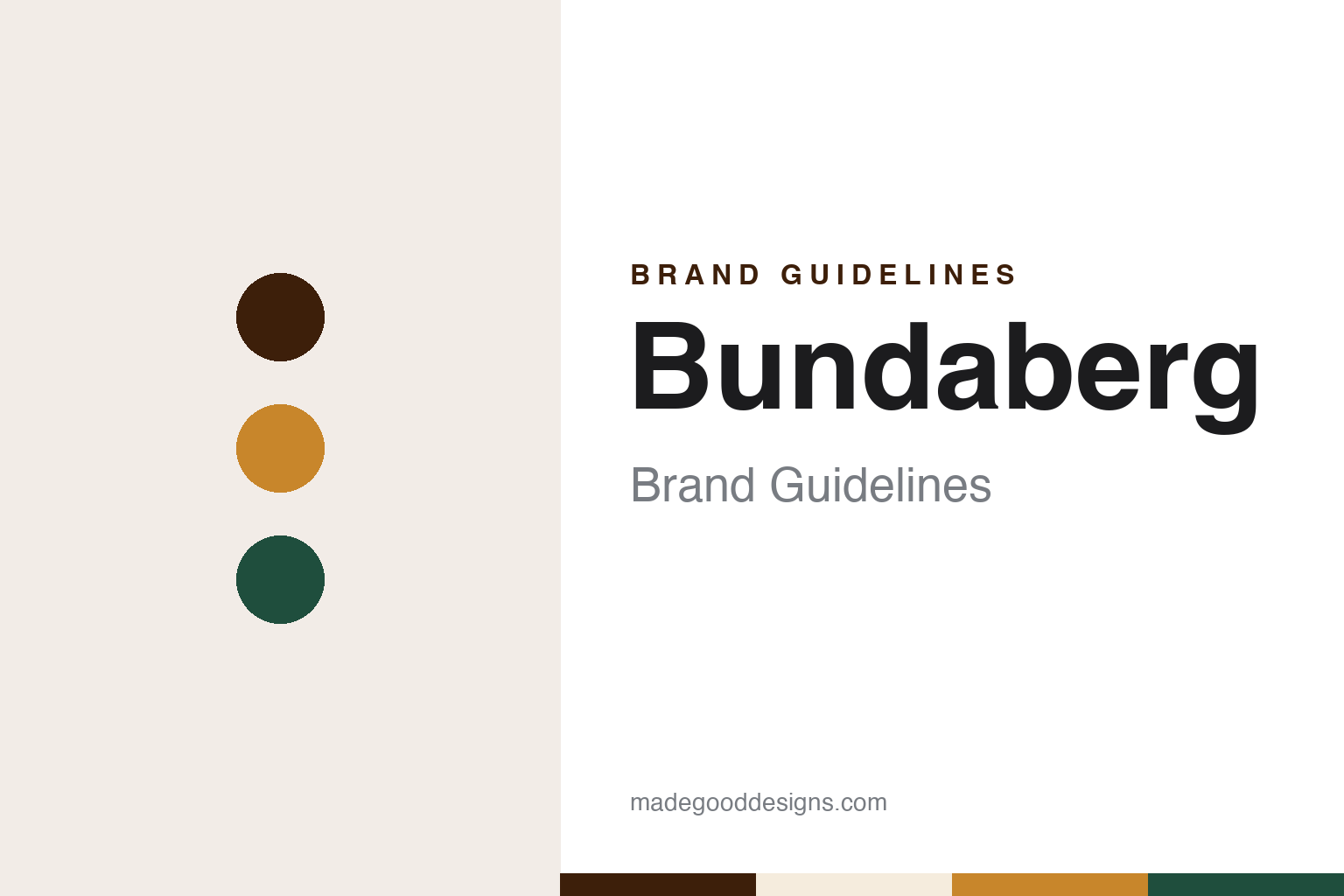
Two constants: a ginger amber, stubby brown and cane green palette and a heritage display serif register. Abstract homage — not a Bundaberg product or mark; no bottle, label or logo is reproduced.
Electra Breweries
A small fermenting business and a family that bought it.
The Bundaberg soft drinks are made by Bundaberg Brewed Drinks, a family company in the sugar-cane town of Bundaberg, on the Queensland coast north of Brisbane. It is a separate business from Bundaberg Rum, whose distillery began operating in the town in 1888 and which was sold to the British drinks group Diageo in 2000, according to Wikipedia; the two share only the town’s name.
The soft-drink business started as a small bottling and fermenting operation. Wikipedia dates it to 1960. In 1968, the company says, Neville and Gladys Fleming, with their son Cliff and daughter-in-law Lee, bought Electra Breweries (Bundaberg) Pty Ltd, then based on Electra Street. In 1973 the business moved to a larger site on Bargara Road in Bundaberg, which became its long-term home.
For its first decades it was a local concern. Through the 1970s and 1980s, the company says, it focused on the local market, making and selling franchised drinks in Bundaberg and Maryborough, while its ginger beer won distribution in Australian and New Zealand supermarkets during the 1980s. Neville and Gladys Fleming retired in 1985 and handed the business to Cliff and Lee Fleming; exports began in 1987. In 1995 the company took the name Bundaberg Brewed Drinks and adopted the promise “Brewed to Be Better,” which it says highlights its point of difference, brewing. Two years later it closed its local delivery-route business after 25 years, and in 2000 it ran its first television advertising campaign.
The family has stayed at the head of the business. Wikipedia says John McLean, the son-in-law of Cliff and Lee Fleming, became chief executive in 2007. In 2024 Cliff Fleming was appointed a Member of the Order of Australia for significant service to business and to the Bundaberg community, the company says.
Colour
Ginger, cane sugar and three days.
Bundaberg’s identity rests on the word “brewed.” The company describes a process that starts with dried ginger root, which it says is grown locally and ground into a coarse flour. The ginger is combined with Queensland cane sugar and water and heated to make a wort, then fermented with yeast, filtered and stored as a concentrate to mature, before being diluted with water, sugar and citric acid, filtered again, carbonated and bottled. In 2018 the company told BeverageDaily that its craft brewing process takes three days.
The range grew out from ginger beer. The company lists a sarsaparilla, sold as root beer in some markets, alongside lemon, lime and bitters, a creaming soda and a series of fruit flavours; it launched a Sparkling Café range with pink grapefruit, blood orange and guava in 2010, added Tropical Mango in 2017 and, for its 50th year of family ownership in 2019, a limited ginger beer with lemon myrtle, an Australian native herb. Smaller cans followed: “Squat” cans on Qantas flights from 2014, a 200ml mini can of ginger beer in 2020, and a lower-sugar “Refreshingly Light” range in 2025.
The pack is part of the brand. Since 2015, the company says, all its drinks have been available in the stubby bottle, the short, wide bottle it calls iconic, and BeverageDaily described Bundaberg’s amber bottles and their rip-top cap, promoted with the line “Flip, Rip and Sip.” At the opening of the new brewery in 2023, Cliff Fleming said the company still bottles its brews in “a little stubby bottle” and still calls Bundaberg home, Food & Drink Business reported.
The brewery is also a visitor attraction. In 2005 the company built the Bundaberg Barrel, a tasting centre beside the brewery, which Wikipedia counts among Australia’s “big things,” the roadside landmarks built at outsize scale. Wikipedia also lists collaborations including a ginger caramel chocolate block with Whittaker’s of New Zealand and an alcoholic ginger beer made with Bundaberg Rum.
Typography
Design and documentation.
The seven brands in this group are all food and drink brands, and all of them come from Australia: Golden Circle, Bundaberg, Uncle Tobys, Rosella, MasterFoods, Leggo’s and Bega. Australian food and drink brands in general sit at many different points in the trade, from companies that still carry a founder’s name or a home town to names that now belong to much larger food groups, and a single brand can be sold everywhere from a corner store to a supermarket shelf.
A food or drink brand’s identity is usually carried less by a single product than by a pack, a name and the meal or moment it promises, because the company behind the name may have changed hands, moved its factory or grown far beyond the town where it started. That makes the questions behind each name worth asking plainly: who started it, who owns it now, and where its products are actually made and packed.
Each guide separates what independent sources record from what the company says about itself — its founding story, its owners over time, where its products are made and how its packaging has changed — and marks plainly what rests only on the company’s own word.
Aa
A heritage display serif for a brewed-in-Queensland ginger beer. (Specimen set in Playfair Display, a serif STAND-IN; NOT the Bundaberg logo.)
Bundaberg
Family-owned, exported and rebuilt at home.
Bundaberg has grown into an exporter while staying family-owned. By 2006, the company says, it was selling in more than 30 countries, including New Zealand, the United Kingdom, the United States and Singapore; Wikipedia now puts the figure at more than 60. It made its first sales to the US warehouse chain Costco in 2012, the company says.
In March 2018 the company signed a distribution partnership with PepsiCo in the United States, giving it access to more than 400,000 stores, restaurants and bars, BeverageDaily reported; Bundaberg remained family-owned and independent and kept making its drinks in Australia. A sales manager told the publication the company had built its own global distribution network but that rising demand made the partnership the next step. In 2022 it was named Queensland Exporter of the Year at the Premier of Queensland’s Export Awards, and in 2023 it was inducted into the Queensland Business Leaders Hall of Fame, according to the company and Wikipedia.
The largest investment came at home. On 31 October 2023 the company opened a new brewery in Bundaberg, attended by the Prime Minister, Anthony Albanese. Food & Drink Business put the project at $152.4 million, of which the company contributed $133.4 million, the Australian government $19 million and the Queensland government $575,800, and reported that it would support more than 600 ongoing jobs; other trade titles, including PKN Packaging News, reported the figure as $120 million. The company says the new Master Brewery was built to increase production for both domestic and export growth. Cliff Fleming said at the opening that the business remained family owned and operated, the same report said.
For a design guide, Bundaberg shows how a small regional bottler made a process word, “brewed,” and a squat bottle into a brand recognised far beyond its town. Compare Whittaker’s, the family chocolate maker it has worked with, and Golden Circle, the Queensland cannery. For this guide we use ginger amber, a stubby brown and a cane green with a heritage serif, an unofficial interpretation; no product or logo is reproduced.
Explore & save
Keep Bundaberg’s identity on hand — save it to a board in the Made Good inspiration library.
Bundaberg identity set
Pin the Bundaberg ginger amber, stubby brown and cane green palette and the heritage display serif register to your own board.