Leggo’s Brand Guidelines
The Cornish-named Bendigo sauce maker that turned Italian.
Aa
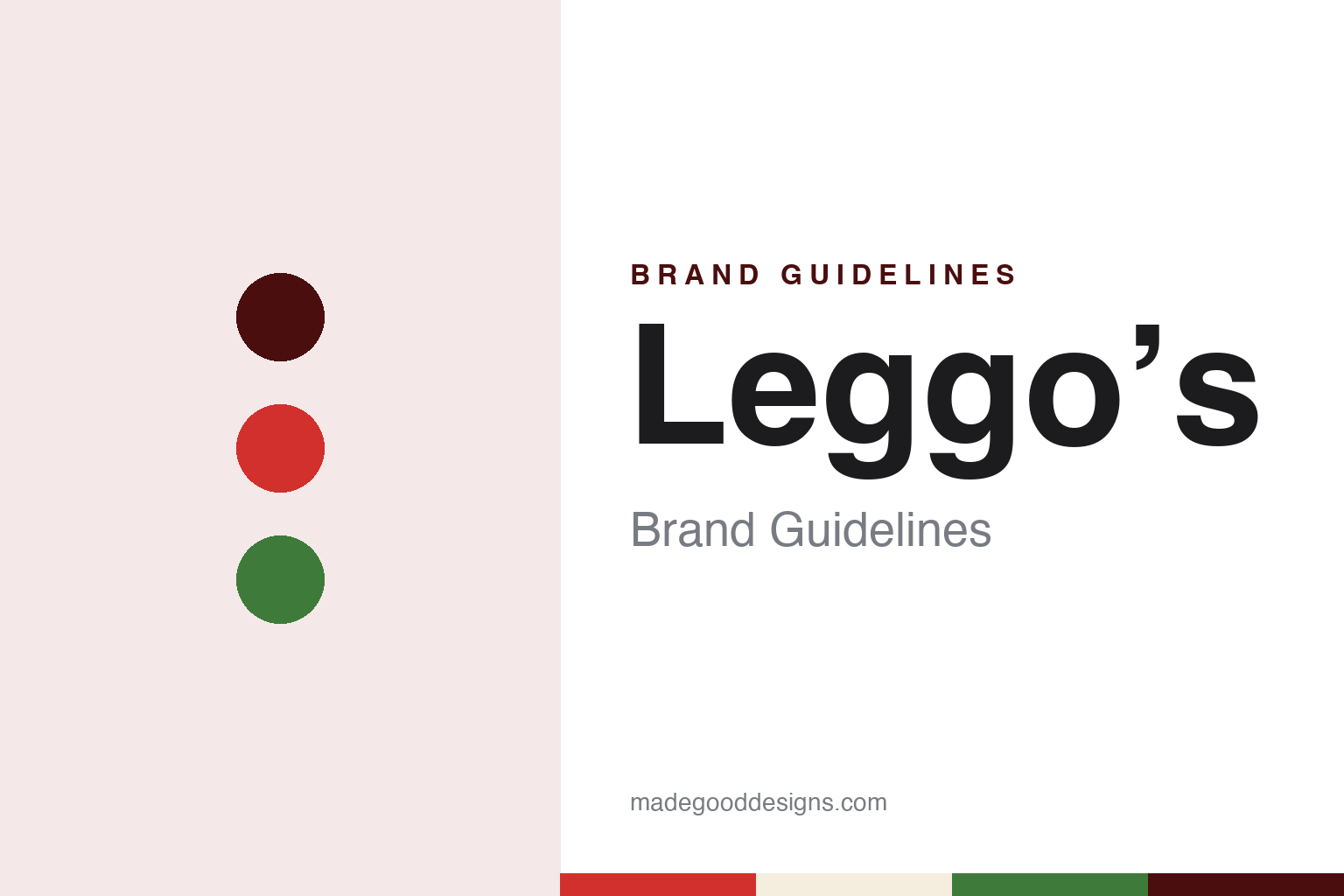
Two constants: a tomato red, basil green and cream palette and a trattoria serif register. Abstract homage — not a Leggo’s product or mark; no jar, tin or logo is reproduced.
Bendigo, not Bologna
A goldfields grocer with a Cornish name.
Leggo’s sells Italian-style sauces, but its name is Cornish. Henry Madren Leggo was the son of Cornish immigrants who came to the Victorian goldfields during the gold rush, the food historian Jan O’Connell writes on her Australian Food Timeline; his father was a Cornish-born miner, and Leggo is a family name found around Penzance and St Just. English Wikipedia’s article on Cornish Australians makes the same point, noting that the brand is often wrongly believed to be Italian.
The business in Bendigo was not Leggo’s own creation. O’Connell says it was founded in 1881 by Frederick Rickards as a grocery distribution and manufacturing business. Henry Leggo began working there soon afterwards, became a partner six years later and in 1894 bought the business and gave it his name, H. M. Leggo & Co. The company today dates its start to Bendigo in 1882; Simplot has also described Leggo’s as part of Australian cuisine since 1894. Leggo’s once said Henry sold his mother’s sauces and pickles to miners, O’Connell writes, but she questions whether the products had anything to do with his mother, since the business was already well established when he took over.
The firm made vinegars, sauces, pickles, soups, cordials, jams and other groceries. Henry Leggo also bought a coffee, tea and spice business, later closing the coffee side to concentrate on condiments, preserves and canned food. Leggo’s tomato sauces took first, second and third prizes and champion gold medals at the Bendigo Show in 1925 and 1926, O’Connell writes.
Colour
Abbotsford, Mentone and the Italian turn.
The business left Bendigo for Melbourne. As freight costs for tinplate and finished goods rose, O’Connell says, processing moved to a new factory in Abbotsford, where the 1930s range included pickles, tomato soups and sauces, baked beans and spaghetti in tomato. By the 1950s the company was struggling; it sold the Abbotsford property and moved to Mentone in 1956, with a narrower range centred on tomato paste and pickles. O’Connell dates the tomato paste to 1948, from a 30th-anniversary repackaging in 1978.
In the early 1970s the brand was bought by Plumrose, the Danish food company, and its image changed. As early as 1957 Leggo’s had promoted its paste for Italian dishes, but advertising into the early 1970s still ranged from English cooking to Mexican. In 1975 Leggo’s launched its first Italian-style sauces, a canned tomato sauce for meats and a meat sauce for pasta, alongside a campaign with the Italian film star Gina Lollobrigida, a Leggo’s Italian Cookbook and the line “Leggo’s. The authentic Italian touch,” O’Connell writes. The 1978 paste pack added the Italian words “Triplo concentrato di Pomodoro” and “Tipo Italiano,” and Al Dente pasta followed in 1980.
The Italian theme ran on into later advertising. In 2000 the former prime minister Gough Whitlam appeared in a Leggo’s pasta sauce commercial, part of a popular series in which Australian celebrities spoke Italian to the camera, news.com.au recalled in 2014; Whitlam’s spot played on his own political slogans, telling viewers they need not “labour” in the kitchen and that “it’s time” to eat.
Typography
Design and documentation.
The seven brands in this group are all food and drink brands, and all of them come from Australia: Golden Circle, Bundaberg, Uncle Tobys, Rosella, MasterFoods, Leggo’s and Bega. Australian food and drink brands in general sit at many different points in the trade, from companies that still carry a founder’s name or a home town to names that now belong to much larger food groups, and a single brand can be sold everywhere from a corner store to a supermarket shelf.
A food or drink brand’s identity is usually carried less by a single product than by a pack, a name and the meal or moment it promises, because the company behind the name may have changed hands, moved its factory or grown far beyond the town where it started. That makes the questions behind each name worth asking plainly: who started it, who owns it now, and where its products are actually made and packed.
Each guide separates what independent sources record from what the company says about itself — its founding story, its owners over time, where its products are made and how its packaging has changed — and marks plainly what rests only on the company’s own word.
Aa
A trattoria serif for a Bendigo brand dressed in Italian. (Specimen set in Libre Baskerville, a serif STAND-IN; NOT the Leggo’s logo.)
Leggo’s
Plumrose, Pacific Dunlop, Simplot and Echuca.
Leggo’s changed hands several times in the 1990s. O’Connell writes that Pacific Dunlop bought the Australian division of Plumrose, with the Leggo’s and Harvest brands, in 1993, and that in 1995 the newly formed Simplot Australia, a subsidiary of the American J. R. Simplot Company of Idaho, bought them as part of Pacific Dunlop’s food brands, together with names such as Edgell and Birds Eye. Simplot still owns Leggo’s; the brand’s website is published by Simplot Australia.
Leggo’s says it has always been made in Australia. The company says its sauces and tomato pastes are produced in Echuca, Victoria, where it employs more than 150 people, that it follows an Australia-first sourcing policy, and that its paste is made from tomatoes grown by farmers in northern Victoria and southern New South Wales. It also says it has donated more than a million jars of pasta sauce to Foodbank Australia since 2011.
That sourcing claim was challenged in July 2026. ABC’s Four Corners reported that forensic testing by the laboratory Source Certain found that 27 of 33 Leggo’s tomato paste products it bought, labelled “Australian grown,” had a chemical profile consistent with tomatoes grown in China, with two-thirds of those linked to Xinjiang; Leggo’s diced tomatoes and passata passed. Simplot declined an interview and said in a statement that it rejected the results. On its website Leggo’s says it refutes the claims, that its records trace the tomatoes in its “Australian-grown” products to Australian paddocks, and that it has commissioned an independent audit.
For a design guide, Leggo’s shows how a Bendigo grocer’s Cornish surname was dressed in Italian words, film stars and celebrity commercials for half a century. Compare Mutti, the Parma tomato maker, and Dolmio, the Mars pasta sauce that began in Australia; and see MasterFoods, another Australian sauce name in foreign hands. For this guide we use a tomato red, a basil green and a cream with a serif, an unofficial interpretation; no product or logo is reproduced.
Explore & save
Keep Leggo’s’s identity on hand — save it to a board in the Made Good inspiration library.
Leggo’s identity set
Pin the Leggo’s tomato red, basil green and cream palette and the trattoria serif register to your own board.