Haitai Brand Guidelines
The 1945 Seoul confectioner named for a mythical guardian.
Aa
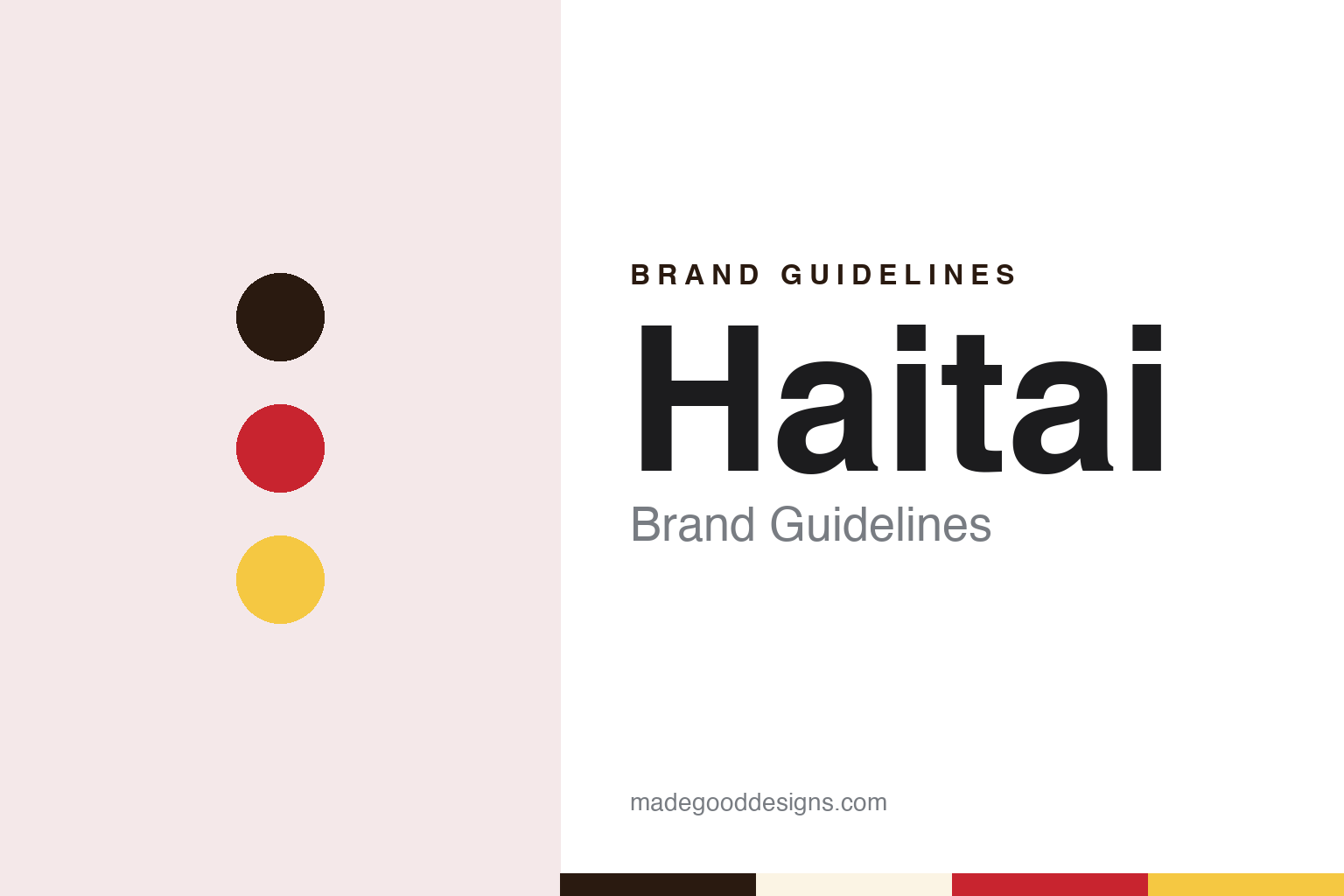
Two constants: a guardian red, honey gold and caramel brown palette and a bold Korean gothic register. Abstract homage — not a Haitai product or mark; no pack, logo or snack is reproduced.
A guardian’s name
Four partners, a caramel and a creature of legend.
Haitai was founded in Seoul on 3 October 1945, less than two months after Korea’s liberation from Japanese rule. Korean Wikipedia says four founders set up the business as a partnership, Haitai Confectionery, in Namyeong-dong in the Yongsan district, and names them as Park Byung-kyu, who later headed the Haitai group, Min Hu-sik, Shin Deok-bal and Han Dal-seong. The firm became Haitai Confectionery Industrial Co. in 1960 and moved its head office and factory to Yangpyeong-dong, south of the Han River, in 1961.
The name is the haetae, also written haechi: a horned, lion-like creature from Chinese and Korean legend. Korean Wikipedia describes it as a symbol of justice that could tell right from wrong; in the Joseon period it was embroidered on the robes of the officials who policed the government, and haetae statues still stand outside the National Assembly in Seoul. In 2008 the City of Seoul adopted the haechi as its official symbol, so the confectioner shares its name with the capital’s emblem.
Sweets came first. Korean Wikipedia’s product timeline begins with Haitai caramels in 1946, ice confections from 1958 and Haitai chocolate in 1968. The 1970s brought the products that still define the brand: the Bravo Cone ice cream in 1970, Ace crackers and the Nugabar ice bar in 1974, the twisted fried snack Matdongsan in 1975, and Babamba ice bars and Acacia gum in 1976. The chocolate-coated sponge cake Oh! Yes followed in 1984, and in 1987 Haitai began selling Gohyang Mandu frozen dumplings.
Colour
A conglomerate, a collapse and a fresh start.
Confectionery profits built a wider group. Korean Wikipedia, drawing on contemporary Korean news reports, says Haitai Confectionery listed its shares in 1972 and spread into drinks, dairy, trading and advertising. In 1982 it founded the Haitai Tigers, the professional baseball team of Gwangju, Park Byung-kyu’s home city, and the predecessor of today’s KIA Tigers. In 1994 the group bought the audio maker Inkel. By the end of 1996 it had 15 affiliates and ranked 24th among South Korean business groups.
The expansion did not survive the Asian financial crisis. MBC News reported on 1 November 1997 that Haitai Confectionery, Haitai Electronics and a packaging affiliate had defaulted. KBS reported the dissolution of the Haitai group on 1 June 1998, and over the following three years its affiliates were liquidated or sold. In August 2001 the baseball team went to Kia Motors, renamed the KIA Tigers, and the group ceased to exist.
The confectionery business carried on. Korean Wikipedia says a new company, Haitai Foods Manufacturing, was set up on 11 July 2001 and took over the confectionery operations through a court-approved transfer that September, then renamed itself Haitai Confectionery & Foods at the end of November 2001. That company is the Haitai of today. Korean Wikipedia’s logo gallery shows three wordmarks since the mid-1980s: one used from 1986 to 2002, a second from 2002 to 2008, and the current mark, introduced in 2008.
Typography
Design and documentation.
The seven brands in this group all make food, and all of them come from South Korea, Singapore and Southeast Asia: CJ CheilJedang, Haitai, Binggrae, Paldo, Khong Guan, Yeo’s and Ayam Brand. Food brands from this part of Asia in general sit at many different points in the trade, from family firms that still carry a founder’s name to names that now belong to much larger food groups, and a single brand can be sold everywhere from a neighbourhood shop to a supermarket shelf abroad.
A food brand’s identity is usually carried less by a single product than by a pack, a name and the meal or snack it promises, because the company behind the name may have changed hands, moved its factories or grown far beyond the city where it started. That makes the questions behind each name worth asking plainly: who started it, who owns it now, and where its food is actually made and packed.
Each guide separates what independent sources record from what the company says about itself — its founding story, its owners over time, where its food is made and how its packaging has changed — and marks plainly what rests only on the company’s own word.
Aa
A bold Korean gothic for a snack maker with a guardian’s name. (Specimen set in Gothic A1, a sans STAND-IN; NOT the Haitai logo.)
Haitai
Crown, Calbee and a honey-butter craze.
Haitai’s new owner was a smaller rival. Crown Confectionery, founded in 1947 and known for its Sando sandwich biscuits, had itself been through court-supervised restructuring after the 1997–98 crisis. Korean Wikipedia dates its takeover of Haitai to January 2005, while English Wikipedia gives October 2004; Korean Wikipedia notes that the deal drew attention because the industry’s fourth-largest company was buying the second. Crown later moved its head office to Haitai’s home district of Namyeong-dong, and in March 2017 the parent company was renamed Crown Haitai Holdings, which holds a controlling stake in Haitai Confectionery & Foods. Haitai itself returned to the Korean stock market in May 2016, Maeil Business reported.
The best-known Haitai product of recent years came from a partnership with Japan. In 2011 the Japanese snack maker Calbee announced a Korean joint venture with Haitai, and in August 2014 Haitai-Calbee launched Honey Butter Chip, a sweet-and-salty potato chip; Calbee had sold a similar flavour in Japan in 2012. Driven by social media, the chips became so hard to find that orders were briefly suspended in November 2014, the Korean business daily Economy Today reported, while The Korea Times described bags being resold online at around three times the shop price. Haitai followed with Honey Tong Tong and other honey-flavoured snacks, and competitors released their own.
Ice cream, one of Haitai’s oldest businesses, has left the company. Korean Wikipedia, citing The Bell, says the ice-cream division was split off as Haitai Ice Cream in January 2020; the dairy and ice-cream maker Binggrae bought it in March 2020 and absorbed it in April 2026, taking brands such as Bravo Cone and Babamba with it.
For a design guide, Haitai shows how a name drawn from Korean legend can outlast the company that first carried it, through bankruptcy, a takeover and a viral snack. Compare Binggrae and Glico, the Osaka confectioner behind Pocky. For this guide we use guardian red, honey gold and caramel brown with a bold sans, an unofficial interpretation; no product or logo is reproduced.
Explore & save
Keep Haitai’s identity on hand — save it to a board in the Made Good inspiration library.
Haitai identity set
Pin the Haitai guardian red, honey gold and caramel brown palette and the bold Korean gothic register to your own board.