La Serenísima Brand Guidelines
The General Rodríguez dairy named after a peace flight.
Aa
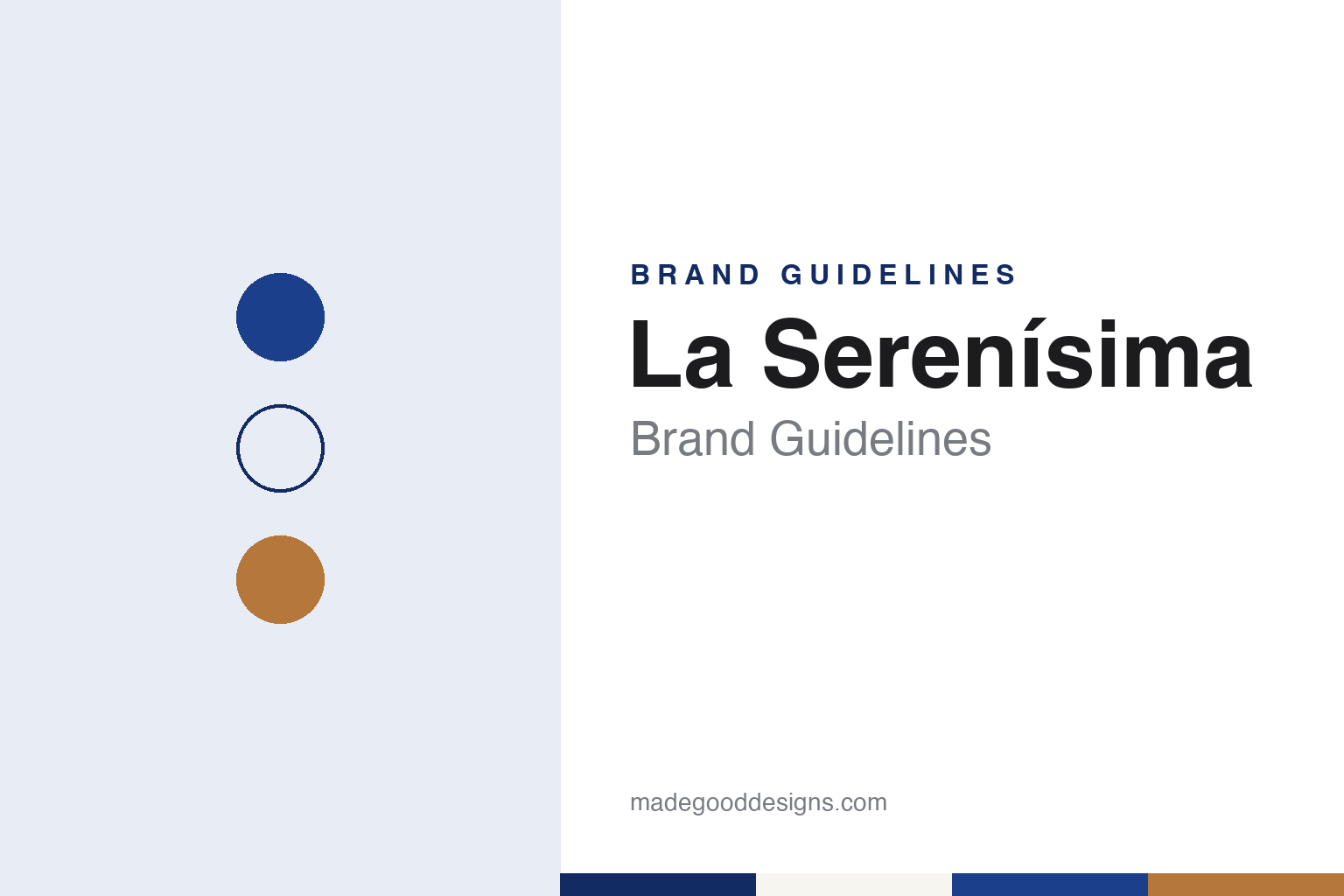
Two constants: a deep blue, milk white and dulce de leche palette and a sturdy dairy sans register. Abstract homage — not a La Serenísima product or mark; no pack, logo or sachet is reproduced.
A wedding and a squadron
Mozzarella, ricotta and a promise made in wartime.
La Serenísima dates its own beginning to a wedding. The company says that Antonino Mastellone married Teresa Aiello in October 1929, and that the day of the wedding is officially taken as the founding date of La Serenísima; its English-language history page gives 26 October and its Spanish-language page 29 October. The business was based in General Rodríguez, west of the city of Buenos Aires, where the company still has its headquarters, and its first products were mozzarella and ricotta. The company says those cheeses were sold to pizzerias on Calle Corrientes and in La Boca and Barracas, Buenos Aires neighbourhoods with large Italian communities.
The name is older than the firm. The company says that during the First World War a squadron of Italian aircraft called “La Serenissima” — spelt with a double s in Italian — flew over Vienna with orders to bomb the city, and dropped thousands of leaflets calling for peace instead; its English timeline places the episode in 1918. Antonino Mastellone, the company says, promised himself that if he ever had a business of his own he would name it after that squadron. The Spanish spelling, with a single s and an accent, became the brand.
The company’s own timeline marks the steps from a cheese dairy to a national milk brand. It bought its first delivery truck in 1935, to carry products into Buenos Aires. In 1952 his son Pascual Mastellone took charge, the company says. Pasteurisation began in 1960, yogurt production in 1963 and dulce de leche, the caramelised milk spread, in 1967. The company that runs the brand is Mastellone Hermanos S.A., and Spanish Wikipedia dates a strategic alliance with Grupo Danone for the production and distribution of yogurts and desserts to 1996.
Colour
Green glass, embossed bottles and pillow sachets.
Much of La Serenísima’s visual history is written in its containers, and the company lists each change as a milestone. It says that from 1961 its pasteurised milk was sold in green glass bottles. In 1967 a transparent, embossed bottle replaced the green glass. In 1968 plastic pillow sachets replaced the glass bottles altogether — a soft pouch rather than a rigid container. The timeline then moves on to new products: a first milk-powder plant in 1971 and butter in 1977.
Spanish Wikipedia adds a mark of a different kind: in 1982 the company introduced an “LS” quality seal. It also lists the range now sold under the company’s umbrella, from La Serenísima itself to Danone brands such as Danonino, Danette and Actimel, and the Ser line. It notes that Ser waters are produced by Aguas Danone Argentina, that certain Cindor-branded biscuits are made by Bagley, and that desserts and some cheeses are developed jointly with Danone.
Advertising has its own episodes. English Wikipedia records that in the 1960s the brand worked with Petrona C. de Gandulfo, the cook whose recipe book La Nación described in 2018 as the most-stolen book in Argentina’s National Library. The best-remembered piece of brand theatre was airborne: English Wikipedia says La Serenísima ran a blimp campaign from 1995. Clarín reported on 24 November 1996 that an airship had come down and that both pilots were unhurt, and the trade site Todo Lechería marked the anniversary of the La Serenísima airship’s last journey in 2020.
Typography
Design and documentation.
The seven brands in this group are all food and drink brands, and all of them come from Argentina or Brazil: Quilmes, SanCor, La Serenísima, Terrabusi, Mantecol, Fargo and Piraquê. Food and drink brands in these two countries in general sit at many different points in the trade, from family firms that still carry a founder’s surname to names that now belong to much larger food groups, and a single brand can be sold everywhere from a corner shop to a supermarket shelf.
A food or drink brand’s identity is usually carried less by a single product than by a pack, a name and the meal or snack it promises, because the company behind the name may have changed hands, moved its factory or grown far beyond the town where it started. That makes the questions behind each name worth asking plainly: who started it, who owns it now, and where its products are actually made and packed.
Each guide separates what independent sources record from what the company says about itself — its founding story, its owners over time, where its products are made and how its packaging has changed — and marks plainly what rests only on the company’s own word.
Aa
A sturdy dairy sans for a milk brand built on bottles and sachets. (Specimen set in Archivo, a sans STAND-IN; NOT the La Serenísima logo.)
La Serenísima
From a family dairy to an Arcor and Danone joint venture.
Ownership changed in stages. Infobae reported on 24 March 2026 that Arcor and Danone had announced an agreement to buy the rest of Mastellone Hermanos. The purchase was made through Bagley Argentina S.A., a company controlled by Arcor and Danone, which was acquiring the 51.32% of shares and voting rights held by the Mastellone family and the investment fund Dallpoint Investments LLC. With it, Infobae said, Arcor and Danone would control 100% of La Serenísima, completing a process whose option to buy the company in stages had been set on 3 December 2015. Spanish Wikipedia records that in April 2025 the two groups had first communicated their intention to exercise that option over the remaining stake.
The deal also redraws the structure behind the brand. Infobae reported that the transaction would create a new joint venture bringing together Danone Argentina S.A., Mastellone Hermanos and the distribution business Logística La Serenísima, operating eleven production plants that make fluid and powdered milk, dulce de leche, cheeses, butter, cream, yogurts and desserts under the La Serenísima name. Danone’s chief executive, Antoine de Saint-Affrique, said the group was very satisfied to take its long-term alliance with Arcor to the next level. The closing, the report added, remained subject to regulatory approvals in several jurisdictions and to corporate ratifications. Through it all the headquarters has stayed in General Rodríguez, the town where the company says the business began.
For a design guide, La Serenísima shows how a dairy can carry a story in its name and a history in its packaging — glass bottles, embossed glass, pillow sachets — while ownership moves from a founding family to multinational partners. Compare SanCor, the Argentine dairy cooperative, and Tillamook, the farmer-owned American co-op. For this guide we use deep blue, milk white and dulce de leche brown with a sturdy sans, an unofficial interpretation; no product or logo is reproduced.
Explore & save
Keep La Serenísima’s identity on hand — save it to a board in the Made Good inspiration library.
La Serenísima identity set
Pin the La Serenísima deep blue, milk white and dulce de leche palette and the sturdy dairy sans register to your own board.