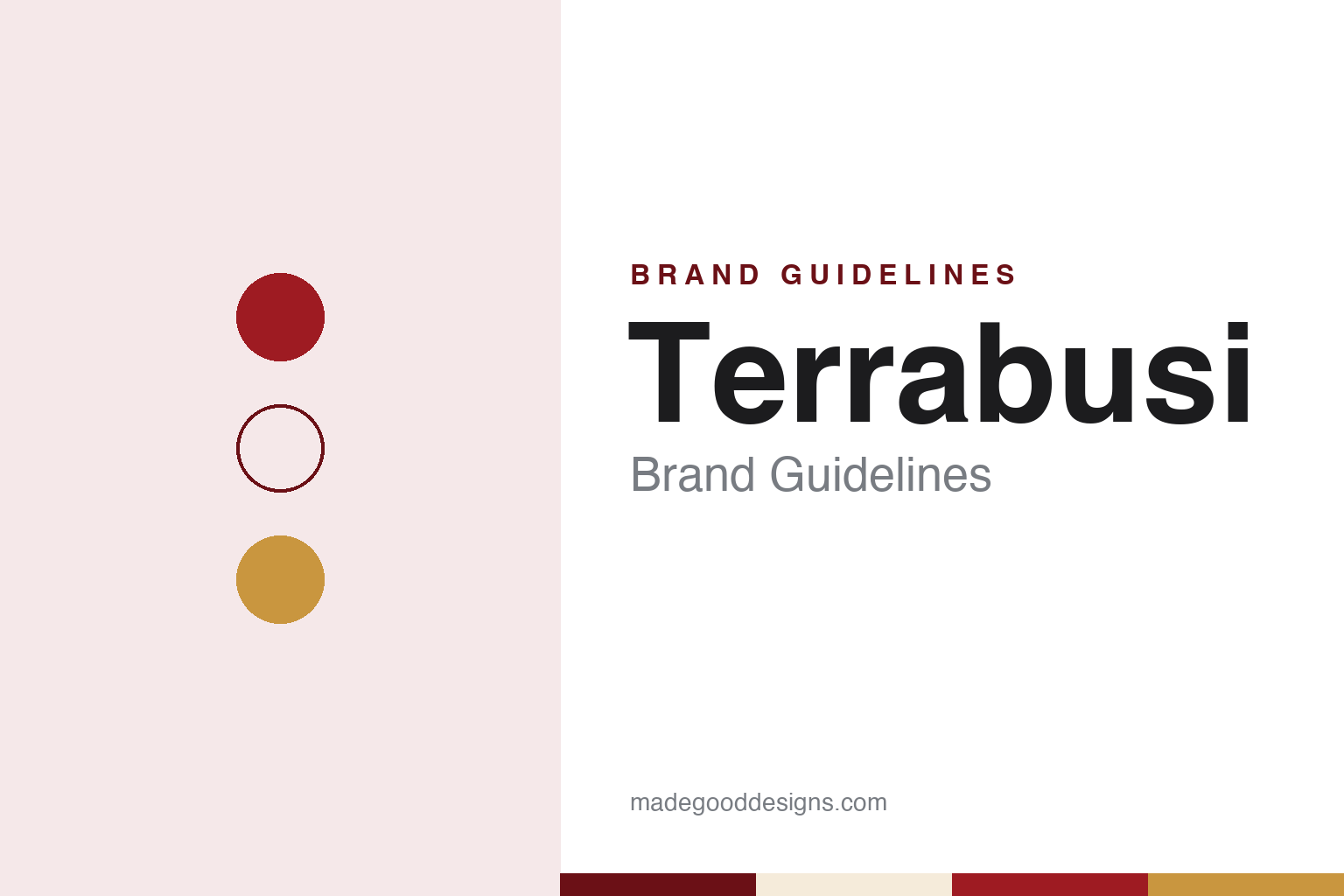
Terrabusi Brand Guidelines
The Buenos Aires biscuit house behind “Dígale sí.”
Aa
Two constants: a red, biscuit cream and baked gold palette and a classic biscuit serif register. Abstract homage — not a Terrabusi product or mark; no pack, logo or biscuit is reproduced.
Terrabusi Hermanos
Three Italian brothers and a biscuit works in Buenos Aires.
Terrabusi began with three brothers. English Wikipedia, citing a 2016 history of the company, says that Ambrosio, Felipe and Julio Terrabusi, Italians, arrived in Argentina at the end of the nineteenth century, and that they founded Terrabusi Hermanos in Buenos Aires in 1911 to make biscuits. The trade site Mas Industrias, in a history published in August 2021, gives the same year and the address of the first works on Sadi Carnot street — today Mario Bravo — where, it says, 25 workers produced five tonnes a month.
Growth came quickly. In 1919, according to English Wikipedia citing El Cronista, the company moved to a factory of 25,000 square metres on San José street in Buenos Aires — Mas Industrias gives the address as San José 1060 — and launched the Express line of crackers. The company went on to launch products that became landmarks of the brand — English Wikipedia names Tita, Manon, Rhodesia and Melba — and says that their success helped Terrabusi overtake its rival Bagley as Argentina’s leading biscuit maker.
The family stayed in charge for most of the century. In 1963, English Wikipedia says, the business moved to a new plant, the “Establecimiento Modelo Terrabusi,” in General Pacheco, north of Buenos Aires, under the leadership of Carlos Terrabusi and Gilberto Montagna Terrabusi, and launched a pasta brand, Don Felipe, named after one of the founders. Spanish Wikipedia’s entry on General Pacheco notes that the Mondelēz plant there formerly belonged to Terrabusi, and Mas Industrias says the site is now the headquarters of Mondelēz International in Argentina.
Colour
A slogan that crossed into politics, and a story that did not hold.
Terrabusi’s best-known piece of branding is a phrase. The history site Ser Argentino dates to 1958 the slogan “Dígale sí a Express, dígale sí a Terrabusi” — “Say yes to Express, say yes to Terrabusi” — and says it was voiced by the broadcaster Cacho Fontana. The same site says the line was so effective that it was echoed in that year’s presidential campaign as “Dígale sí a Frondizi.” English Wikipedia says the shorter “Dígale sí a Terrabusi” stayed in use for decades.
The brand’s product names have their own folklore. A widely shared story, retold by outlets including Mas Industrias in 2021, holds that Tita and Rhodesia were named in a romance between Julio Terrabusi’s widow and a man called Edelmiro Rhodesia. English Wikipedia, citing FiloNews in 2020, says none of those stories could be proved and that there is no record of Edelmiro Rhodesia’s existence; it points instead to an advertisement in the magazine Caras y Caretas of 28 March 1936 that it says lists the products, as evidence that the brothers created them.
Other names sit in the same family. Spanish Wikipedia’s entry on the Lincoln biscuit records a square variant with the familiar dotted pattern sold under the Terrabusi brand, and English Wikipedia lists Duquesa, Express, Lincoln, Manon, Melba, Rhodesia and Tita among the brand’s products, together with a Terrabusi alfajor, the filled sandwich biscuit. In 1999, Clarín reported, Nabisco also bought Canale, another long-established Argentine biscuit maker.
Typography
Design and documentation.
The seven brands in this group are all food and drink brands, and all of them come from Argentina or Brazil: Quilmes, SanCor, La Serenísima, Terrabusi, Mantecol, Fargo and Piraquê. Food and drink brands in these two countries in general sit at many different points in the trade, from family firms that still carry a founder’s surname to names that now belong to much larger food groups, and a single brand can be sold everywhere from a corner shop to a supermarket shelf.
A food or drink brand’s identity is usually carried less by a single product than by a pack, a name and the meal or snack it promises, because the company behind the name may have changed hands, moved its factory or grown far beyond the town where it started. That makes the questions behind each name worth asking plainly: who started it, who owns it now, and where its products are actually made and packed.
Each guide separates what independent sources record from what the company says about itself — its founding story, its owners over time, where its products are made and how its packaging has changed — and marks plainly what rests only on the company’s own word.
Aa
A classic biscuit serif for a century-old Buenos Aires maker. (Specimen set in DM Serif Display, a serif STAND-IN; NOT the Terrabusi logo.)
Terrabusi
Nabisco, Kraft and Mondelēz — and a pasta brand that went its own way.
The family era ended in 1994, when, according to English Wikipedia, Nabisco acquired Terrabusi; it adds, citing El Cronista, that the family turned to farming and horse breeding. From then on the brand followed the American company through a series of corporate changes. In June 2000 Philip Morris agreed to buy Nabisco and combine it with Kraft Foods, as the Baltimore Sun and the Associated Press reported at the time; the Sun’s headline described a deal uniting the snack giant with Kraft Foods. Kraft Foods was spun off from Altria, Philip Morris’s parent, in 2007, and in October 2012, as Infobae reported, the Kraft Foods business that held its global snacks brands took the name Mondelēz International. Mas Industrias summarises the local sequence: Nabisco in 1994, Kraft Foods in Argentina from 2001 and Mondelēz from 2012.
One part of the old company took a different route. El Cronista reported on 6 October 2014 that Molinos Río de la Plata had bought Mondelēz’s dry-pasta brands in Argentina, along with a plant in Tres Arroyos, in Buenos Aires Province, and the right to use the Terrabusi name for pasta only. Spanish Wikipedia lists Terrabusi among the Molinos brands, so the family name now appears on biscuits from Mondelēz and on pasta from Molinos.
For a design guide, Terrabusi shows how a founding family’s surname can become a maker’s mark that outlives the family’s ownership, carried by a slogan that entered everyday speech and by product names with stories of their own, and how a single name can be divided by category between two owners. Compare Mantecol, the Argentine peanut sweet that spent two decades with Cadbury and Mondelēz before returning to its founding family in 2022, and Ritz, the Nabisco cracker. For this guide we use red, biscuit cream and baked gold with a classic serif, an unofficial interpretation; no product or logo is reproduced.
Explore & save
Keep Terrabusi’s identity on hand — save it to a board in the Made Good inspiration library.
Terrabusi identity set
Pin the Terrabusi red, biscuit cream and baked gold palette and the classic biscuit serif register to your own board.