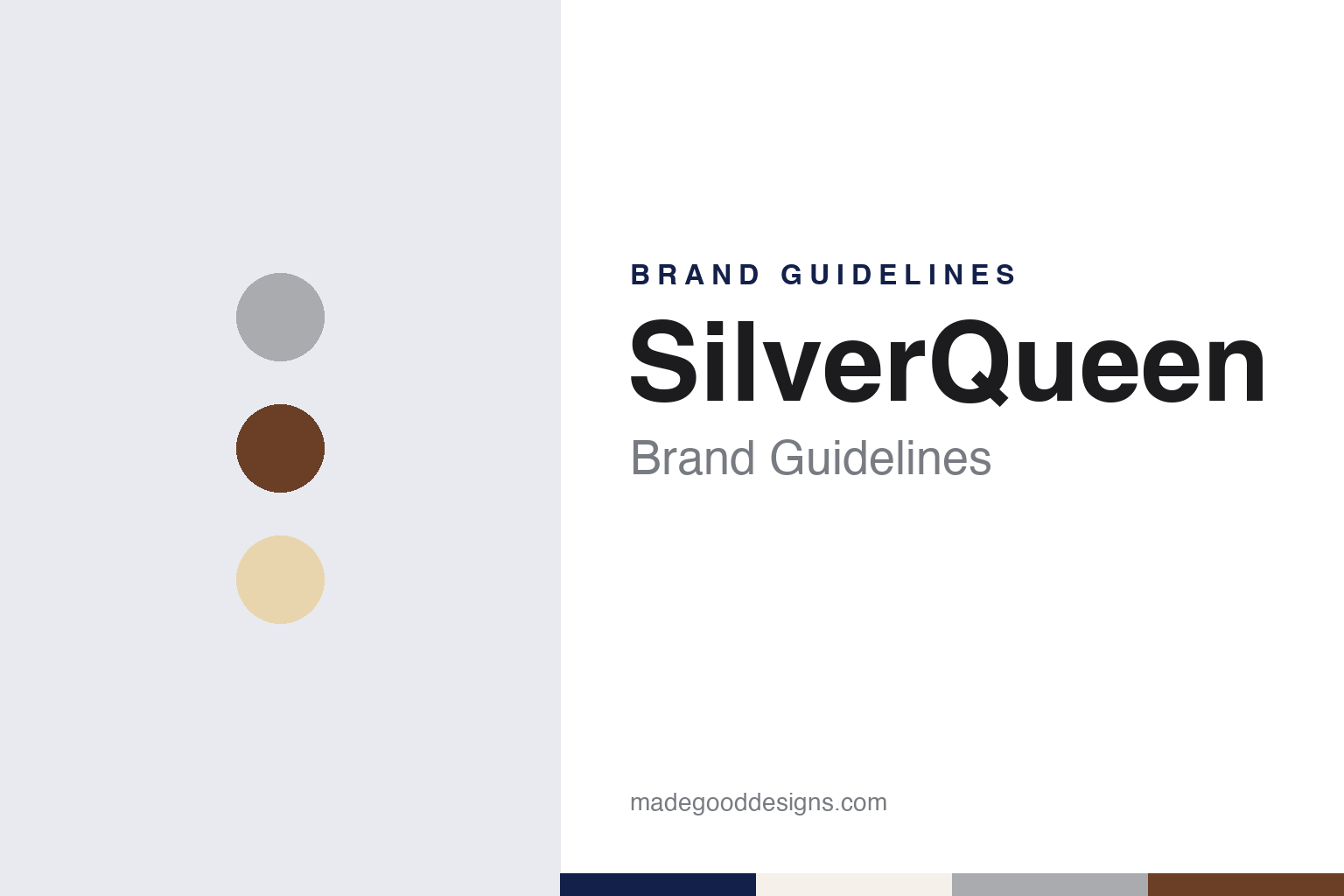
SilverQueen Brand Guidelines
The Garut cashew chocolate bar behind Delfi.
Aa
Two constants: a silver, royal navy and milk-chocolate palette and a regal display serif register. Abstract homage — not a SilverQueen product or mark; no pack, logo or bar is reproduced.
From NV Ceres to SilverQueen
A Dutch-era factory, a new owner and a cashew bar.
Indonesian Wikipedia calls SilverQueen one of Indonesia’s best-known chocolate bar brands, and its story begins in Garut, West Java. Delfi Limited, the Singapore-listed company that owns it today, says in its 2025 annual report that its manufacturing began with an initial factory in Garut, before production was consolidated in Bandung, “where our operations continue today.” The company says it introduced SilverQueen chocolate bars and Ceres chocolate confectionery in the 1950s; Indonesian Wikipedia gives the year as 1950.
The business behind the bar was older than the brand. Indonesian Wikipedia, citing the news site detik (2022) and the business magazine Warta Ekonomi (2020), says SilverQueen was first made by NV Ceres, a Garut company owned by a Dutchman, which passed to Ming Chee Chuang, a young man of Chinese descent from Burma. The press accounts differ on the details. detik reported in 2022 that Chuang was living in Garut and bought NV Ceres from its Dutch owner in the 1950s, while the news site VOI reported in 2021 that the Dutch owner sold up after the Japanese arrived in 1942 and that Chuang, a businessman long resident in Bandung, then took over the factory. Both say he renamed it PT Perusahaan Industri Ceres.
According to Warta Ekonomi, the renamed company’s first product was a wafer biscuit sold as Ritz from 1951; the magazine and detik both report that Nabisco challenged the name and that Ceres kept it for its wafers. The chocolate bar came next. detik and VOI both describe the mix of chocolate and cashew nuts as the bar’s hallmark from the start, and Delfi still describes SilverQueen as known for “its signature blend of milk chocolate and cashews.” VOI added, citing a 2010 book of Indonesian business stories by M. Ma’ruf, that President Sukarno was said to be fond of Chuang’s chocolate. The company’s own short history puts it more plainly: Delfi was “founded by the Chuang family in the 1950’s as a chocolate manufacturer in Indonesia.”
Colour
One bar, many formats and a family of sister brands.
SilverQueen grew up alongside a set of sister brands made by the same Bandung business. Indonesian Wikipedia says PT Perusahaan Industri Ceres also makes Delfi chocolate, Ceres chocolate sprinkles and the Selamat biscuits and wafers. Delfi’s 2025 annual report adds the history: Ceres began as a chocolate-rice topping, the hagelslag of Dutch colonial breakfasts turned Indonesian custom, and Selamat, a chocolate biscuit brand, followed in the 1970s. Snack lines such as Cha Cha, Take-It and Top were launched as stand-alone brands, the company says, a deliberate choice to give each a separate identity.
The Delfi brand arrived in the mid-1980s, the annual report says, “with its iconic skier logo,” as a premium, European-style moulded chocolate launched first in Singapore. In Indonesia it was positioned as a premium alternative to SilverQueen, and it later became a master-brand absorbing the company’s stand-alone snack brands that did not sit under SilverQueen, Ceres or Selamat. SilverQueen, Ceres and Selamat stayed outside it as brand umbrellas of their own, the company says.
The SilverQueen range itself has widened over the decades from the cashew milk-chocolate bar to almond, white, dark and fruit-and-nut versions, a thicker Chunky Bar and bite-sized Bites, Indonesian Wikipedia’s list of varieties shows. Indonesian Wikipedia gives the slogan as “Santai belum lengkap tanpa Silver Queen” — roughly, “Relaxing isn’t complete without Silver Queen” — and says it was aimed at teenagers. Delfi says it has recently evolved the brand to win Millennials and Gen Z with new flavours, formats and pack sizes, among them green tea matcha and “Very Berry” bars and matching Bites.
Delfi calls SilverQueen its flagship and its most significant strategic brand, accounting for the largest share of its product portfolio. The company says it is the nation’s most popular chocolate and holds the largest share of Indonesia’s quality-chocolate-bar category; its 2025 report also says it raised promotional spending on SilverQueen in 2023 and again in the second half of 2025.
Typography
Design and documentation.
The seven brands in this group all make food or drink, and all of them come from Indonesia, Singapore or Malaysia: SilverQueen, Garudafood, Nabati, F&N, Marigold, Hup Seng and Gardenia. Food and drink brands from the region in general sit at many different points in the trade, from family firms that still carry a founder’s name to names that now belong to much larger food groups, and a single brand can be sold everywhere from a corner shop to a supermarket shelf.
A food or drink brand’s identity is usually carried less by a single product than by a pack, a name and the everyday meal or drink it promises, because the company behind the name may have changed hands, moved its factory or grown far beyond the town where it started. That makes the questions behind each name worth asking plainly: who started it, who owns it now, and where its products are actually made and packed.
Each guide separates what independent sources record from what the company says about itself — its founding story, its owners over time, where its products are made and how its packaging has changed — and marks plainly what rests only on the company’s own word.
Aa
A regal display serif for a bar named for a queen. (Specimen set in Playfair Display, a serif STAND-IN; NOT the SilverQueen logo.)
SilverQueen
A Singapore holding company, a cocoa detour and a return to brands.
The business behind SilverQueen is still run by the Chuang family, but its holding company moved to Singapore. Ming Chee Chuang’s sons John and Joseph took over the business, detik and VOI reported, and in 1984 the family established Petra Foods in Singapore as a holding company, with PT Ceres becoming its subsidiary. English Wikipedia, citing Forbes, says John Chuang co-founded Petra Foods with his brothers Joseph and William; all three sit on the board today, Delfi’s 2025 annual report shows, with John as chief executive. The same report says Joseph became chief operating officer of PT Perusahaan Industri Ceres in 1984.
For three decades Petra Foods was as much a cocoa processor as a chocolate maker. Its company history says it entered the cocoa-ingredients business in 1988 with a processing plant in the Philippines, added plants in Thailand, Mexico, Brazil and Germany, and became Asia’s largest cocoa-bean grinder. Petra Foods listed on the Singapore Exchange in November 2004. In 2006 it bought Nestlé’s confectionery business in the Philippines, including the Goya and Knick Knacks brands and a factory in Marikina. In 2013 it completed the sale of its cocoa-ingredients division to Barry Callebaut, the company and Barry Callebaut said, to concentrate on its own brands.
In 2016 Petra Foods renamed itself Delfi Limited, after its main brand, Singapore Business Review reported. In 2014, Reuters reported, the company won a dispute with Nestlé in Singapore over its Take-It wafer’s resemblance to KitKat. In 2018 Delfi acquired the rights to the Van Houten chocolate brand in key Asian markets, The Straits Times reported. Delfi says its chocolate is made in two facilities, one in Indonesia and one in the Philippines, and its annual report names the Bandung production lines; it has shifted some Philippine production to Indonesia. The company sells in Indonesia, the Philippines, Malaysia and Singapore and exports to markets including Thailand, Brunei, India, South Korea and Vietnam.
For a design guide, SilverQueen shows how one recipe — milk chocolate and cashews — can carry a local bar through seven decades and a move to a regional holding company. Compare Van Houten, the Dutch cocoa name Delfi now sells in Asia, and Mayora, the Jakarta biscuit and confectionery family. For this guide we use silver, a royal navy and a milk-chocolate brown with a serif, an unofficial interpretation; no product or logo is reproduced.
Explore & save
Keep SilverQueen’s identity on hand — save it to a board in the Made Good inspiration library.
SilverQueen identity set
Pin the SilverQueen silver, royal navy and milk-chocolate palette and the regal display serif register to your own board.