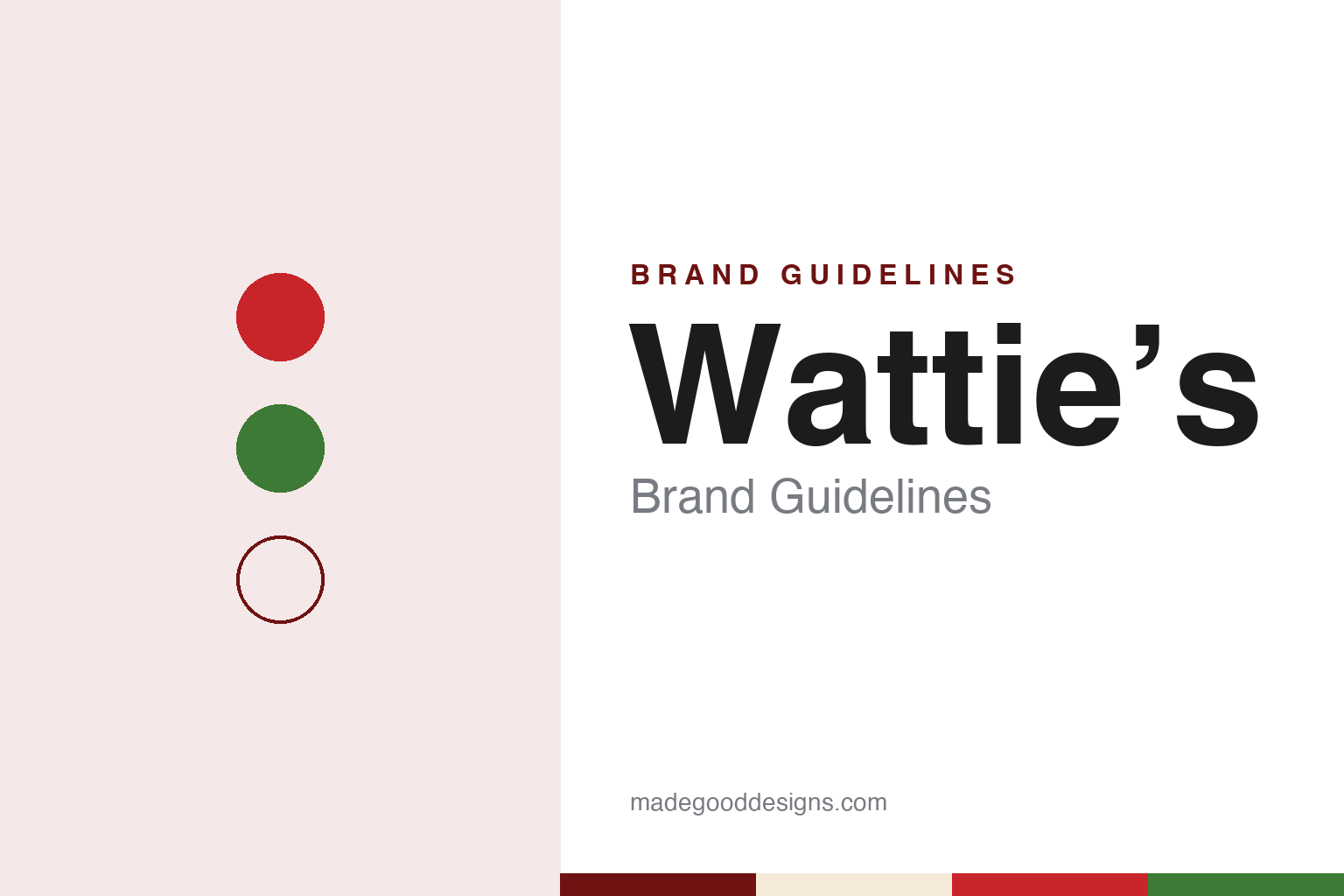
Wattie’s Brand Guidelines
The Hastings cannery that became a New Zealand pantry staple.
Aa
Two constants: a tomato red, pea green and label cream palette and a sturdy slab serif register. Abstract homage — not a Wattie’s product or mark; no can, label or logo is reproduced.
J. Wattie Canneries
Two friends, surplus fruit and Hawke’s Bay.
Wattie’s began in Hawke’s Bay in 1934, when James “Jim” Wattie and his friend Harold Carr formed a small company called J. Wattie Canneries Ltd. The company’s own history, as published on its website in 2019, says fresh fruit was being wasted in the district because it cost too much to send it from Hastings to the cities of Auckland and Wellington. English Wikipedia, citing The New Zealand Herald in 2024, adds that Wattie was unhappy that an Auckland jam maker planned to import jam pulp from Australia, and that jam was the first product.
The company says that in 1935 it began supplying pulped gooseberries, plums and peaches to be made into jam, which led on to canning peaches and pears. When bad weather wiped out the peach and pear crops in 1936, Wattie and Carr decided to grow and can peas and tomatoes instead rather than import fruit; the company says many people doubted that peas would grow in Hawke’s Bay. During the Second World War its operations were designated an essential industry, and most of what it made went into canned rations, the company says.
After the war the cannery turned its tomatoes into the products that defined the brand: the company names Wattie’s Tomato Sauce, baked beans, spaghetti and tomato purée as the lines that grew out of that period. In 1950 it built a factory in Gisborne so it could add sweet corn, persuading local farmers to plant the crop. It also moved into fish canning and, to use the waste from it, launched the pet-food brands Felix and Fido, and, the company says, it took up frozen vegetables as household fridge-freezers became more common.
Baby food followed in 1958. The company says it sought the approval of the Plunket Society, New Zealand’s child-health organisation, and that the relationship was formalised in 1990 with the launch of Wattie’s–Plunket Baby Foods.
Colour
A fire, a knighthood and a sauce.
The defining crisis came in February 1962, when fire destroyed most of the company’s King Street factory in Hastings. Accounts of the recovery differ. The company’s history says stocks of beans and tomatoes were sent to the Gisborne factory within six hours and that canning restarted within 24 hours. English Wikipedia, citing The New Zealand Herald and Hawke’s Bay Today in 2024, says the fire destroyed the main steam line from the boiler room to the plant, that production resumed within 50 hours, and that the insurance claim was the largest insurance loss in New Zealand to that date. The factory was rebuilt, and the company says planned expansions were brought forward.
Jim Wattie was appointed a Commander of the Order of the British Empire in the 1963 New Year Honours, for services to the processed-food industry, and a Knight Bachelor in 1966, for services to industry and the export trade, according to the honours lists published in The London Gazette. His racehorse Even Stevens won the 1962 Melbourne Cup, English Wikipedia says, and in 1994 he was inducted into the New Zealand Business Hall of Fame. The company says that in 1969 it began a frozen-food factory in Christchurch to avoid the cost of shipping across Cook Strait, and that in 1972 Sir James stepped down as managing director of Wattie Industries, handing over to his elder son Gordon, while his younger son Ray ran the canneries division.
The brand’s best-known product is its tomato sauce. English Wikipedia says it is made in New Zealand and carries the line “NZ’s Favourite” on its label, and that 1990s television advertising used the slogan “You’ll always be a Kiwi, if you love our Wattie’s Sauce.” The company also credits Food in a Minute, a series of short television cooking programmes launched in the mid-1990s, with building sales of its canned pasta sauces and frozen products; the concept later moved to a recipe website.
Typography
Design and documentation.
The seven brands in this group all make food, and all of them come from New Zealand and Australia: Cottee’s, Griffin’s, Wattie’s, Eta, Bluebird, Anchor and Mainland. Food brands from the two countries in general sit at many different points in the trade, from names that still carry a founder’s surname to names that now belong to much larger food groups, and a single brand can be sold everywhere from a corner dairy to a supermarket shelf.
A food brand’s identity is usually carried less by a single product than by a pack, a name and the meal or snack it promises, because the company behind the name may have changed hands, moved its factory or grown far beyond the town where it started. That makes the questions behind each name worth asking plainly: who started it, who owns it now, and where its food is actually made and packed.
Each guide separates what independent sources record from what the company says about itself — its founding story, its owners over time, where its food is made and how its packaging has changed — and marks plainly what rests only on the company’s own word.
Aa
A sturdy slab serif for a cannery brand built on sauce and peas. (Specimen set in Roboto Slab, a serif STAND-IN; NOT the Wattie’s logo.)
Wattie’s
Goodman Fielder, Heinz and Hastings.
Wattie’s became part of larger groups in two steps. In 1980 Wattie Industries and the Australian company Goodman Fielder bought shares in each other, and in 1987 the two merged to form Goodman Fielder Wattie Ltd, the company’s history says. In October 1992 the H. J. Heinz Company of Pittsburgh bought Wattie’s from Goodman Fielder. The business has been called Heinz Wattie’s Limited since, and English Wikipedia gives its current owner as Kraft Heinz and its headquarters as Hastings, with about 1,900 staff.
Under Heinz the company kept buying local brands. Its history lists the disused Tomoana freezing works in Hastings, rebuilt as a food factory and distribution centre from 1995; Craig’s jams and canned beans and the Pacific and Hellaby’s corned-beef brands in 1996; and, in 1998, the ETA salad dressings and peanut butter, under licence, together with the Bruno pet-food brand. In 1999 it set up Kowhai Farm, an organic cropping farm run with Lincoln University. English Wikipedia lists Craig’s, Farex, Eta, Greenseas and Gregg’s among the brands it now makes beside Wattie’s and Heinz.
Production has been consolidating. On 11 March 2026 the company proposed closing its Auckland, Christchurch and Dunedin factories, ending frozen packing at Hastings and discontinuing several brands, affecting about 350 jobs, RNZ reported; on 27 March RNZ reported that the closures would go ahead, with the number of roles affected reduced to about 300. Hastings remains the brand’s home: The New Zealand Herald marked 90 years of Wattie’s in Hawke’s Bay in September 2024.
For a design guide, Wattie’s shows how a regional cannery’s name can become a national pantry word, carried on cans and sauce bottles for nine decades. Compare the Australian cannery Golden Circle and the spreads and dressings brand Eta, which Wattie’s took on in New Zealand in 1998. For this guide we use tomato red, pea green and label cream with a slab serif, an unofficial interpretation; no product or logo is reproduced.
Explore & save
Keep Wattie’s’s identity on hand — save it to a board in the Made Good inspiration library.
Wattie’s identity set
Pin the Wattie’s tomato red, pea green and label cream palette and the sturdy slab serif register to your own board.