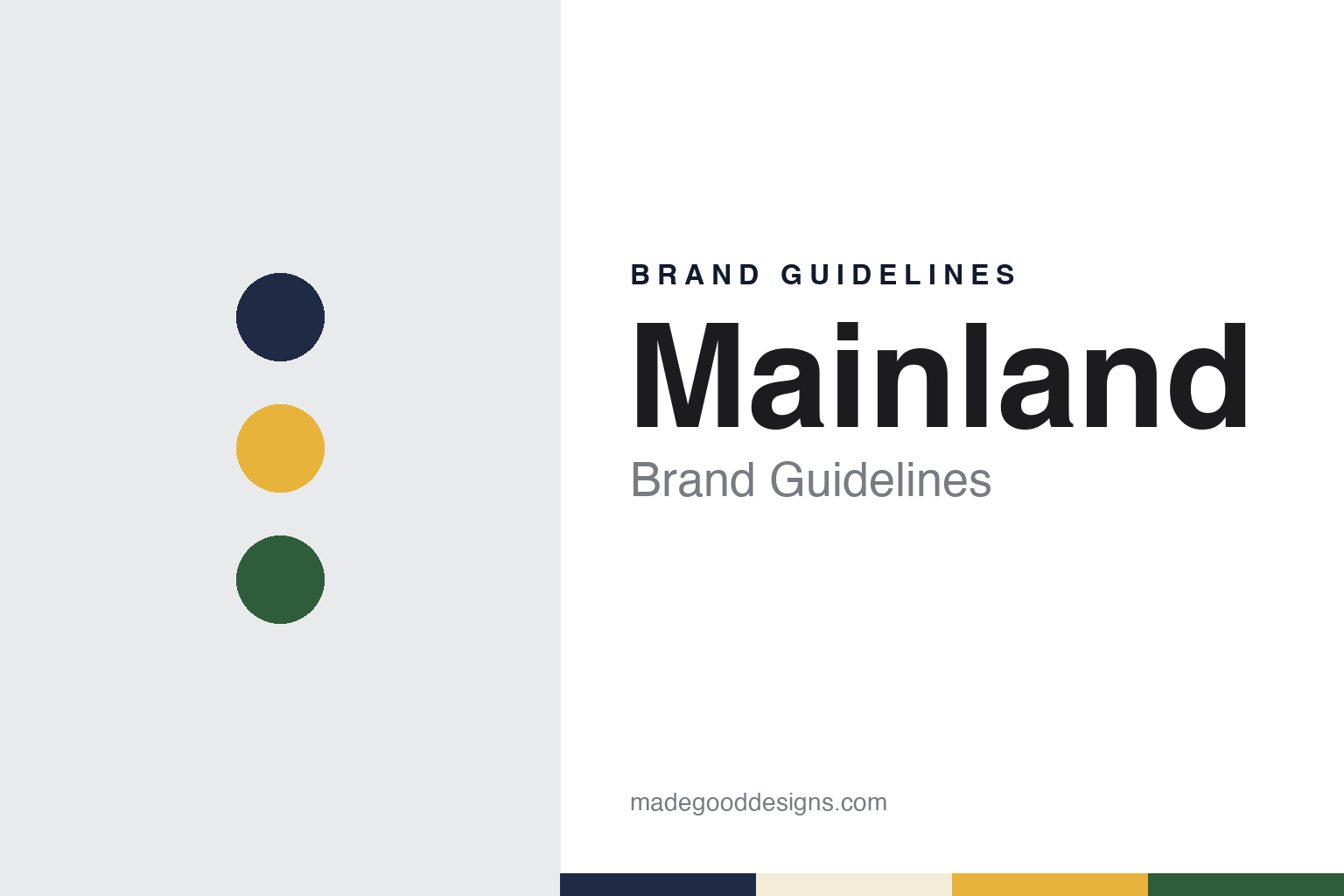
Mainland Brand Guidelines
The Otago cheese brand that told New Zealand good things take time.
Aa
Two constants: a vintage navy, cheddar gold and pasture green palette and a condensed sans register. Abstract homage — not a Mainland product or mark; no pack, logo or cheese is reproduced.
South Island cheese
A supply contract, a registered name and a Dunedin plant.
Mainland began as a trading arrangement between New Zealand’s two main islands. English Wikipedia says Mainland Products Ltd was founded in 1954 by Peter McConnon. The company’s own history, “The Mainland Story,” describes McConnon as a food technologist and says that in 1954 he set up a two-year contract to supply Auckland Food Products with South Island cheese from Otago, which the company calls the first big supply connection between the two islands.
The brand itself followed a year later. In 1955, the company says, the Mainland name was registered with the Intellectual Property Office of New Zealand and the brand was officially launched, which is why Mainland marked its 50th birthday in 2005. Its own timeline puts cheddar at the centre of the story from the 1960s: in 1965, the company says, its Vintage Cheddar established Mainland as the leader in cheddars.
A year after that the business put down roots in Dunedin. In 1966, according to the company, Mainland built its own dairy processing premises on Macandrew Road, moving into larger-scale production; coolstores, warehouses and offices were added over time, the site grew to a staff of about 130, and it remained open until around 2006. The company’s timeline goes on to the launch of Mainland Special Reserve in 1999, a range it says was meant to lead everyday Mainland buyers towards speciality cheeses such as brie and camembert, and to new snacking packs in 2013.
Colour
Patience as an advertising idea.
Mainland is best known in New Zealand for one idea: that cheese, like anything worth having, needs time. English Wikipedia says the brand’s New Zealand advertising has largely been built on the theme of waiting or patience, mirroring the way cheese is aged, and that the “Good Things Take Time” campaign, which began in 1993, is one of the longest-running campaigns in New Zealand television history. The same article says the ads won awards and that the campaign was voted by the public one of the best ads of the 1990s.
The line has outlasted the original commercials. The company’s website still signs off with “Good things take time,” and its brand story ends with a cheesemaker’s saying, “Cheese is ready when it’s ready.” The company dates new packaging and a new television campaign to 2010; that October the New Zealand Herald ran a story headlined “Good things take time, but always come to an end,” and the Otago Daily Times one headlined “Actor not cheesed off about Mainland break.” In July 2023 Stuff described Terry Procter as the actor from the iconic Mainland cheese ads, and Farmers Weekly called him the “Cheese Man.”
Across the Tasman the tone was different. English Wikipedia says Mainland’s Australian advertising played on New Zealand accents, with lines such as “your friend in the fridge” and a joke on “Tuesday” and “cheese day.” The Australian website today uses the line “Aged longer for a better taste.” On its New Zealand site the company describes an Epicure cheddar aged for three years, soft Special Reserve cheeses made with extra cream added to the vat, and a spreadable Buttersoft butter, and it calls its blocks “New Zealand cheese.” The brand also sponsors the Yellow-Eyed Penguin Trust, the company says.
Typography
Design and documentation.
The seven brands in this group all make food, and all of them come from New Zealand and Australia: Cottee’s, Griffin’s, Wattie’s, Eta, Bluebird, Anchor and Mainland. Food brands from the two countries in general sit at many different points in the trade, from names that still carry a founder’s surname to names that now belong to much larger food groups, and a single brand can be sold everywhere from a corner dairy to a supermarket shelf.
A food brand’s identity is usually carried less by a single product than by a pack, a name and the meal or snack it promises, because the company behind the name may have changed hands, moved its factory or grown far beyond the town where it started. That makes the questions behind each name worth asking plainly: who started it, who owns it now, and where its food is actually made and packed.
Each guide separates what independent sources record from what the company says about itself — its founding story, its owners over time, where its food is made and how its packaging has changed — and marks plainly what rests only on the company’s own word.
Aa
A condensed sans for a cheese brand built on patience. (Specimen set in Oswald, a sans STAND-IN; NOT the Mainland logo.)
Mainland
From a family business to Kiwi Co-op, Fonterra and Lactalis.
Mainland Products grew well beyond cheese. English Wikipedia says the company expanded into milk, ice cream under the Tip Top name and processed meats under Kiwi Huttons, among other foods. In the 1990s Kiwi Co-operative Dairies, led by chief executive Craig Norgate, bought 83% of the business, and in 2002 the balance passed to Fonterra, the dairy co-operative formed in 2001 from a merger that included Kiwi Co-op and also led by Norgate. In 2005, English Wikipedia says, Fonterra sold most of the former Mainland business to Graeme Hart’s Rank Group but kept all the cheese assets, and with them the Mainland brand.
Under Fonterra the name stretched further still: the co-operative’s consumer arm came to be called Mainland Group, and Mainland sat alongside Anchor, Kāpiti and Anlene among its brands. In May 2024 Fonterra announced plans to sell its global consumer business, and on 11 November 2024 it confirmed the sale, RNZ reported, saying the businesses in scope included Fonterra Oceania, Fonterra Sri Lanka and 17 manufacturing sites around the world, three of them in New Zealand. On 22 August 2025 Fonterra agreed to sell the business, including the Mainland and Anchor brands and processing operations in Australia and Sri Lanka, to the French dairy group Lactalis, together with a long-term agreement for Fonterra to supply Lactalis with milk and ingredients, RNZ reported. Lactalis chief executive Emmanuel Besnier said the brands would strengthen its growth across Oceania, Southeast Asia and the Middle East.
Fonterra said the sale became unconditional in March 2026 and announced its completion at the end of that month, and the New Zealand Herald and Interest.co.nz reported the completion at the time. English Wikipedia’s article on Lactalis dates the completion to April 2026 and says the business was then renamed Lactalis-Mainland Dairy. Either way, Mainland is no longer a Fonterra brand, and the Mainland website now carries a copyright line for the Lactalis Group of companies.
For a design guide, Mainland shows how a single line about patience can carry a cheese brand for more than three decades, through several changes of owner. Compare Anchor, the New Zealand butter brand sold to Lactalis in the same deal, and Bega, the Australian cheese maker. For this guide we use a vintage navy, a cheddar gold and a pasture green with a condensed sans, an unofficial interpretation; no product or logo is reproduced.
Explore & save
Keep Mainland’s identity on hand — save it to a board in the Made Good inspiration library.
Mainland identity set
Pin the Mainland vintage navy, cheddar gold and pasture green palette and the condensed sans register to your own board.