Mayora Brand Guidelines
The Jakarta biscuit family behind Roma and Kopiko.
Aa
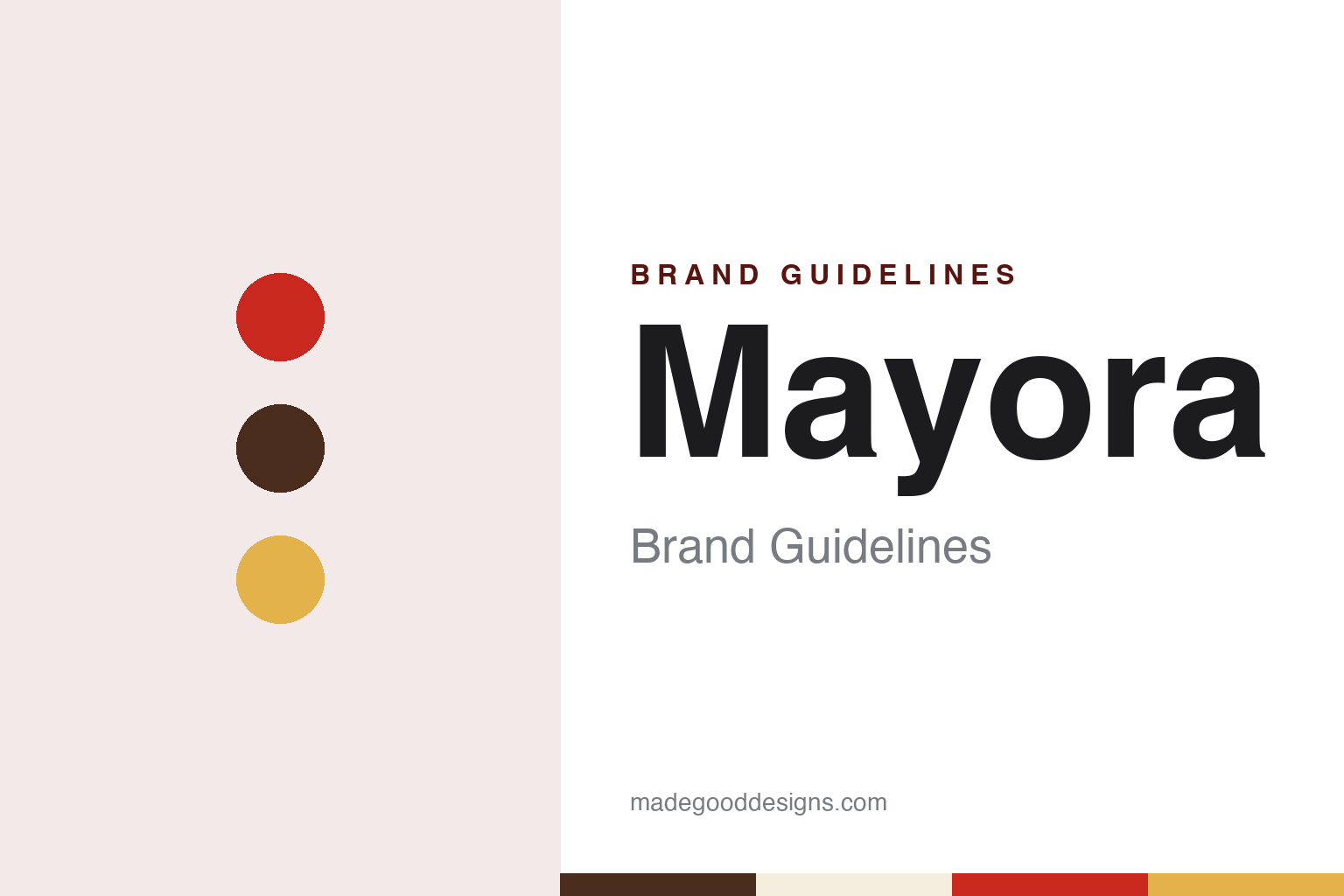
Two constants: a Roma red, coffee brown and biscuit gold palette and a bold geometric sans register. Abstract homage — not a Mayora product or mark; no pack, logo or sweet is reproduced.
A home kitchen in Jakarta
Marie biscuits, a move to Kampung Bali and a Roma name.
Mayora traces its start to a home kitchen. The company says it baked its first biscuits there in 1948, and that the first product was a Marie biscuit; Indonesian Wikipedia, citing the business press, describes the bakers as a family of Chinese descent making biscuits at home in Jakarta. In 1967, the company says, the business moved to Kampung Bali, in central Jakarta, and began selling its biscuits under the Roma name. It bought its first electric oven in 1972, and the range grew to Roma Marie and a Roma coconut biscuit.
The man most associated with the company is Jogi Hendra Atmadja. CNN Indonesia reported in 2021 that he grew up in the family’s home biscuit business and trained as a doctor at Trisakti University before turning to the trade; Indonesian Wikipedia calls him the family’s third generation. According to CNN Indonesia, Jogi founded the company with Darmawan Kurnia and Raden Soedigdo on 17 February 1977 in Jakarta, with a first factory in Tangerang, west of the capital, and took the role of president commissioner. The company says that Tangerang plant was its first full-production biscuit plant, and that Roma Malkist crackers were first made there.
The two Wikipedias tell the company’s early structure differently. English Wikipedia says the firm was established in 1977 as United Brand and took the Mayora Indah name after 1990. Indonesian Wikipedia, citing Indonesian business references, describes PT Mayora Indah as one company in the family’s Inbisco Group (Indonesian Biscuit Company), with United Brand a separate sister firm, set up in 1981 and renamed PT Unita Branindo in 1984, that made sweets, chocolate and wafers. In 1990, it says, Mayora Indah took over Unita Branindo’s business, and Unita Branindo became its main shareholder.
Colour
Coffee candy, wafer rolls and a closing line.
The brand that carried Mayora abroad was Kopiko. English Wikipedia, citing a 2018 broker’s report, dates the coffee-flavoured sweet to 1982; the company calls it the first coffee candy on the market and says that in the same year it launched the Astor wafer roll and first sold its products outside Indonesia. CNN Indonesia described Kopiko in 2021 as the first coffee candy in Indonesia. Further sub-brands followed, by the company’s timeline: Beng-Beng, a layered chocolate wafer bar, in 1984; Choki-Choki, a chocolate paste sold in a stick, in 1985; Torabika instant coffee mixed with sugar in 1990; and the Energen cereal drink in 1992.
Kopiko has found attention far from Jakarta. The Jakarta Post reported in November 2017 that a large bag of Kopiko was spotted in photographs the International Space Station posted of its crew’s Thanksgiving dinner, and that the pictures went viral on Indonesian social media. In June 2026 The Korea Times reported that Macrocom, a Seoul importer, has paid for Kopiko to appear in more than a dozen Korean dramas since 2021, beginning with Vincenzo on tvN and continuing with Castaway Diva in 2023, Connection in 2024 and Brave New World in 2026, with characters shown eating the sweets and the label in view.
Across this many sub-brands, Mayora’s own name works mainly as a sign-off. CNN Indonesia reported that each new product launch carries the line “Satu Lagi dari Mayora” (“one more from Mayora”), and Indonesian Wikipedia notes that the phrase is often heard at the end of its television advertisements.
Typography
Design and documentation.
The seven brands in this group all make food and drink, and they come from Indonesia and Vietnam: ABC, Bango, Kapal Api, Teh Botol Sosro, Vinamilk, Trung Nguyên and Mayora. Food and drink brands in general sit at many different points in the trade, from family firms that still carry a founder’s surname to names that now belong to much larger food groups, and a single brand can be sold everywhere from a roadside stall to a supermarket shelf.
A food or drink brand’s identity is usually carried less by a single product than by a pack, a name and the meal or drink it promises, because the company behind the name may have changed hands, moved its factory or grown far beyond the town where it started. That makes the questions behind each name worth asking plainly: who started it, who owns it now, and where its products are actually made and packed.
Each guide separates what independent sources record from what the company says about itself — its founding story, its owners over time, where its products are made and how its packaging has changed — and marks plainly what rests only on the company’s own word.
Aa
A bold geometric sans for a group that signs off every launch with its own name. (Specimen set in Poppins, a sans STAND-IN; NOT the Mayora logo.)
Mayora
A listed company, a family group and a ring of Tangerang plants.
PT Mayora Indah has been a listed company since 4 July 1990, when its shares began trading on the Jakarta stock exchange, now the Indonesia Stock Exchange; Indonesian Wikipedia says it listed on the Surabaya exchange the same day. It remains under the control of the Atmadja family. English Wikipedia lists its largest shareholders as Unita Branindo, Mayora Dhana Utama and Jogi Hendra Atmadja himself, and names his son Andre Sukendra Atmadja as president director.
Production has stayed concentrated around Tangerang. The company’s timeline records a coffee plant for its Torabika Eka Semesta subsidiary at Cikupa in 1991, a head office in Tomang, Jakarta, in 1994, a plant in the MM2100 industrial estate at Cibitung in 1996, a beverage plant at Ciawi in 2005 and a large biscuit plant at Balaraja in 2013. Indonesian Wikipedia, citing the annual report, counts 12 factories in 2022, ten of them in the Tangerang area and one in Calamba in the Philippines, and lists snack subsidiaries set up in Medan in 1991 and Surabaya in 1992.
Not every Mayora brand sits inside the listed company. Indonesian Wikipedia describes a wider Mayora Group of family-owned firms that are not consolidated into PT Mayora Indah, including PT Tirta Fresindo Jaya, founded in 2005, which makes the ready-to-drink tea Teh Pucuk Harum, launched in 2011, and Le Minerale bottled water, sold since 2015. The company says its products reach more than 90 countries.
For a design guide, Mayora shows how a family biscuit maker can build a portfolio of separate sub-brands, each with its own pack, and tie them together with a single closing line. Compare Indomie, another Indonesian staple with a reach abroad, and Kapal Api, an Indonesian coffee name. For this guide we use a Roma red, a coffee brown and a biscuit gold with a bold sans, an unofficial interpretation; no product or logo is reproduced.
Explore & save
Keep Mayora’s identity on hand — save it to a board in the Made Good inspiration library.
Mayora identity set
Pin the Mayora Roma red, coffee brown and biscuit gold palette and the bold geometric sans register to your own board.