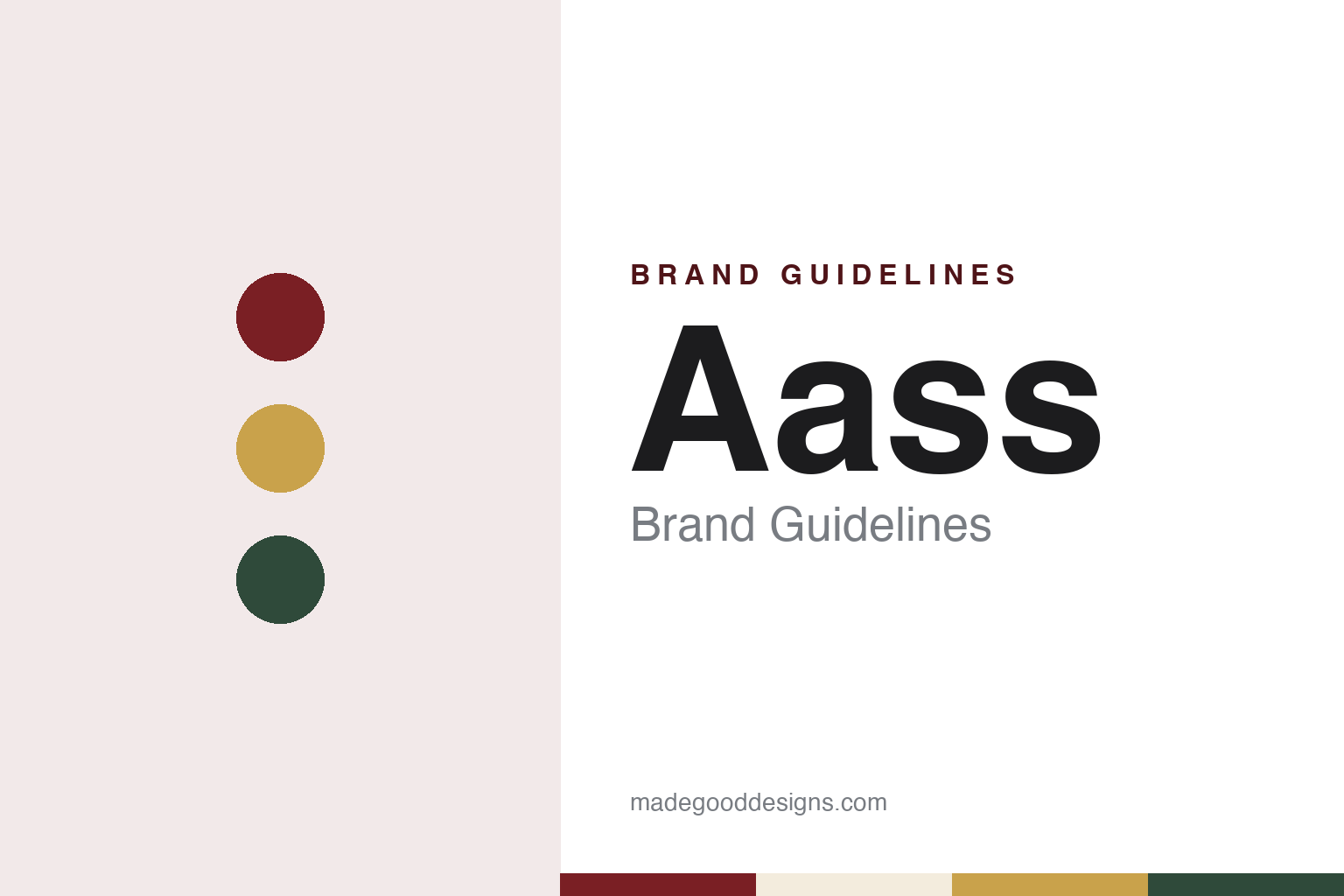
Aass Brand Guidelines
The Drammen brewery of 1834, family-run for five generations.
Aa
Two constants: a brewhouse red, malt gold and river green palette and an old-style book serif register. Abstract homage — not an Aass product or mark; no label, logo or can is reproduced.
A riverside brewery and a farm boy from Øvre Eiker
Brewing in Drammen from 1834, and the family that took it over.
Aass Bryggeri traces its start to 1834, when brewing began on its site in Drammen, the river city west of Oslo. The company calls itself Norway’s oldest brewery, and Brauwelt International described it the same way in 2022. English Wikipedia says the business began as a company dealing in timber, groceries, baking and brewing, and Norwegian Wikipedia names its founder as the brewer and baker Ole Pehrson.
The Aass name came later. The company says Halvor Ellingsen bought the brewery in 1842, and Norwegian Wikipedia adds that he introduced a Bavarian-style beer. In 1860 the property was bought by the merchant H. F. Gjessing together with Poul Lauritz Aass, a farmer’s son from Øvre Eiker who had come to Drammen as a teenager, according to the company; the two ran it as Gjessing & Aass. The company says Aass became sole owner after the Drammen city fire of 1866.
The brewery has never moved. It stands on Nedre Sund at Bragernes, beside the Drammenselva, Norwegian Wikipedia says, and its buildings by the river are a familiar part of the townscape. The company’s 2025 sustainability report puts it plainly: the brewery is still in the same place as in 1834, reflected in the river. Visitors can tour it through the company’s own visitor centre, and the old director’s residence, where every generation of the family has lived for a time, is now let for celebrations; tastings are held in the Gildehallen and at a pilot brewery on the site, the report says.
Colour
Five generations, a soft-drinks chapter and a fight for a name.
Ownership has passed down the family line ever since. The company lists the generations as Poul Lauritz Aass; his son Jens Landmark Aass, who trained as a brewer in Germany and, Norwegian Wikipedia says, took over in 1898 and mechanised the brewery; Detlev John Schmidt Aass, who led it through the Second World War, when shortages of ingredients forced rationing, and stepped down in 1979; Terje Aass, chief from 1979 to 2013, who according to Norwegian Wikipedia bought the neighbouring building of 1902 in 2008; and Christian August Knudsen Aass, who became chief executive in 2013. The company says that in the next generation the business was organised as a company with the shares divided among his heirs, to keep it in the family.
Beer has not been the whole story. The company says Aass began distributing Coca-Cola in 1957 and later bottled it under licence, an arrangement that ended in 2000. Norwegian Wikipedia says Aass was also a co-owner of A/S Solo, the company behind Norway’s Solo orange soda, until 2014. In 1999, the company says, Terje Aass won the rights to the Lundetangen name in a Supreme Court case; Norwegian Wikipedia notes that Lundetangen had been a brewery from 1854 until 1986.
The beer range is broad and traditional in its names. English Wikipedia lists Juleøl, the strong Christmas beer, alongside Pilsner, Fatøl, Classic, Bock and the dark Munich-style Bayer. Norwegian Wikipedia says Aass Bock is sold through Vinmonopolet and exported to the United States. Today the company says it brews around twenty-five beers and also sells cider, alcohol-free beer, mineral water and spirits, and English Wikipedia notes a supporters’ club for Drammen beer, Drammensølets venner.
Typography
Design and documentation.
The seven brands in this group are all Nordic beer names: Mikkeller, To Øl, Nøgne Ø, Aass, Karhu, Lervig and Amager Bryghus. They span two centuries of brewing. Aass was founded in Drammen in 1834 and is still owned by the Aass family, English Wikipedia records; Karhu is a Finnish beer brand that belongs to the brewer Sinebrychoff, part of the Carlsberg Group. The rest are products of the craft-beer wave that began around the turn of this century: Nøgne Ø in Grimstad in 2002, Lervig in Stavanger in 2003, Mikkeller in Copenhagen in 2006, Amager Bryghus on the island of Amager in 2007 and To Øl in Copenhagen in 2010.
A beer brand’s identity is usually carried less by a single bottle than by a name, a label and the place it promises, because the company behind it may have changed hands, taken on investors or moved its brewing somewhere else entirely. Some of these names began as “gypsy” brewers that rented other breweries’ equipment before, in some cases, building their own; others became part of larger brewing groups. That makes the questions behind each name worth asking plainly: who started it, who owns it now, and where its beer is actually brewed.
Each guide separates what independent sources record from what the company says about itself — its founding story, its owners over time, where its beer is brewed and how its labels and cans have changed — and marks plainly what rests only on the company’s own word.
Aa
An old-style book serif for a brewery that dates its first beer to 1834. (Specimen set in Libre Caslon Text, a serif STAND-IN; NOT the Aass logo.)
Aass
A family brewery that has made Norwegian ownership part of the brand.
The fifth generation now runs the brewery. The company says Lauritz Aass took over from his brother Christian August K. Aass in autumn 2024, the year the brewery marked its 190th anniversary with a programme of events and a party at the brewery in September. Its 2025 sustainability report describes Aass as family-owned and 100 per cent Norwegian-owned.
That ownership has become part of how the brewery presents itself. Brauwelt International reported in April 2022 that Aass resigned from Norway’s Brewery and Beverage Association on 22 March 2022, citing foreign ownership of the country’s two largest brewing groups, those controlled by Carlsberg, the owner of Ringnes, and by Royal Unibrew, the owner of Hansa Borg, and that Christian Aass called the Royal Unibrew takeover of Hansa Borg “a very sad day for Norway.” The magazine quoted him as saying that Norwegian ownership was important and that the brewery could do more outside the association than inside it. English Wikipedia likewise describes Aass as one of Norway’s few remaining independent breweries.
The packaging is changing too. The company says it has moved from plastic bottles to aluminium cans and opened a new brewhouse in 2015, and its 2025 sustainability report says its alcoholic beers arrive in 2026 with a new design and cardboard multipacks in place of plastic.
For a design guide, Aass shows how a family name, a founding year and a fixed riverside address can do the work of a brand story for nearly two centuries. Compare Ringnes, the Oslo brewery of the Ringnes brothers, and Solo, the Norwegian orange soda Aass once co-owned. For this guide we use brewhouse red, malt gold and river green with a book serif, an unofficial interpretation; no product or logo is reproduced.
Explore & save
Keep Aass’s identity on hand — save it to a board in the Made Good inspiration library.
Aass identity set
Pin the Aass brewhouse red, malt gold and river green palette and the old-style book serif register to your own board.


