Solo Brand Guidelines
The Tønsberg orange soda with a Spanish recipe.
Aa
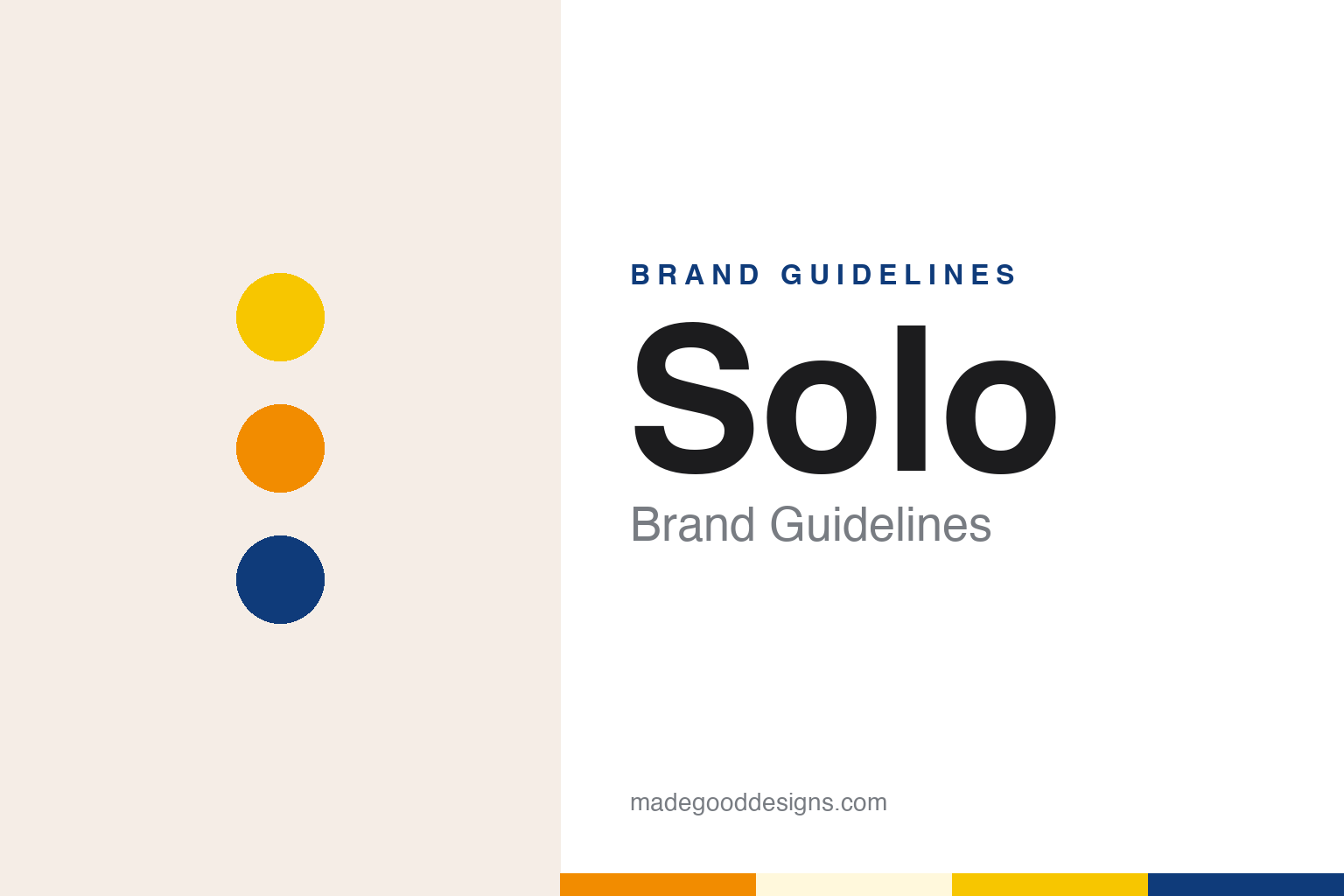
Two constants: a Solo yellow, orange and winter blue palette and a bold rounded sans register. Abstract homage — not a Solo product or mark; no bottle, can, logo or label is reproduced.
Naranjina Solo
A Spanish orange concentrate, a trade trip and a brewery in Tønsberg.
Solo is a Norwegian orange soft drink, but its recipe came from Spain. Norwegian Wikipedia, citing a 2010 article by the drinks writer Petter Nome, says that Torleif Gulliksrud brought home the recipe for a Spanish drink called Naranjina Solo, roughly “orange alone,” and gave it to Theodor W. Holmsen, the director of Tønsberg Bryggeri in Vestfold. The brewery began producing it in 1934. Dagbladet reported in March 2018 that the recipe came from Valencia, where an orange concentrate had been created by a biochemist named Trigo, and that Gulliksrud picked it up on a trade trip to Spain in the 1930s; the paper called him “Solo’s father” and said the first bottles were filled in Tønsberg in 1934.
The brewery that launched it was much older. Norwegian Wikipedia, citing the local-history journal Njotarøy and Tønsbergs Blad, says Tønsberg Bryggeri, first called Tønsbergs Ølbryggeri, made beer, soft drinks, cordials and canned goods from 1856 to 1976. It was bought by Nora Fabrikker in 1962 and closed in 1976, but Solo outlived it.
The drink caught on quickly. The brand’s own website says Solo was launched in 1934 and was soon regarded as Norway’s national soft drink. English Wikipedia, citing Store norske leksikon and an Aftenposten article marking the drink’s 60th anniversary in May 1994, says it became the country’s most popular soft drink and was bigger than Coca-Cola in Norway until the 1960s.
Colour
Yellow is cool, a national soft drink and a long slide in market share.
Solo’s most recognisable asset is its colour. Dagbladet wrote in 2018 that the drink’s yellow had become iconic, summed up in the slogan “Gult er kult,” “yellow is cool,” and that Solo had long been marketed as distinctly Norwegian, tied to Easter and to winter sports. An older line survives on a painted advertisement on a wall in Oslo, photographed for English Wikipedia, which promises Solo as “first against thirst.”
Its share of the market has fallen a long way from the top. Norwegian Wikipedia says that at its peak Solo held about 25 per cent of the Norwegian soft-drink market, and that Coca-Cola and later Pepsi passed it in sales. Aftenposten reported in April 2007 that Pepsi had overtaken Solo in 1999, leaving it third, and Norwegian Wikipedia puts its share at 7 per cent in 2005. Dagbladet described it in 2018 as the fourth-largest soft drink in Norway.
The name now covers more than the original orange drink. Norwegian Wikipedia lists Solo Super, a no-added-sugar version, alongside tropical, passion-fruit and Christmas variants of Solo Super, and says the name is also used on a fruit ice lolly made by the Norwegian ice-cream maker Hennig-Olsen. The brand also has a youth fund: the Solofondet foundation, set up in the early 1990s, gave grants to young people’s projects until 2004 and began awarding them again in 2019 after a 15-year pause, the Solo website says. The foundation describes its purpose as inspiring and helping active, engaged young people with their ideas and projects, and it now asks a jury of ten young people to review applications and recommend which ones should receive support, with the final decision left to its board.
Typography
Design and documentation.
The seven brands in this group all make food or drink, and they come from Finland and Norway: Hartwall, Koff, Mills, Solo, Olvi, Lapin Kulta and Atria. Food and drink brands in general sit at many different points in the trade, from family firms that still carry a founder’s surname to names that now belong to much larger groups, and a single brand can be sold everywhere from a corner kiosk to a supermarket aisle.
A food or drink brand’s identity is usually carried less by a single product than by a pack, a name and the meal or drink it promises, because the company behind the name may have changed hands, moved its production or grown far beyond the town where it started. That makes the questions behind each name worth asking plainly: who started it, who owns it now, and where its products are actually made and packed.
Each guide separates what independent sources record from what the company says about itself — its founding story, its owners over time, where its products are made and how its packaging has changed — and marks plainly what rests only on the company’s own word.
Aa
A bold rounded sans for a drink sold on the line “yellow is cool.” (Specimen set in Baloo 2, a sans STAND-IN; NOT the Solo logo.)
Solo
One trademark, a joint company and several bottlers.
Solo has no single owner in the usual sense. Norwegian Wikipedia says the Solo trademark is owned by a marketing company, A/S Solo, which is a joint venture of three drinks makers, Ringnes, Oskar Sylte and Mack, and that these are the companies that bottle the drink; until 2014, it says, the brewer Aass was also a partner. English Wikipedia, citing Aftenposten, likewise names Ringnes, Oskar Sylte and Mack as Solo’s owners. Dagbladet reported in 2018 that Solo was run through its own company, with Ringnes in charge of the brand.
Ringnes, the largest of the three, is itself foreign-owned. The Oslo brewer says that Orkla became the sole owner of Pripps Ringnes, that Pripps Ringnes merged with Carlsberg in 2000 to form Carlsberg Breweries, and that in 2004 Orkla sold its 40 per cent stake in Carlsberg Breweries to Carlsberg, which thereby became the sole owner of Ringnes. Oskar Sylte is a mineral-water maker founded in Molde in 1929, Norwegian Wikipedia says.
The arrangement has outlasted the brewery where Solo began. Tønsberg Bryggeri closed in 1976, but the trademark now belongs to the joint company, and Dagbladet wrote in 2018 that Solo was still being marketed as a Norwegian drink, more than 80 years after Gulliksrud brought the recipe from Valencia. The brand’s own site still calls it the country’s favourite orange soft drink.
For a design guide, Solo shows how a single colour and a confident slogan can hold a brand together across decades and several bottlers. Compare Hartwall, the Finnish soft-drink and beer maker, and Mills, the Oslo food brand of the Heje family. For this guide we use a Solo yellow, an orange and a winter blue with a rounded sans, an unofficial interpretation; no product or logo is reproduced.
Explore & save
Keep Solo’s identity on hand — save it to a board in the Made Good inspiration library.
Solo identity set
Pin the Solo yellow, orange and winter blue palette and the bold rounded sans register to your own board.