Olvi Brand Guidelines
The Iisalmi brewery still run from its 1878 home town.
Aa
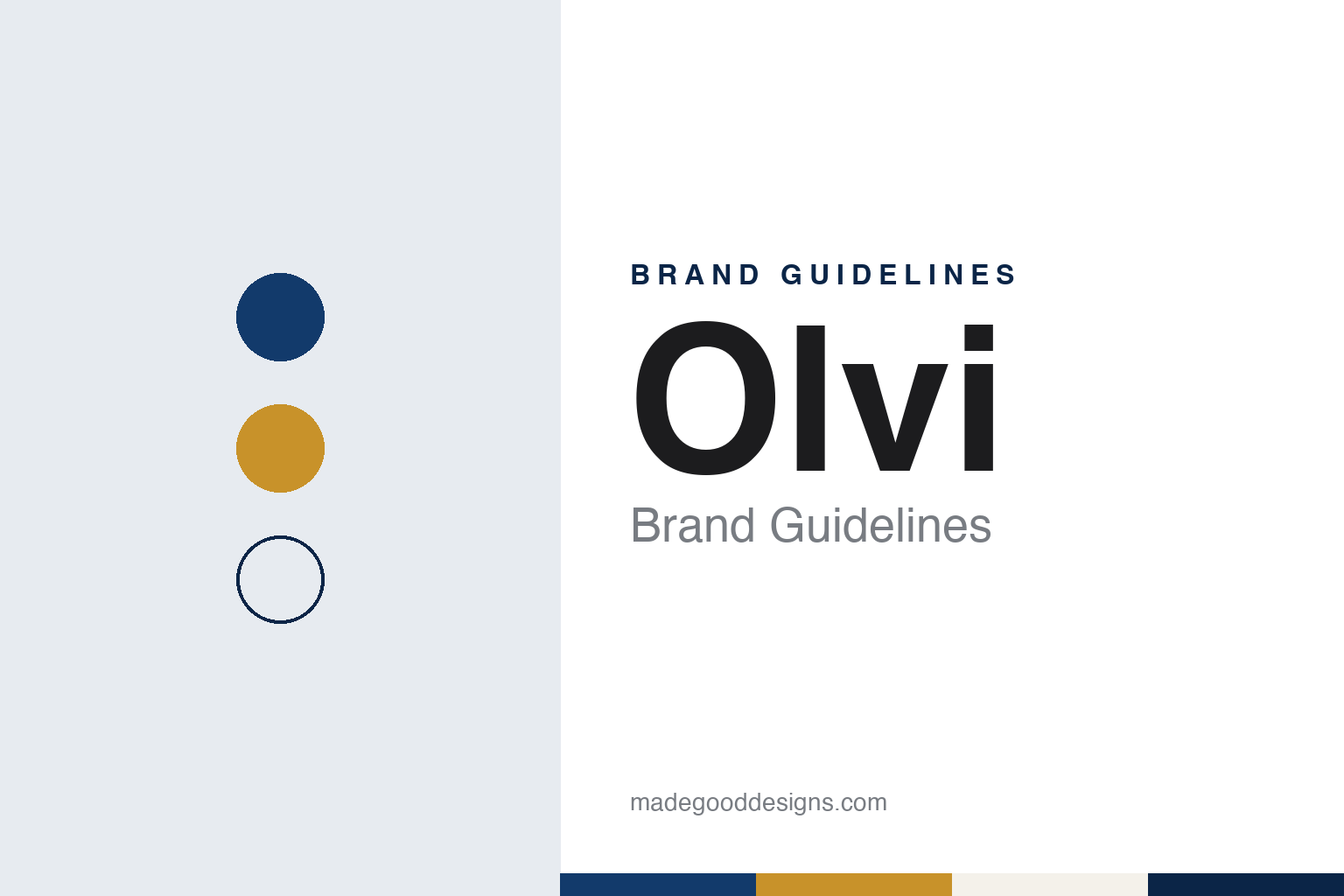
Two constants: an Olvi blue and barrel amber palette and a condensed sans register. Abstract homage — not an Olvi product or mark; no label, can or barrel emblem is reproduced.
Iisalmen Oluttehdas
Eight townsmen, a brewmaster and a rock ravine.
Olvi began in Iisalmi, a small town in the Savonia region of eastern Finland, in 1878. The company’s own history opens with the brewmaster William Gideon Åberg and his wife Onni founding the brewery, and its timeline adds that on 5 October 1878 eight Iisalmi townsmen, led by the apothecary Gustaf Ignatius, met at the town’s inn to discuss founding a beer factory, with Åberg, then manager and brewmaster of the Lahdentaka brewery in Kuopio, invited as their expert. Finnish Wikipedia, citing Tuija Valta’s company history Olvi Oyj 120 vuotta (1998), says Åberg became the first brewmaster and manager of the new company, Iisalmen Oluttehdas Osakeyhtiö.
The brewery was built on the northern shore of Luuniemi, where, Finnish Wikipedia says, a ravine in the rocky shoreline made it easy to cut cellars into the rock; natural ice was used for cooling until 1953. The first beer was sold in 1880. The company says it added sahti and sima, two traditional Finnish brews, in 1892, and Finnish Wikipedia dates its first soft drinks to 1906.
The Åberg family stayed at the centre of the business. In 1919 the shares passed to William’s son Evert Wilhelm Åberg — the same year Finland’s prohibition law took effect. During prohibition the company opened a sales depot in Kajaani and, in 1925, founded Kajaanin Kalja. When prohibition ended in 1932, the Kajaani company was renamed Oluttehdas Oiva and leased the Iisalmi brewery, and the company says the two merged under the Oiva name in 1938.
The Olvi name came later, and from elsewhere. In 1952, the company says, the trade ministry refused its request to shorten its name to Oiva Oy, and when a Helsinki brewery called Olvi Oy closed, Oiva bought that company’s name and logo. In 1955 E. W. Åberg and his wife Hedwig set up the Olvi Foundation, to which the majority of the shares passed; Finnish Wikipedia, citing the company’s shareholder list, puts the foundation’s share of the votes at about 53 per cent.
Colour
A barrel emblem, labels and six-packs.
Olvi’s most consistent visual device is a barrel. The company’s timeline says a barrel logo, in various forms, has served as its trademark since 1947, and in another entry that the emblem has been with the company since 1952. In its 125th-anniversary year, 2003, the logo was renewed by the graphic designer Marko Salonen of the advertising agency PHS; the company says the traditional barrel was kept, modernised, streamlined and given a more Finnish character. In 2008, it says, the barrel became the brewery’s only official mark, and in 2009 the product designs and the logo were renewed again.
Regulation has shaped the packs. The company says a 1977 law banning alcohol advertising led it to renew its labels. In 1997, it says, it introduced Finland’s first beer six-pack, for the beer then called Olvi Special, now Olvi III, and in 1999 the first twelve-pack in Finland. For its 120th anniversary in 1998 it launched a beer called Olvi CXX, Roman numerals for 120, which was renamed CXX in 2000 and ran until 2003.
The company has also drawn on its own archive. In 2002 it launched a retro soft-drink series, Honolulu and Mombasa, followed by Rio Grande in 2003, whose labels, the company says, were based in layout and idea on Olvi’s own labels of the 1950s and 1960s; the series ended in 2004. Its advertising has run in long campaigns: the company dates a campaign titled “Älä ota sitä vakavasti” (“Don’t take it seriously”) from 1998 to 2004, when it was replaced by “Suomalainen seurapeli” (“A Finnish party game”).
Licensed characters have appeared on its soft drinks. The company launched Lordi Cola in 2006, after the Finnish band Lordi won the Eurovision Song Contest that May, and Donald Duck soft drinks in 2007; in 2012 it began making Angry Birds soft drinks with the game company Rovio, according to the company and Kauppalehti.
The beer brand itself has scored well in surveys. Finnish Wikipedia, citing Markkinointi & Mainonta and the newspaper Iisalmen Sanomat, says the magazine’s annual brand-esteem survey ranked Olvi Finland’s most esteemed beer brand in 2008–2009 and 2011–2013, and the company’s Sandels top in 2014–2016.
Typography
Nordic food and drink.
The seven brands in this group all make food or drink, and they come from Finland and Norway: Hartwall, Koff, Mills, Solo, Olvi, Lapin Kulta and Atria. Food and drink brands in general sit at many different points in the trade, from family firms that still carry a founder’s surname to names that now belong to much larger groups, and a single brand can be sold everywhere from a corner kiosk to a supermarket aisle.
A food or drink brand’s identity is usually carried less by a single product than by a pack, a name and the meal or drink it promises, because the company behind the name may have changed hands, moved its production or grown far beyond the town where it started. That makes the questions behind each name worth asking plainly: who started it, who owns it now, and where its products are actually made and packed.
Each guide separates what independent sources record from what the company says about itself — its founding story, its owners over time, where its products are made and how its packaging has changed — and marks plainly what rests only on the company’s own word.
Aa
A condensed sans — an echo of brewery lettering, not of any documented Olvi typeface. (Specimen set in Barlow Condensed, a sans STAND-IN; NOT the Olvi logo.)
Olvi
From one town to six countries.
Olvi grew beyond Finland from the 1990s. It joined the Helsinki stock exchange’s OTC list in 1987 and the main list in 1998, according to the company; Finnish Wikipedia gives 1997 for the main-list listing of its A share. In 1993 the juice company Sonkari merged into Olvi. In 1996 it bought 15 per cent of the Tartu brewery in Estonia — now A. Le Coq — and the whole company the following year. It became majority owner of Cēsu Alus in Latvia in 1999, and of the Lithuanian brewery now called Volfas Engelman in 2000. In 2003 its Estonian subsidiary bought the drinks maker Ösel Foods, Helsingin Sanomat reported, and in 2008 Olvi bought a majority of Lidskoe Pivo in Lida, Belarus.
More recent purchases have been in Finland and the Nordic countries. In 2018 Olvi bought majority stakes in the importer Servaali and The Helsinki Distilling Company, Yle reported. In 2021 it bought a controlling stake in Bryggeriet Vestfyen in Denmark, a brewery founded in 1885, Yle reported in May and August that year. In December 2025 it agreed to buy a majority of Brewery International, an importer and distributor in Sweden and Norway, Food and Drink Technology reported, and in January 2026 it bought the Bosnian brewer Banjalučka Pivara, Iltalehti reported. On 5 March 2022 Olvi announced that it would stop exporting to Russia and withdraw from Belarus, Yle and Helsingin Sanomat reported.
The headquarters and main brewery remain in Iisalmi, and the company has an office in Helsinki. Olvi describes itself as an “independent Finnish brewery since 1878” and says that of the roughly 78 breweries in Finland at its founding, only Olvi survives as an independent Finnish company. Its Finnish range includes the Olvi and Sandels beers, A. Le Coq, FIZZ cider and the TEHO energy drink; the company has said Olvi lager is brewed from Finnish ingredients apart from its hops, which come from Bavaria. Patrik Lundell has been chief executive since 2023, succeeding Lasse Aho, who led the company from 2004.
For a design guide, Olvi shows how a regional brewery can keep one emblem through a century of renaming, regulation and expansion. Compare Lapin Kulta, a Finnish rival lager first brewed in Lapland, and Hartwall, the Helsinki drinks company that owns Lapin Kulta. For this guide we use a deep blue, an amber and a birch white with a condensed sans, an unofficial interpretation; no product or logo is reproduced.
Explore & save
Keep Olvi’s identity on hand — save it to a board in the Made Good inspiration library.
Olvi identity set
Pin the Olvi blue and barrel amber palette and the condensed sans register to your own board.