Tine Brand Guidelines
Norway’s farmer-owned dairy and its wooden box.
Aa
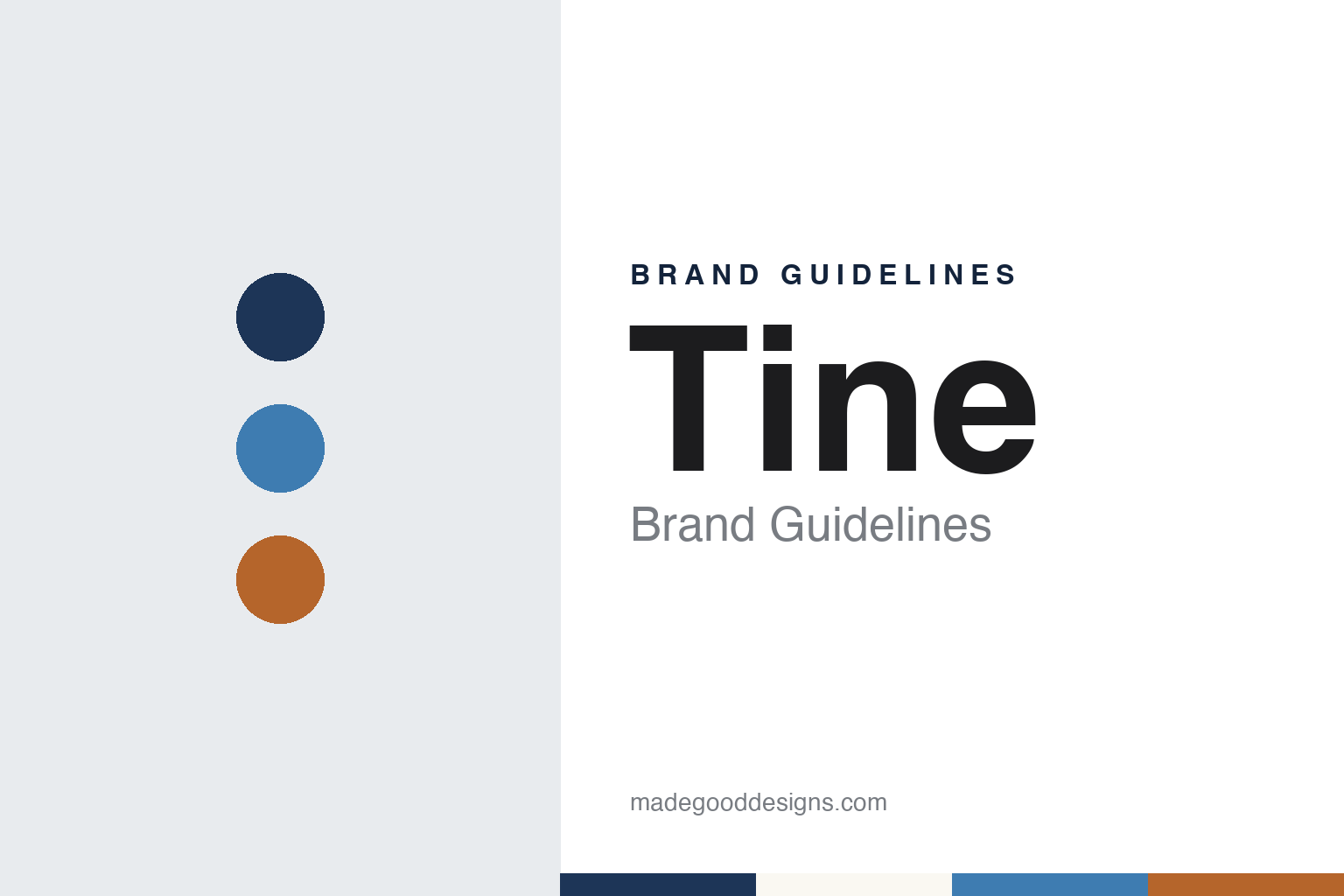
Two constants: a fjord navy, dairy blue and brunost caramel palette and a clean geometric sans register. Abstract homage — not a Tine product or mark; no pack, logo or cheese is reproduced.
A co-operative and a box
Farmers’ dairies, an export company and a new name.
Tine is the brand of TINE SA, Norway’s largest dairy co-operative, which is owned by the milk producers who deliver their milk to it. English Wikipedia, citing the group’s 2025 annual report, published in May 2026, counts 7,572 farmer-owners and 5,318 employees, with the head office in Oslo. The co-operative’s roots are older than its name. Norwegian Wikipedia traces them to 1856, when the first co-operative dairy began at the Rausjødalen mountain dairy, and English Wikipedia, citing the company, says the first nationwide dairy co-operative, Den Norske Meieriforening (the Norwegian Dairy Association), was founded in 1881. The company itself says the story of TINE began in 1856, when a group of Norwegian farmers came together to produce dairy as a co-operative, and it uses the phrase “Since 1856” in its international marketing.
As a business, the company dates from 1928, when Norske Meieriers Eksportlag, an export company for the Norwegian dairies, was formed. Both English and Norwegian Wikipedia say it was renamed Norske Meieriers Salgssentral, a sales centre, in 1942, and Norske Meierier (Norwegian Dairies) in 1984. In 2002, Norwegian Wikipedia says, the regional dairy companies merged with Norske Meierier and its subsidiaries to form the group TINE BA. In 2010 the group was reorganised as a single nationwide co-operative under the Co-operatives Act, which had been introduced from 2008, and took the name TINE SA. It is one of the farmer-owned national co-operatives that belong to the interest organisation Norsk Landbrukssamvirke.
The name comes from an everyday object. A tine is a traditional Norwegian wooden container, a bentwood box that was used to keep butter and cheese, English Wikipedia says. Norwegian Wikipedia, citing the Norwegian trademark register and the group’s 2012 annual report, says the tine shown in the logo was adopted as a trademark for the dairy co-operative in 1973, and that the brand name in its present form came into use in the summer of 1992. English Wikipedia says the Tine name has served since 1992 as an easily identified brand for the company’s dairy products.
Colour
Jarlsberg, brown cheese and a cartoon cow.
Tine’s best-known name abroad is Jarlsberg, a mild Swiss-type cheese made from cow’s milk. English Wikipedia says the Jarlsberg trademark was first registered in 1972 and is owned by Tine. The modern cheese was developed in 1956 by Ole Martin Ystgaard at the Dairy Institute of the Agricultural University of Norway, the Stamford newspaper The Advocate reported in 2004; it drew on a cheese made in Vestfold in the 1850s, and it takes its name from the former countship of Jarlsberg in that region. Jarlsberg reached the United States in 1964, The Advocate said. English Wikipedia says Jarlsberg accounts for 80% of Tine’s exports from Norway, and TINE Ireland calls it the group’s largest export product, with the United States, Australia, Canada and the United Kingdom as its main markets.
At home, Tine is the largest maker of brunost, the caramel-coloured Norwegian whey cheese. English Wikipedia, citing the company, says Tine is the world’s largest producer of brunost and markets 13 varieties of it, along with three types of the soft spread prim. Its other cheeses carry their own names. Norvegia is a gouda-type cheese, and Ridder, a washed-rind cheese, has been made in Tresfjord since 1969, the broadcaster NRK reported in 2015. The blue cheese Norzola was launched in 1974, Aftenposten Aften reported that August. The fresh goat’s-milk cheese Snøfrisk, made in Ørsta, was launched in connection with the 1994 Winter Olympics in Lillehammer, Norwegian Wikipedia says.
Tine also built brands for children. Litago, a range that has included yoghurts, drinks and brunost, began with a fruit yoghurt in 1994, and an illustration of a good-natured cow was one of the elements of its packaging, Aftenposten reported in 2001. In February 2025 Tine introduced mellommelk, a drinking milk with 2% fat that sits between its light and whole milks, NRK reported. Norwegian Wikipedia, citing the prize’s list of past winners, says Tine received the challenger award at Matprisen, a Norwegian food prize, in 2016.
Typography
Design and documentation.
The seven brands in this group all make food or drink, and all of them come from Switzerland or Norway: Villars, Maestrani, Ramseier, Appenzeller Alpenbitter, Elmer Citro, Ringnes and Tine. Food and drink brands from these two countries in general sit at many different points in the trade, from family firms that still carry a founder’s surname to co-operatives and names that now belong to much larger groups, and a single brand can be sold everywhere from a village shop to a supermarket shelf.
A food or drink brand’s identity is usually carried less by a single product than by a pack, a name and the taste it promises, because the company behind the name may have changed hands, moved its production or grown far beyond the town where it started. That makes the questions behind each name worth asking plainly: who started it, who owns it now, and where its products are actually made and packed.
Each guide separates what independent sources record from what the company says about itself — its founding story, its owners over time, where its products are made and how its packaging has changed — and marks plainly what rests only on the company’s own word.
Aa
A clean geometric sans for a dairy named after a wooden box. (Specimen set in Outfit, a sans STAND-IN; NOT the Tine logo.)
Tine
Ice cream, cheese subsidiaries and a factory in Cork.
The Tine group reaches beyond its own brand through subsidiaries. The best known at home is Diplom-Is, which is wholly owned by Tine. English Wikipedia, citing the ice-cream maker’s own history, says the Norwegian dairies set up the Diplom-Is brand in Oslo at the end of the 1920s, with its first advertisement in 1930; the regional dairies’ ice creams were all branded Diplom-Is from 1951, and in 1991 the dairies combined their ice-cream production in one company. Tine also owns 51% of the ready-meal company Fjordland and, abroad, the cheese sellers Norseland Inc. in the United States and Canada, Ilchester Cheese Company, formerly Norseland Ltd., in Britain and Ireland, and Wernersson Ost in Sweden, English Wikipedia says, citing the company. Since 2003, Norwegian Wikipedia says, a department of Tine has also carried out market regulation for milk under an agreement with the Norwegian state.
Where Tine’s products are made depends on the product. Its Norwegian dairies include those at Ørsta, where Snøfrisk is made, and Tresfjord, home of Ridder. Jarlsberg, however, is also made abroad. In the United States, Alpine Cheese Co. in Ohio has made it under contract from Norseland, the trade paper Farm and Dairy reported in 2004. In Ireland, the cheese was made by Dairygold under licence, the Evansville Courier & Press reported in 2012, and in November 2016 the Irish Examiner reported that Norway’s agriculture minister had visited Mogeely, in County Cork, to see the site where a TINE and Dairygold partnership would develop a facility beside Dairygold’s cheese plant. TINE Ireland now says it produces Jarlsberg in its new factory at Mogeely.
For a design guide, Tine shows how a farmers’ co-operative can carry a whole country’s dairy aisle under one short name and the image of a wooden box, while letting brands such as Jarlsberg travel on their own. Compare Lurpak, the Danish butter mark now owned by the co-operative Arla, and Kerrygold, the Irish dairy brand. For this guide we use a fjord navy, a dairy blue and a brunost caramel with a geometric sans, an unofficial interpretation; no product or logo is reproduced.
Explore & save
Keep Tine’s identity on hand — save it to a board in the Made Good inspiration library.
Tine identity set
Pin the Tine fjord navy, dairy blue and brunost caramel palette and the clean geometric sans register to your own board.