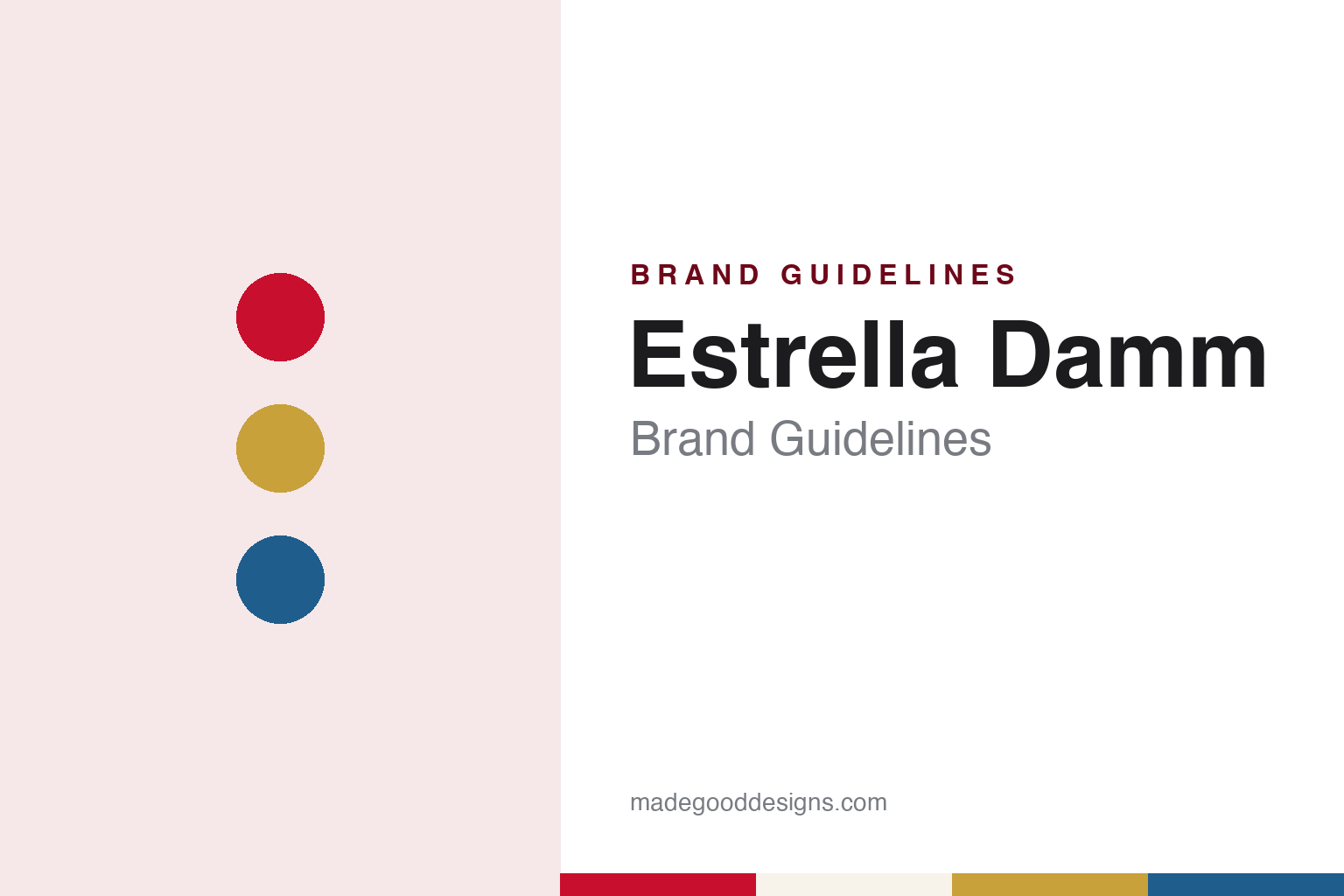
Estrella Damm Brand Guidelines
The Barcelona lager whose star became its name.
Aa
Two constants: an Estrella Damm red, gold and Mediterranean blue palette and a display serif register. Abstract homage — not an Estrella Damm product or mark; no bottle, can, star emblem or logo is reproduced.
Two Alsatians
A brewery on Carrer de Viladomat and a beer named after a star.
Estrella Damm traces its origin to 1876, when the Alsatian brewer August Kuentzmann Damm opened a brewery in Barcelona. He had left Alsace after the Franco-Prussian War, and English, Spanish and Catalan Wikipedia name his cousin Joseph Damm, a master brewer, as his partner; Spanish Wikipedia adds that August arrived in the city with his wife, Melanie. Catalan Wikipedia, citing the business historian Francesc Cabana, places the first brewery at number 27 Carrer de Viladomat, with a 2,400-litre kettle that made it the second-largest in the city after Moritz.
The business soon changed hands. In 1877, Cabana writes, it passed to Adolphe Leinbacher, a Swiss resident of Barcelona, who went into partnership with Joseph Damm in 1881; after further changes of name it was held by Joseph Damm alone from 1895 and then by his children. The company S.A. Damm was constituted in 1910, Spanish and Catalan Wikipedia say.
The beer’s identity began with a symbol rather than a name. English and Spanish Wikipedia say it was first marketed as “Strasburger Bier,” but that drinkers came to know it by its emblem, a red five-pointed star, and asked for “the one with the star.” In 1905 production moved to a new brewery on Carrer del Rosselló in the Eixample, nicknamed “La Bohemia” after the brewing region of central Europe; it remained the main brewery until 1992 and is still the company’s head office. In the early 1900s the beer was shown at trade fairs in Brussels, Rome, London, Paris and Genoa, Catalan Wikipedia says.
Colour
From Estrella Dorada to Estrella Damm.
The star turned into the name in 1921, when the beer became Estrella Dorada, “golden star,” according to English and Spanish Wikipedia. Catalan Wikipedia, citing Cabana, lists an “Estrella Dorada-Pilsen” and an “Estrella Roja-Munich” among the company’s beers from 1910. English and Spanish Wikipedia say that in 1939, after Franco’s victory in the Civil War, the red star disappeared from the packaging and became gold.
The modern name dates from 1991, when Estrella Dorada became Estrella Damm. The brand kept the gold of the five-pointed star but brought back red, the colour of the original star, as its corporate colour, both Wikipedias say. English Wikipedia’s article on the company adds that bottles and caps once showed a golden star on a white ground, while the star on today’s cans sits on red.
The beer is a pale lager brewed with barley malt, rice and hops, and Spanish Wikipedia says it follows the original recipe of 1876. Damm has its own maltings at Bell-lloc, in the province of Lleida, Spanish Wikipedia says. In 2009 the chefs and sommeliers of the restaurant El Bulli created Inedit for Estrella Damm, a blend of lager and wheat-beer styles flavoured with coriander, orange peel and liquorice.
Advertising has done much to fix the brand’s “Mediterranean” image. Spanish Wikipedia says Damm made its first television campaign in 1970, on the first channel of Televisión Española. From 2009 it put most of its budget into a summer campaign under the line “Mediterráneamente,” starting with a music-video spot shot on Formentera; the 2011 film was directed by Isabel Coixet at El Bulli with Ferran Adrià. In 2015 the spot became a ten-minute short, Vale, directed by Alejandro Amenábar on Ibiza with Dakota Johnson, and later films starred Jean Reno and Peter Dinklage. In 2019 the campaign turned to plastic pollution in the Mediterranean.
Typography
Brands from the north and south of Europe.
The seven brands in this group all make drinks, and all of them come from Sweden, Belgium or Spain: Pripps, Ramlösa, Jupiler, Estrella Damm, Mahou, Cruzcampo and Kas. Drink brands in general sit at many different points in the trade, from family firms that still carry a founder’s surname to names that now belong to much larger brewing and beverage groups, and a single brand can be sold everywhere from a corner bar to a supermarket shelf.
A drink brand’s identity is usually carried less by a single product than by a bottle, a label, a name and the occasion it promises, because the company behind the name may have changed hands, moved its brewery or bottling plant or grown far beyond the town where it started. That makes the questions behind each name worth asking plainly: who started it, who owns it now, and where its drinks are actually brewed, bottled and packed.
Each guide separates what independent sources record from what the company says about itself — its founding story, its owners over time, where its drinks are made and how its labels and advertising have changed — and marks plainly what rests only on the company’s own word.
Aa
A high-contrast display serif for a lager with a nineteenth-century story. (Specimen set in DM Serif Display, a serif STAND-IN; NOT the Estrella Damm logo.)
Estrella Damm
A Barcelona company with a German shareholder and a Bedford brewery.
Estrella Damm still belongs to S.A. Damm, which remains a Barcelona company. Catalan Wikipedia, citing Cabana, says the German food group Dr. Oetker entered its capital in 1967; English and Catalan Wikipedia list the largest shareholders as the Canary Islands oil company Disa Corporación Petrolífera, owned by the Carceller family, with about a third, and Dr. Oetker with about a quarter. Damm left the Barcelona stock exchange in April 2015 after a delisting offer, Spanish Wikipedia says. Its president is Demetrio Carceller Arce.
Production has moved out of the city centre. When the Rosselló brewery closed in 1992, Catalan Wikipedia says, brewing moved to Santa Coloma de Gramenet and El Prat de Llobregat, and from 2013 the group’s beer was concentrated at El Prat and in Murcia. The brand is also packaged in England. English Wikipedia says the Eagle Brewery in Bedford had packaged Estrella Damm since 2010 when Carlsberg Marston’s agreed in 2022 to sell it to Damm; Catalan Wikipedia says Damm officially opened it in October 2025 as its first plant outside the Iberian peninsula.
The company has tied the brand closely to Barcelona. Damm was one of the sponsors of the 1992 Barcelona Olympic Games and has supported Catalonia’s castellers, the human-tower teams, since the same year, Spanish Wikipedia says. In March 2015 Estrella Damm was named best Spanish beer at the Spain Brewery Awards given by the jury of the New York International Beer Competition, Spanish Wikipedia reports.
For a design guide, Estrella Damm shows how one emblem — a five-pointed star whose colour changed with the country’s politics — can become the name of the product itself. Compare Dr. Oetker, the German food company that is one of Damm’s main shareholders, and Cruzcampo, the Seville beer whose brewer swapped shareholdings with Damm in 1975, according to Catalan Wikipedia. For this guide we use red, gold and a Mediterranean blue with a serif, an unofficial interpretation; no product or logo is reproduced.
Explore & save
Keep Estrella Damm’s identity on hand — save it to a board in the Made Good inspiration library.
Estrella Damm identity set
Pin the Estrella Damm red, gold and Mediterranean blue palette and the display serif register to your own board.