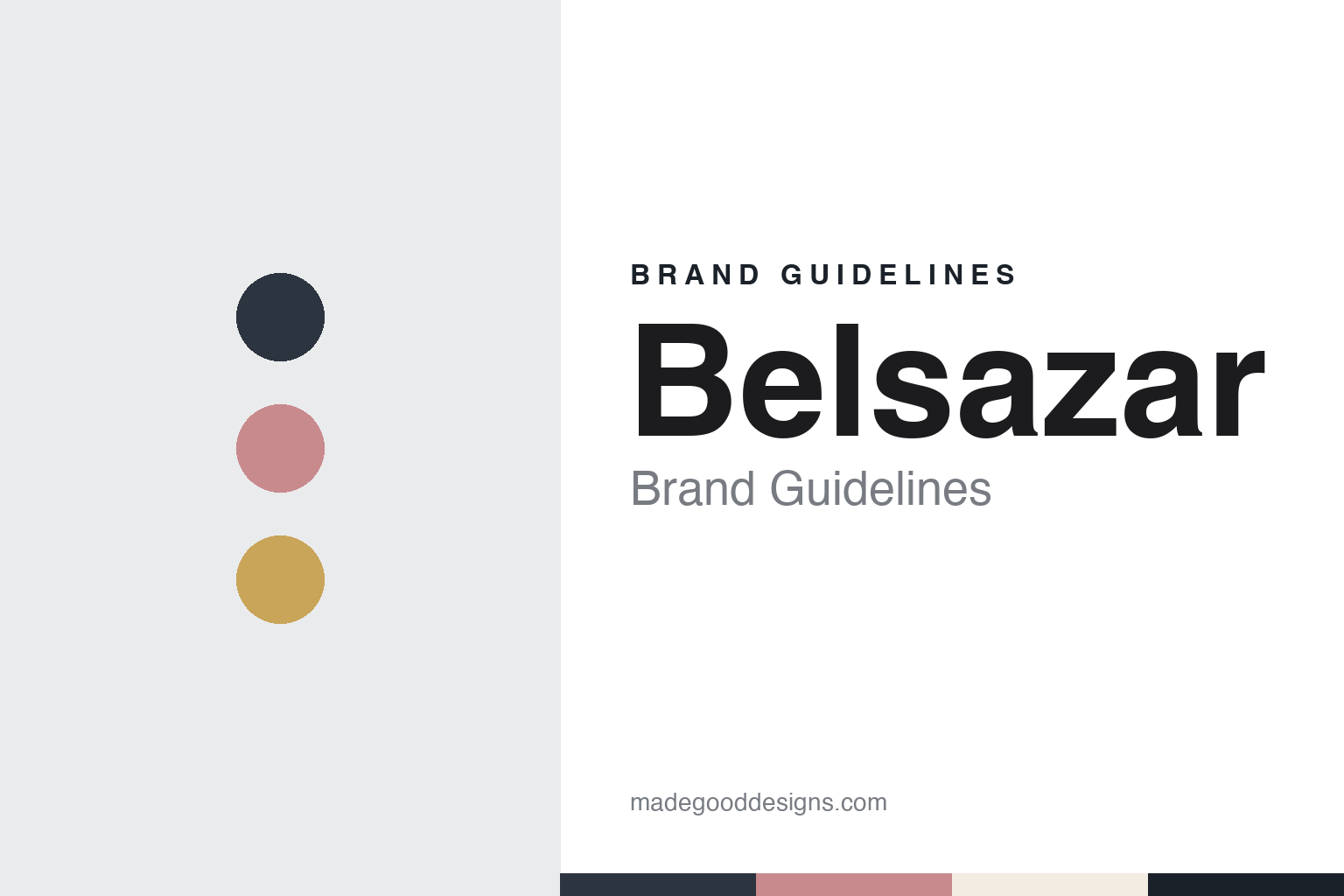
Belsazar Brand Guidelines
The Black Forest vermouth from Berlin, owned by Diageo since 2018.
Aa
Two constants: a slate, rosé and Riesling gold palette and a high-contrast serif register. Abstract homage — not a Belsazar product or mark; no label, logo or bottle is reproduced.
A Berlin start-up with Black Forest roots
Two founders, a fruit-brandy family and a forgotten name.
Belsazar was conceived in Berlin but is made in the far south-west of Germany. Drinks Industry Ireland reported in April 2018 that Maximilian Wagner and Sebastian Brack launched the brand in Berlin in 2013 and sold the first bottle in April 2014. A launch release published by about-drinks.com in February 2014 named a third figure behind the project, Philipp Schladerer of the Schladerer fruit-brandy distillery, and said the vermouth was made, aged and bottled at the Schladerer house distillery in the Breisgau, with distribution run from Berlin.
The name comes from that distillery’s past. The same 2014 release said Belsazar refers to Sixtus Balthasar Schladerer, whose long-forgotten recipes served as a template. German Wikipedia says Sixtus Balthasar Schladerer began distilling at Bamlach in 1813 and that his son moved the business to Staufen in 1844; the company, known for its Black Forest fruit spirits, has been led by Philipp Schladerer-Ulmann alone since 2011, the article says.
The idea was a German vermouth built from regional wine. The 2014 release said the base wines came from growers in the Kaiserstuhl and Markgräflerland and rested for several months in neutral stoneware casks with up to 30 herbs. The Buyer, recalling a 2015 visit in a piece published in September 2017, wrote that the wine came from the nearby Zehringer winery, that Schladerer’s fruit brandy went into the blend, that the rosé used the distillery’s raspberry brandy, and that grape must was used as a natural sweetener. Peter Dean added that the red was built on Pinot Noir and Moscatella with wormwood, tonka bean and orange peel, that the white used a Gewürztraminer base, and that slow filtration and stone-cask ageing set it apart from the oxidised style of Noilly Prat.
Colour
A wine bottle, a diamond and calligraphy.
Belsazar set out to look like German wine rather than an Italian aperitif. In a release published by about-drinks.com in July 2014, the company said its design drew on the tradition of classic German Qualitätswein in the choice of bottle shape and the tactile treatment of the logo paper, while the calligraphy, the diamond-shaped logo and the colours followed modern design standards. The distillery partner has its own packaging history: German Wikipedia says Alfred Schladerer developed the house’s square bottle in 1932 and that the shape was registered as a trademark in 1939.
The company described each style in its own terms at launch. The February 2014 release called the Dry fruity and floral with bitter notes of bitter orange, gentian and cinchona bark; the Red ruby-coloured, with vanilla, candied orange and dark chocolate; the Rosé light, with pink grapefruit, orange blossom and berries; and the White golden and mild, with vanilla and dried peach. Drinks Industry Ireland wrote in 2018 that the vermouths were made from grapes including Pinot Noir, infused with herbs, finished with fruit brandy and aged for up to three months.
The range has stayed compact. The 2014 launch release listed four vermouths, Dry, Red, Rosé and White, each at between 17.5 and 19 per cent alcohol, and Lebensmittel Praxis listed a rosé wine aperitif with Dry, Red and White vermouths in January 2025.
The brand went abroad early. A release published by about-drinks.com in October 2014 said Belsazar would go on sale in Great Britain from 1 November 2014, after an announcement at Bar Convent Berlin, with the hospitality specialist Axiom Brands as exclusive UK importer and the London studio Bompas & Parr working on the launch. Drinks Industry Ireland reported in 2018 that the vermouth was by then also sold in the Netherlands, Belgium, Scandinavia and, since autumn 2017, the United States.
Typography
Design and documentation.
The seven brands in this group are sherry and vermouth names: Valdespino, Williams & Humbert, Barbadillo and Emilio Hidalgo on the sherry side, and Dolin, Belsazar and Mancino on the vermouth side. Sherry is a fortified wine from the far south of Spain, made by bodegas in towns such as Jerez de la Frontera and Sanlúcar de Barrameda; vermouth is a wine flavoured with herbs and spices, made here in France, Germany and Italy. Both trades sit at many different points in the drinks business, from family houses that still carry a founder’s name to labels that now belong to larger groups.
A sherry or vermouth brand’s identity is usually carried less by a single bottle than by a label, a name and the place it promises, because the company behind the name may have changed hands, moved its production or grown far beyond the place where it started. That makes the questions behind each name worth asking plainly: who started it, who owns it now, and where its wine is actually made and bottled.
Each guide separates what independent sources record from what the company says about itself — its founding story, its owners over time, where its sherry or vermouth is made and how its labels have changed — and marks plainly what rests only on the company’s own word.
Aa
A high-contrast serif for a vermouth dressed like a German wine. (Specimen set in Playfair Display, a serif STAND-IN; NOT the Belsazar logo.)
Belsazar
From an accelerator stake to a Diageo brand.
Belsazar was among the earliest bets of Distill Ventures, the drinks accelerator backed by Diageo. Global Venturing reported on 21 March 2018 that Diageo had acquired the brand for an undisclosed amount, that Belsazar had graduated from the accelerator in 2014, and quoted Frank Lampen, head of Distill Ventures, on the investment. Drinks Industry Ireland reported in April 2018 that Diageo had taken full ownership, and that Wagner and Brack would stay involved. Diageo has owned Belsazar since 2018.
Distribution in its home market changed hands in 2025. Lebensmittel Praxis reported in January 2025 that Rising Brands, a subsidiary of the Nuremberg drinks group GES, would take over exclusive distribution of the “Diageo brand” Belsazar in Germany from February 2025, with a focus on bars and restaurants, and quoted Olena Neznal, managing director of Diageo Northern Europe, welcoming the partnership.
The name needs care online. Belsazar is also the German form of Belshazzar, the Babylonian king of the Book of Daniel, and the title of a ballad by Heinrich Heine, so searches for the word return far more than vermouth.
For a design guide, Belsazar shows how a start-up can borrow the cues of German wine, a bottle shape, textured paper and a diamond mark, to give a new vermouth a sense of place. Compare Schladerer, the Staufen distillery that makes it, and Noilly Prat, the French dry vermouth. For this guide we use slate, rosé and Riesling gold with a high-contrast serif, an unofficial interpretation; no product or logo is reproduced.
Explore & save
Keep Belsazar’s identity on hand — save it to a board in the Made Good inspiration library.
Belsazar identity set
Pin the Belsazar slate, rosé and Riesling gold palette and the high-contrast serif register to your own board.


