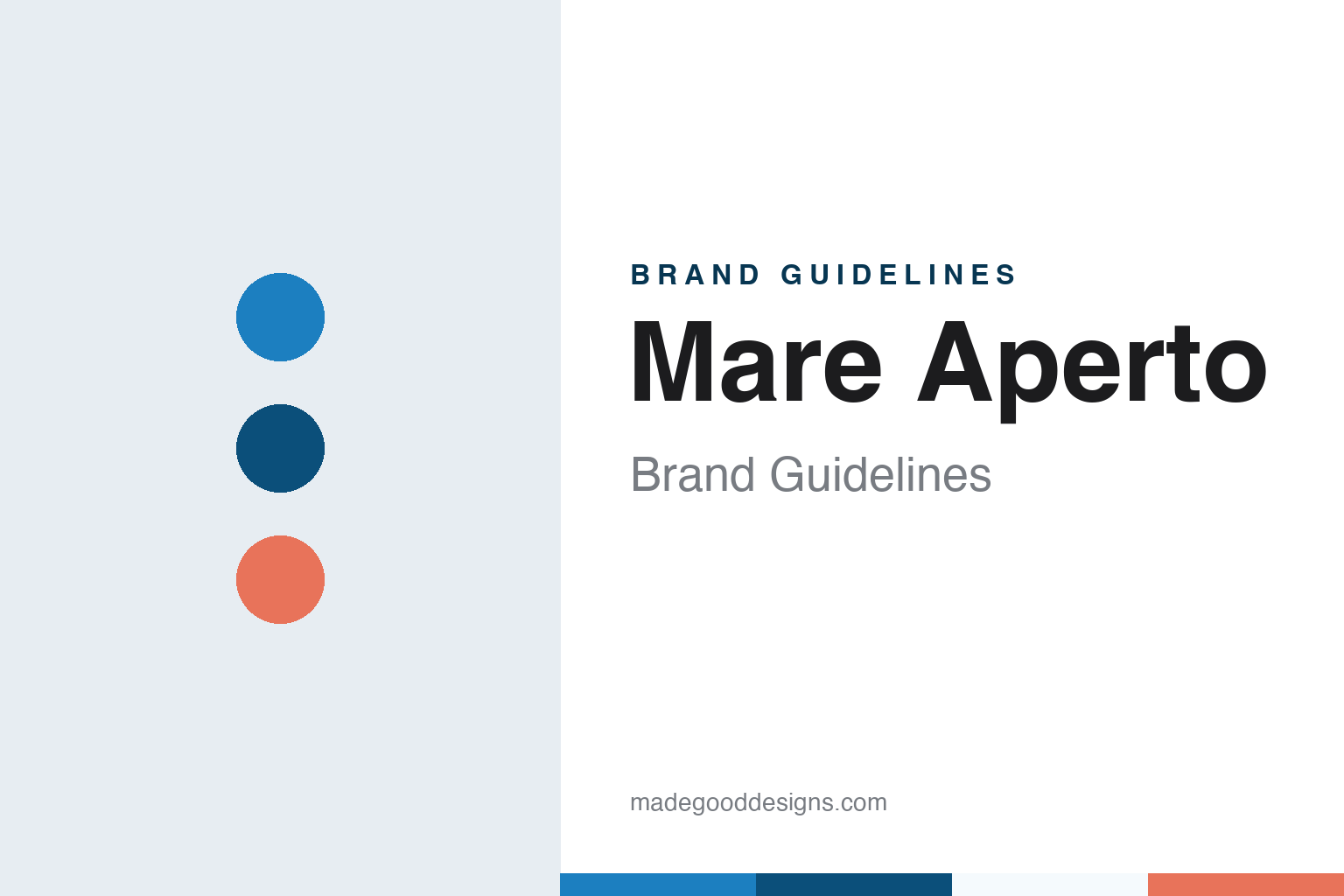
Mare Aperto Brand Guidelines
Jealsa’s Genoa tuna brand, born a joint venture with Star in 2000.
Aa
Two constants: an open-sea blue, deep water and tuna coral palette and a rounded geometric sans register. Abstract homage — not a Mare Aperto product or mark; no tin, label or logo is reproduced.
A Spanish–Italian joint venture
Made by a Galician canner, sold in Italy under an Italian name.
Mare Aperto — “open sea” in Italian — is a tinned-tuna brand sold in Italy by Mare Aperto Foods Srl of Genoa, which belongs to the Spanish canning group Jealsa. Il Fatto Alimentare described it in January 2021 as a Genoese company of the Spanish Jealsa group, and the brand’s own site names Jealsa as its parent company and gives a Genoa address.
The brand began as a partnership. The Spanish trade publication Alimarket reported in July 2015 that Jealsa and Star, the Italian food group then part of The GB Foods, set up Mare Aperto as a joint venture in 2000 to sell canned fish on the Italian market. The work was divided along national lines: Jealsa made the products, chiefly tuna and tuna salads, and Star distributed them in Italy under the Mare Aperto name.
That arrangement ended in March 2015, when Jealsa bought back the 50% of Mare Aperto that it did not already control from Star, Alimarket reported; the deal had been completed months before Jealsa made it public at its annual results presentation to staff. QuiFinanza wrote in December 2019 that Jealsa had acquired Mare Aperto in 2015. Jealsa has owned the brand outright since 2015.
Colour
The family canner from the Ría de Arousa behind the tins.
The parent is a Galician family business. Jealsa says it is a Spanish family company founded in 1958 by Jesús Alonso Fernández, originally to make and sell canned fish and shellfish. A 2018 Faro de Vigo report, republished on Jealsa’s site, places the company at O Bodión in Boiro, on the shore of the Ría de Arousa, and lists Rianxeira, Escurís, Mare Aperto and Robinson Crusoe among its brands. The same report said Jealsa makes most of the canned fish and shellfish sold under the Hacendado label of the Spanish retailer Mercadona.
Production sits mostly in Galicia. An Undercurrent News report of July 2018, also republished by Jealsa, described upgrades at the group’s facilities in Boiro and Pobra do Caraminal, alongside a tuna-loin plant at Puerto Quetzal in Guatemala, a shellfish plant at Puerto Montt in Chile and canned tuna and sardine production in Brazil, and named Jesús Manuel Alonso Escurís as the group’s president. QuiFinanza wrote in 2019 that the group’s production plants are in Galicia. The group also fishes for itself: Undercurrent News reported that its company Sant Yago operates two tuna vessels and an auxiliary vessel in the Atlantic.
Jealsa describes itself today as organised in three divisions — Jealsa alimentación for food, Seanergy 360 and Beltaine — and Il Fatto Alimentare reported in 2021 that a subsidiary, Valora Marine Ingredients, turns fish by-products into raw materials for the cosmetic and nutraceutical industries, while a Pet Select line uses part of the catch for pet food.
Typography
Design and documentation.
The seven brands in this group are all tinned-fish names, from brands based in Spain, Italy and the United States: Matiz, Palacio de Oriente, Albo, Rio Mare, Mare Aperto, AsdoMAR and Wild Planet. Tinned-fish brands sit at many different points in the trade, from family canneries that still carry a founder’s name to labels that belong to much larger food groups, and the same name can appear on a delicatessen shelf and in a supermarket aisle. Two of the seven share an owner: Italy’s Bolton Group, based in Milan, lists both Rio Mare and Wild Planet among its food brands, having announced its acquisition of Wild Planet in August 2021.
A tinned-fish brand’s identity is carried less by the fish than by the tin: its label, its colours, its name and the place it promises. The company behind a name may have changed hands, moved its canning or bought its fish from far away, which makes the plain questions worth asking: who started the brand, who owns it now, and where its fish is caught, packed and canned.
Each guide separates what independent sources record from what the company says about itself — its founding story, its owners over time, where its fish is processed and how its tins and labels have changed — and marks plainly what rests only on the company’s own word.
Aa
A rounded geometric sans for a plain two-word name. (Specimen set in Figtree, a sans-serif STAND-IN; NOT the Mare Aperto logo.)
Mare Aperto
A tagline, a sustainability logo and a peel-off lid.
The brand’s message is the sea itself. Its tagline is “Buono col mare” — good with the sea — and Mare Aperto Foods says that 2020 marked a change of pace, with a new brand positioning built on quality, innovation, sustainability, safety and transparency. Il Fatto Alimentare noted in 2021 that the tuna had been advertised on television and was sold in chains including Esselunga.
The packs carry a second mark. Mare Aperto says its products bear the logo of We Sea, the sustainability programme of Mare Aperto and its parent Jealsa. QuiFinanza described We Sea in December 2019 as a programme with its own logo and five strands, running from responsible sourcing and quality control to renewable energy, social responsibility and the circular economy, each named in the same punning style, such as “We Buy & Sea”. Il Fatto Alimentare reported in 2021 that Mare Aperto is where the programme is fully applied in Italy, with similar work at group brands in Spain, Chile and Brazil. Mare Aperto says it has belonged to the International Pole & Line Foundation since 2018, and Jealsa announced its membership in December 2018.
The other feature the brand points to is the opening. Mare Aperto says it offers Easy Peel, a peel-off film instead of a metal lid, across its whole line, and presents it as a safety feature that takes less force to open. The range runs from tuna in olive oil, extra virgin olive oil or sunflower oil to tuna au naturel, low-salt and organic versions, and a pole-and-line caught line.
The name needs a little care online: “mare aperto” is an ordinary Italian phrase for the open sea, so the brand is best searched with its company name, Mare Aperto Foods, or its site, mareaperto.it.
For a design guide, Mare Aperto shows how a brand born of a Spanish–Italian joint venture can speak entirely in Italian, with a plain “open sea” name, a sea-themed tagline and a sustainability programme logo on its packs. Compare Calvo, the Galician tuna canner from Carballo, and AsdoMAR, the Genoa tuna brand of Generale Conserve. For this guide we use open-sea blue, deep water and tuna coral with a sans, an unofficial interpretation; no product or logo is reproduced.
Explore & save
Keep Mare Aperto’s identity on hand — save it to a board in the Made Good inspiration library.
Mare Aperto identity set
Pin the Mare Aperto open-sea blue, deep water and tuna coral palette and the rounded geometric sans register to your own board.


