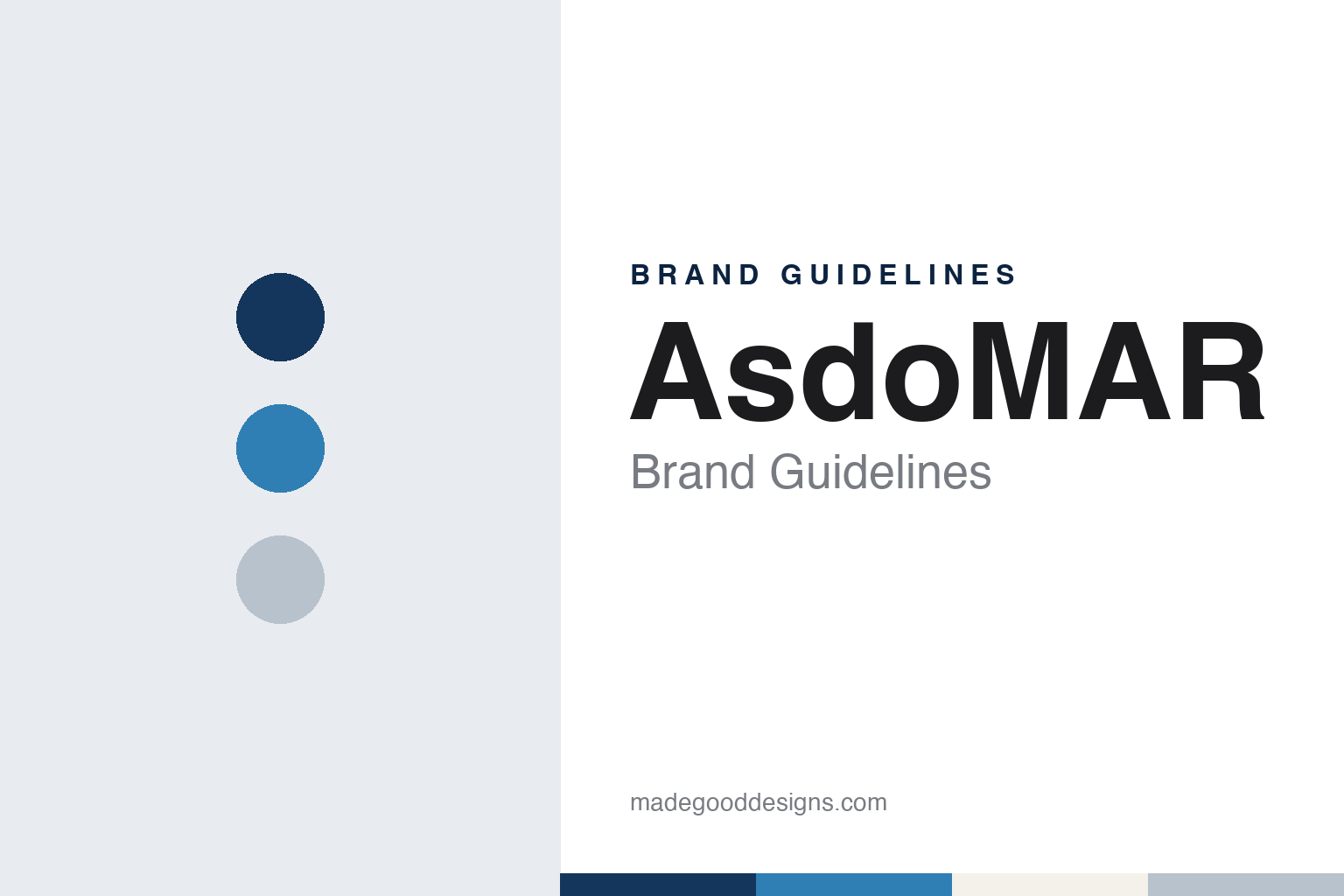
AsdoMAR Brand Guidelines
Generale Conserve’s Genoa tuna, made in Olbia and Vila do Conde.
Aa
Two constants: a deep navy, sea blue and mackerel silver palette and a classic book serif register. Abstract homage — not an AsdoMAR product or mark; no tin, label or logo is reproduced.
A Genoa brand with a Portuguese start
From importing Portuguese tuna to canning its own.
AsdoMAR is a tinned-fish brand from Genoa. It belongs to Generale Conserve SpA, a Genoese company that, according to Italian Wikipedia, was founded in 1989 by local entrepreneurs and began by selling canned tuna made in Portugal under the As do Mar name. Liguria Business Journal described the company in July 2015 as having started in the late 1980s as a distribution business. The brand’s own site writes the name AsdoMAR in running text and ASDOMAR in its logo, while Italian Wikipedia spells it As do Mar.
The turn from importer to manufacturer came under Vito Gulli. Italian Wikipedia says Gulli, a manager, bought a minority stake and became president in 2001, and became majority shareholder and chief executive in 2005, when the company moved from importing canned fish to making its own. In a June 2014 interview with EconomyUp, Gulli said he had previously managed the canned-fish companies Star, Nostromo and Palmera.
The Portuguese side of the story is a cannery at Vila do Conde in northern Portugal. AsdoMAR says the plant had been its preferred supplier from the start; when the company running it fell into crisis in 2006, Generale Conserve took over its management, and it completed the purchase in 2011. Liguria Business Journal reported the same sequence in 2015. Italian Wikipedia names the Portuguese company as Gencoal SA, and the brand’s site still lists Gencoal as the plant’s operator. AsdoMAR says about 150 women work there, processing mackerel largely by hand, and that salmon production began at the plant in 2012.
Colour
Tuna in Sardinia, mackerel in Portugal, and a two-word slogan.
Tuna moved to Sardinia. In 2008 Generale Conserve bought plant and machinery at the closed Palmera tuna factory in Olbia, Gulli told EconomyUp in 2014, and took on workers who had been laid off when Palmera was wound up; Italian Wikipedia cites a June 2008 report in La Nuova Sardegna on the reopening. A new plant beside the old one opened in 2010, according to both EconomyUp and Liguria Business Journal. AsdoMAR says the Olbia plant receives whole yellowfin tuna and handles every stage on site, from cutting and cooking to packing, and that its by-products go to a fishmeal unit for animal feed. The brand’s site sums up the division of labour simply: tuna is worked in Italy, mackerel in Portugal.
The brand’s words do much of the identity work. Italian Wikipedia gives its slogan as “La Qualità e il Rispetto” — quality and respect — and the brand’s site groups its company pages under the same two headings, Qualità and Rispetto. The fish carries Friend of the Sea certification, Liguria Business Journal reported in 2015, and the scheme still has its own section on the brand’s site.
The range is short. Gambero Rosso’s producer profile lists tuna and tuna belly, tuna with beans and tuna pâté, mackerel and salmon, with yellowfin and skipjack tuna from the Atlantic, Pacific and Indian oceans. AsdoMAR describes its mackerel fillets as prepared to a traditional Portuguese recipe and says its salmon is Atlantic salmon, processed by hand; the Vila do Conde plant page adds skipjack fillets, grilled or in extra virgin olive oil, as a more recent line.
Typography
Design and documentation.
The seven brands in this group are all tinned-fish names, from brands based in Spain, Italy and the United States: Matiz, Palacio de Oriente, Albo, Rio Mare, Mare Aperto, AsdoMAR and Wild Planet. Tinned-fish brands sit at many different points in the trade, from family canneries that still carry a founder’s name to labels that belong to much larger food groups, and the same name can appear on a delicatessen shelf and in a supermarket aisle. Two of the seven share an owner: Italy’s Bolton Group, based in Milan, lists both Rio Mare and Wild Planet among its food brands, having announced its acquisition of Wild Planet in August 2021.
A tinned-fish brand’s identity is carried less by the fish than by the tin: its label, its colours, its name and the place it promises. The company behind a name may have changed hands, moved its canning or bought its fish from far away, which makes the plain questions worth asking: who started the brand, who owns it now, and where its fish is caught, packed and canned.
Each guide separates what independent sources record from what the company says about itself — its founding story, its owners over time, where its fish is processed and how its tins and labels have changed — and marks plainly what rests only on the company’s own word.
Aa
A classic book serif for a brand that speaks in a two-word slogan. (Specimen set in Libre Caslon Text, a serif STAND-IN; NOT the AsdoMAR logo.)
AsdoMAR
Two owners, one brand, and a pantry tried and dropped.
Ownership changed in two steps. Italian Wikipedia says the manager Adolfo Valsecchi entered the company in 2014. The advisory firm Lincoln International lists a 2015 transaction in which Sparfin, a vehicle wholly owned by Valsecchi, agreed to acquire 74% of Generale Conserve through the conversion of a bond issued in 2014. BeBeez reported on 6 February 2017 that Gulli had sold his remaining 26% to Sparfin and a group of private-equity investors, and that Valsecchi, already chief executive, would also become chairman. L’Unione Sarda, in a May 2022 profile of Valsecchi, gives a slightly different path: 55% in 2015 and the whole company in 2017.
Along the way the company tried, and then dropped, a wider pantry. In 2013 it bought the canned-meat brand Manzotin from Bolton Alimentari and the tomato brand De Rica from Conserve Italia, Italian Wikipedia says, citing Il Sole 24 Ore and the trade site Food Web. Manzotin went to the Cremonini group in 2016 and De Rica to Consorzio Casalasco del Pomodoro in 2017. L’Unione Sarda wrote in 2022 that selling both let the company concentrate on fish. Gambero Rosso’s profile names Janus and Smeralda as further Generale Conserve brands, alongside private-label work for retailers.
The name needs a little care. The brand’s site is asdomar.it, the company behind it is Generale Conserve, and the spelling varies between sources — AsdoMAR on the brand’s pages, AsDoMar in BeBeez, As do Mar in Italian Wikipedia.
For a design guide, AsdoMAR shows how an Italian tuna brand can carry a name first used on tuna canned in Portugal, run a two-country supply chain of Sardinian tuna and Portuguese mackerel, and keep its message to a slogan about quality and respect. Compare Rio Mare, the Italian tuna brand of the Bolton group, and Mare Aperto, the Genoa tuna brand of Spain’s Jealsa. For this guide we use deep navy, sea blue and mackerel silver with a serif, an unofficial interpretation; no product or logo is reproduced.
Explore & save
Keep AsdoMAR’s identity on hand — save it to a board in the Made Good inspiration library.
AsdoMAR identity set
Pin the AsdoMAR deep navy, sea blue and mackerel silver palette and the classic book serif register to your own board.