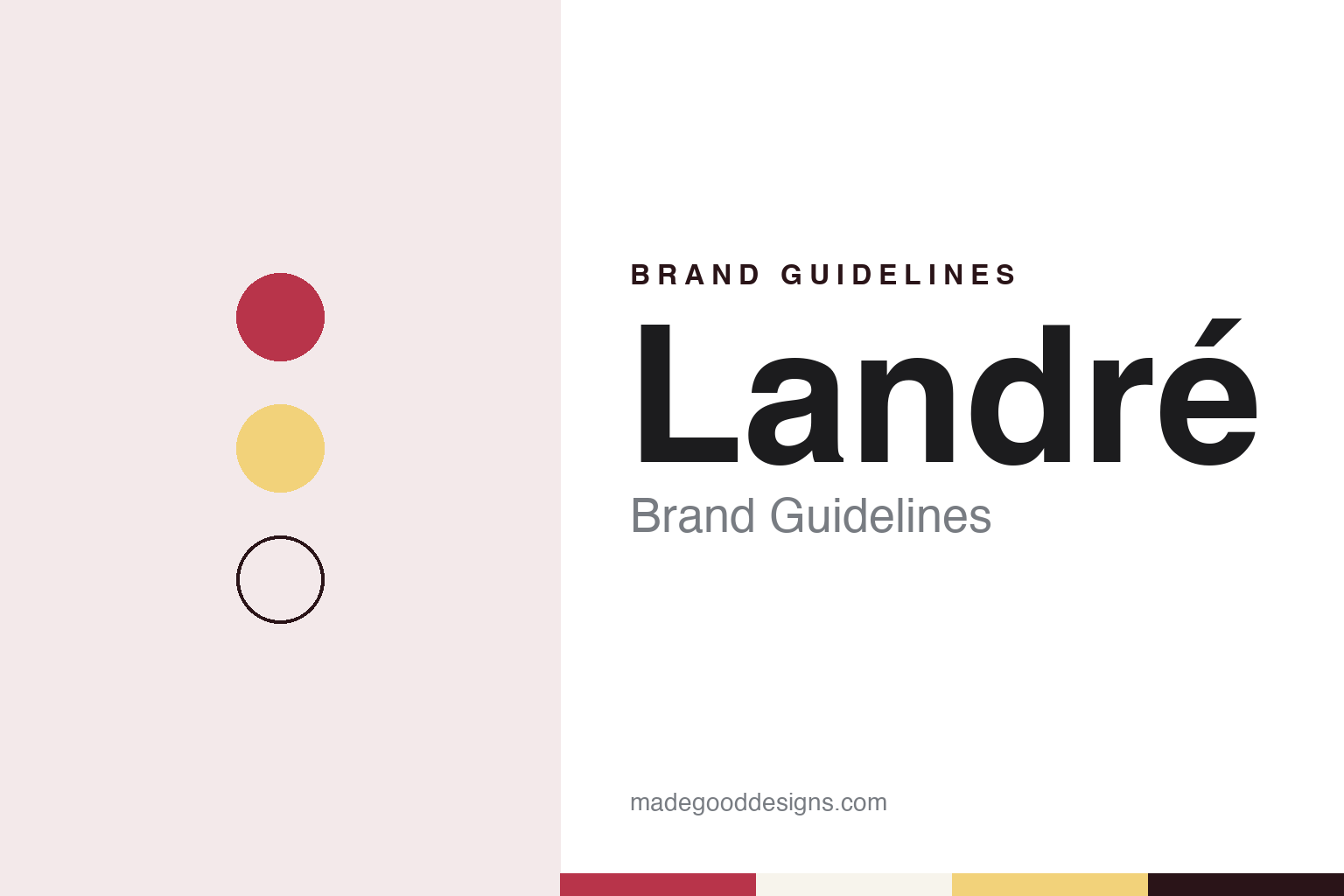
Landré Brand Guidelines
The Lower Saxony maker of exercise books, pads and refills.
Aa
Two constants: a Landré margin red, colour-bar yellow and paper white palette and a bookish serif register. Abstract homage — not a Landré product or mark; no exercise book, logo or packaging is reproduced.
Ideas from paper
A family name on the school exercise book.
Landré is a German brand of paper learning materials: school exercise books, letter pads, ring-binder refills, spiral-bound college pads, flip-chart pads and drawing pads. That is how the company described itself on its own website in 2001, in a version preserved by the Wayback Machine, under the heading “ein Unternehmen mit Tradition” — a company with tradition. Its slogan on the same page was “Ideen aus Papier,” ideas from paper.
The company’s chronicle starts in 1920, when it says the firm was founded by Ferdinand Willy Landré. In 1936, the chronicle continues, Landré received a patent on the spiral ring pad, and in 1942 F. W. Landré developed the shorthand pad, the Stenoblock.
The firm was based in Gronau (Leine) in Lower Saxony. The imprint of the Landré website in December 2002 gives the head office of Landré GmbH there.
Landré sold through the stationery trade rather than its own shops. The 2001 website lists its channels as stationery wholesalers and retailers, the office-supply trade, office superstores, mail-order companies and department stores with specialist sections.
Colour
Ruling numbers and colour bars.
The chronicle on the 2001 website then moves to the classroom. It dates Landré’s wire-stitched school exercise book to 1973. In 1982, it says, the company developed an industrially produced recycled-paper series for school use, and in 1990 it presented a complete range of school supplies on paper made from pulp bleached without chlorine.
The detail most relevant to design is a system of marking. In 1984, according to the same chronicle, Landré introduced the “Systemheft”, an exercise book identified by colour bars and ruling numbers, so that a pupil, parent or teacher could tell at a glance which ruling a book contained. The company said in 2001 that this system had since become standard in the market; that is its own claim.
Later entries turn to teaching aids. In 1998, the chronicle says, Landré developed a handwriting-learning system that it marketed with the phrase “Anti Drunter und Drüber Effekt” — roughly, an effect against letters straying below and above the line. In 1999 the system was extended and a number-learning system was added, which the company attributed to the success of the first.
Paper sourcing was part of the pitch. A separate page of the 2001 website, headed “Holzfreies Papier und Gewässerschutz” — wood-free paper and water protection — describes a range called LANDRÉ pro terra, whose paper the company said was made from pulp bleached with an oxygen process rather than chlorine, and surface-sized so that it would take ink. The page argued that avoiding chlorine bleaching in pulp production helps protect waterways from chlorinated hydrocarbons.
The same page says Landré was a member of the Vereinigung der deutschen Hersteller für umweltschonende Lernmittel, an association of German makers of environmentally friendly learning materials based in Berlin, whose members had committed themselves voluntarily not to import or process papers or pulps that contribute to the destruction of tropical rainforests. Another page of the site said Landré supported the work of “Keine Macht den Drogen”, the German anti-drugs campaign, whose support association was founded in Munich in March 1996 on the initiative of the footballer Karl-Heinz Rummenigge.
The last entry, for 2000, is a statement of intent: the company said it wanted to keep using its long experience and tradition to produce high-quality, modern “ideas from paper.”
Typography
Design and documentation.
The seven brands in this group are all office and paper names: Hamelin, Oxford, Exacompta, Atoma, Brunnen, Landré and Avery. Office and paper brands in general sit at many different points in the trade, from family companies that still carry a founder’s name to labels that now belong to much larger stationery groups, and a single brand can be sold everywhere from a school-supplies aisle to a corporate stationery cupboard.
An office or paper brand’s identity is usually carried less by a single notebook or file than by a cover, a name and the system it promises, because the company behind the name may have changed hands, moved its production or grown far beyond the town where it started. That makes the questions behind each name worth asking plainly: who started it, who owns it now, and where its paper goods are actually made.
Each guide separates what independent sources record from what the company says about itself — its founding story, its owners over time, where its products are made and how its covers and packaging have changed — and marks plainly what rests only on the company’s own word.
Aa
A bookish serif — the register of the school exercise book. (Specimen set in Source Serif 4, a serif STAND-IN; NOT the Landré logo.)
Landré
Herlitz, then Hamelin.
Ownership changed at the turn of the century, and the sources describe it differently. The 2001 Landré website states that since 1 January 2000 the company had been majority owned by Groupe Hamelin of Caen, France, which it described as a producer of paper learning materials, organisation products and mailing supplies with production in France, Spain, Italy and Germany. The trade journal EUWID Paper, reporting on 27 April 2000, referred instead to “the takeover of the German paper converter Landré GmbH by its strategic partner Herlitz AG.” That remark came in a report whose main news was Groupe Hamelin’s takeover of Bantex, so the two transactions were reported side by side; the company’s website and the trade journal simply give different accounts of who held control of Landré in 2000.
The Berlin stationery group Herlitz did hold a stake. On 17 December 2001 the Lebensmittel Zeitung reported that Herlitz AG was selling its stake in Landré GmbH to Groupe Hamelin as part of its restructuring, the year before Herlitz itself filed for insolvency.
The two companies met again two decades later. Hamelin, based at Hérouville-Saint-Clair near Caen, bought Pelikan Group, the owner of the Herlitz brand, in a deal cleared by Germany’s competition authority in December 2023, as the trade journal pbs report recorded. Hamelin also owns the Oxford range of notebooks and the Elba filing brand.
For a design guide, Landré shows how a stationery brand can be built on a practical code — numbered rulings and coloured bars on the cover — as much as on a logo. Compare Oxford, Hamelin’s notebook brand, and Herlitz, the Berlin exercise-book house. For this guide we use a margin red, a colour-bar yellow and an exercise-book white with a serif, an unofficial interpretation; no product or logo is reproduced.
Explore & save
Keep Landré’s identity on hand — save it to a board in the Made Good inspiration library.
Landré identity set
Pin the Landré margin red, colour-bar yellow and paper-white palette and the bookish serif register to your own board.


