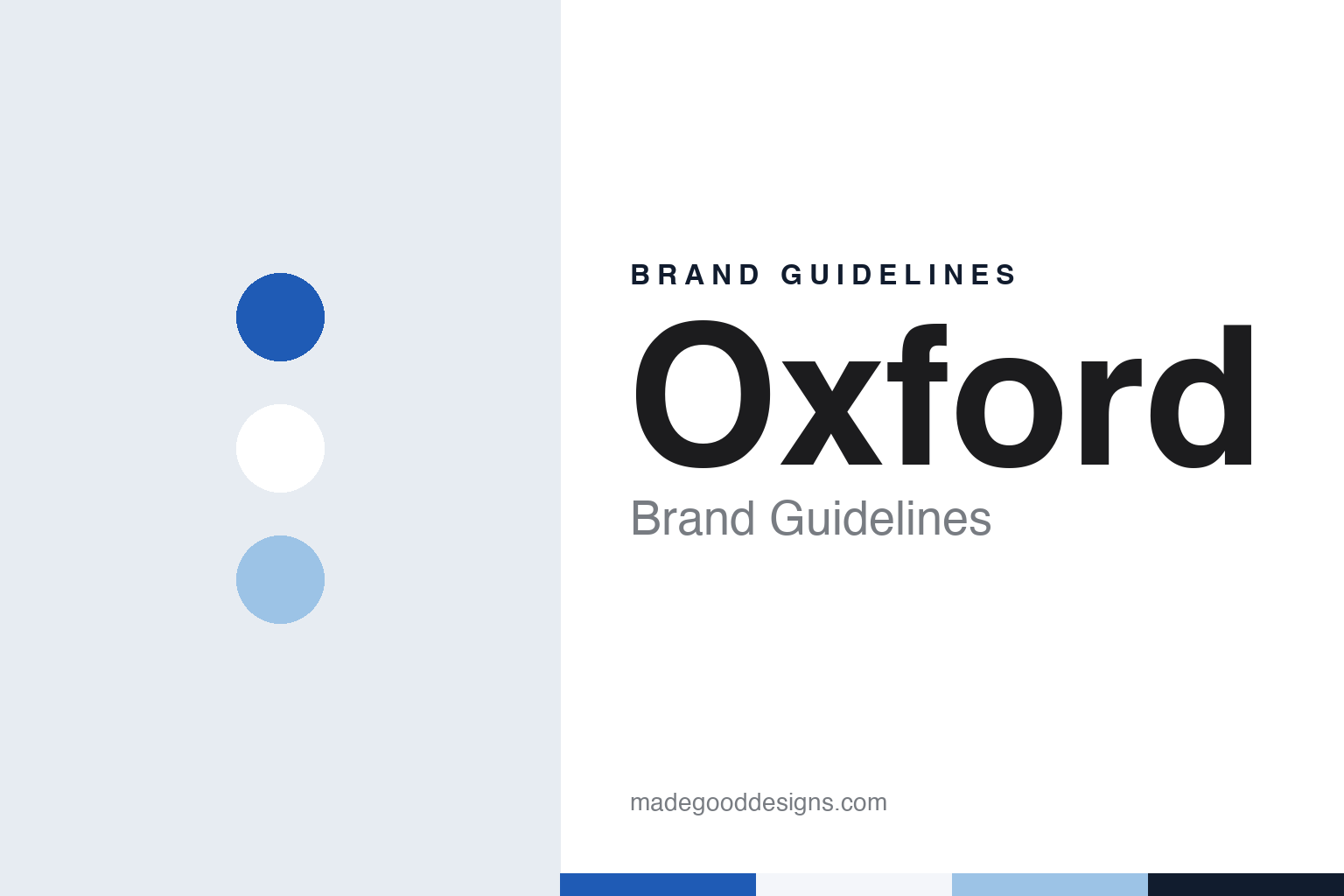
Oxford Brand Guidelines
The Angoulême paper name that became Hamelin’s notebook brand.
Aa
Two constants: a crest blue, ruled-line blue and white palette and a clean sans register. Abstract homage — not an Oxford product or mark; no notebook, crest or packaging is reproduced.
Angoulême, 1916
A paper name from a Charente mill.
Oxford, in French stationery, is a notebook rather than a university. French Wikipedia describes Oxford as a trade mark of the French Groupe Hamelin, known for its writing notebooks, and the brand has nothing to do with the English city’s university or its press.
The name came from a paper mill. Hamelin’s own timeline for the brand says that in 1916 the Papeteries Laroche-Joubert gave the name OXFORD to the best paper they had made, to mark its quality. The Laroche-Joubert mills were at Angoulême in the Charente; French Wikipedia’s articles on the Laroche-Joubert family describe them as making newsprint, diaries, notebooks and stationery under the Oxford brand, and say that Jean Laroche-Joubert, who ran the Angoulême mills from 1936 to 1978, developed the Oxford brand. The same family articles trace the Laroche-Joubert paper business back to Jean-Edmond Laroche-Joubert, a nineteenth-century paper entrepreneur who also sat in parliament as a Bonapartist deputy.
The notebook itself followed. Hamelin dates the launch of the Oxford quality notebook to the 1960s, and lists a school diary, the agenda scolaire, under the Oxford name in 1962. In 1982, the timeline says, Hamelin bought the Oxford brand, which it describes as opening new opportunities for it; Hamelin, a family-owned stationery group founded in Caen in 1864, has owned Oxford ever since. On its brand page Hamelin describes Oxford as having pursued excellence for more than a century, counting from that 1916 paper.
Colour
From a paper standard to an app.
Under Hamelin the brand was built around its paper. The company’s timeline says that in 1990 Oxford set a defined quality standard for its paper and named it Optik Paper, a registered name that Hamelin says is now used in every Oxford product.
The next step was to take Oxford across Europe. In 2002, Hamelin says, Oxford became the group’s strategic European brand and was the subject of advertising campaigns across the continent. In 2003 and 2004 it split the range into segments: the International and Office lines for professionals and a range for students, added to the traditional school notebooks, with notebooks such as the Meetingbook and the Organiserbook, which the company describes as patented. The Openflex notebook with a flexible polypropylene cover followed in 2007, again according to the company. On its group pages Hamelin describes the International range as aimed at managers, and names the Infinium notebook, whose cover it says cannot be torn, among Oxford’s products.
The British side of the group added an older name. English Wikipedia says the Black n’ Red books, made by John Dickinson Stationery, a company Hamelin bought in 2005, are now distributed under the Oxford brand within the group, with their black covers, red spine and the brand name set in red.
Oxford has since tied its paper to software. Hamelin’s timeline lists a connected notebook in 2001, the scribzee app in 2017, which lets users scan their handwritten notes and store, organise and share them, the polypropylene easyBook in 2018, and FLASH 2.0 revision flashcards in 2020, designed to be scanned with scribzee; Hamelin says the cards let secondary-school and university students write their own question-and-answer cards and then use them in a revision mode, which shows progress, or a quiz mode. Hamelin says most Oxford products work with the scribzee app, and that Oxford notebooks received the EU Ecolabel in 2016.
Typography
Design and documentation.
The seven brands in this group are all office and paper names: Hamelin, Oxford, Exacompta, Atoma, Brunnen, Landré and Avery. Office and paper brands in general sit at many different points in the trade, from family companies that still carry a founder’s name to labels that now belong to much larger stationery groups, and a single brand can be sold everywhere from a school-supplies aisle to a corporate stationery cupboard.
An office or paper brand’s identity is usually carried less by a single notebook or file than by a cover, a name and the system it promises, because the company behind the name may have changed hands, moved its production or grown far beyond the town where it started. That makes the questions behind each name worth asking plainly: who started it, who owns it now, and where its paper goods are actually made.
Each guide separates what independent sources record from what the company says about itself — its founding story, its owners over time, where its products are made and how its covers and packaging have changed — and marks plainly what rests only on the company’s own word.
Aa
A clean, upright sans — the register of a notebook cover. (Specimen set in Archivo, a sans STAND-IN; NOT the Oxford logo.)
Oxford
Two lions, a shield and a slogan.
Oxford’s mark is heraldic. French Wikipedia describes the logo as two lions facing each other and breathing flames, one in blue and one in white, holding a two-tone blue and white shield, with the brand name written beneath them.
The brand also has a line. Hamelin’s brand page uses the registered slogan “OXFORD, POWER IN YOUR HANDS”, given in French as “Le pouvoir est entre vos mains”, and frames the brand around handwriting given the reach of digital tools. Its brand values say that handwriting plays an essential part in learning, and its manifesto argues that taking notes is more than putting words on paper, presenting digital tools as a way to get more out of handwriting. When Hamelin agreed to buy Pelikan in June 2023, Les Echos headlined the deal as “the maker of Oxford notebooks” buying the Pelikan pens. The French business magazine Challenges headlined its September 2014 report on the back-to-school season as a duel between Clairefontaine and Oxford.
The brand has its own website, my-oxford.com, which French Wikipedia gives as Oxford’s official site, separate from the group’s corporate pages. On manufacturing, Hamelin says it makes its notebooks, refill paper and pads mainly in Europe, at four production sites, and its French site names two French production sites, at Caen and Moult in Normandy. Hamelin also says that in 2025 most Oxford notebooks carried an environmental label issued by a third-party body.
For a design guide, Oxford shows how a paper name from a Charente mill became a cross-border notebook brand, held together by a two-colour crest, a named paper standard and an app. Compare Hamelin, the Caen group that has owned Oxford since 1982, and Clairefontaine, its French rival. For this guide we use crest blue, ruled-line blue and page white with a sans, an unofficial interpretation; no product or logo is reproduced.
Explore & save
Keep Oxford’s identity on hand — save it to a board in the Made Good inspiration library.
Oxford identity set
Pin the Oxford crest blue, ruled-line blue and white palette and the clean sans register to your own board.