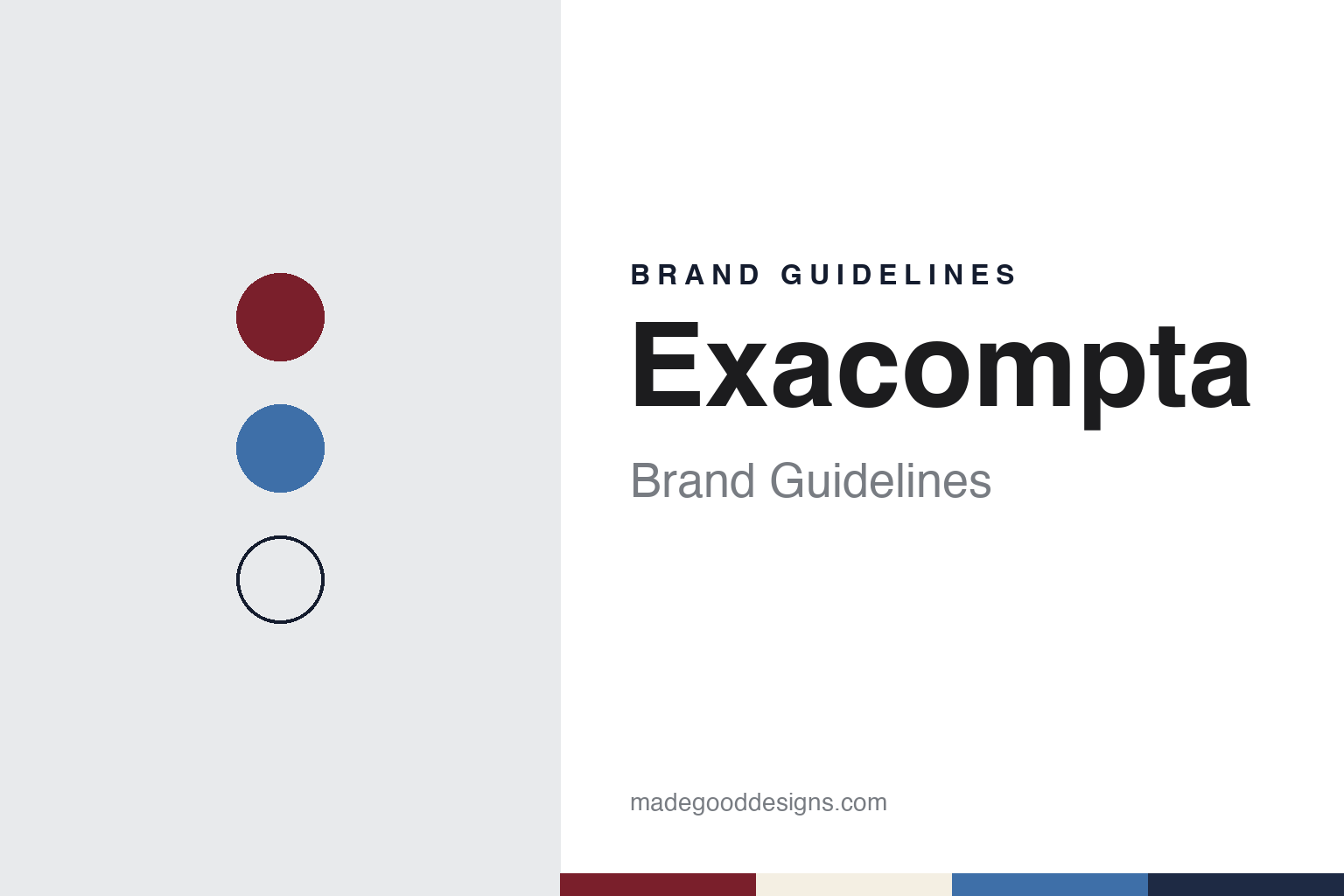
Exacompta Brand Guidelines
The Paris maker of registers, diaries and filing.
Aa
Two constants: an Exacompta burgundy, navy and ledger-cream palette and an orderly sans register. Abstract homage — not an Exacompta product or mark; no register, logo or packaging is reproduced.
Paris, 1928
A workshop for account books on the Canal Saint-Martin.
Exacompta began as a workshop for account books. The company says it was founded in 1928 as a workshop making registers and diaries in Paris, on the banks of the Canal Saint-Martin. The group it belongs to, Exacompta Clairefontaine, gives the same date in its own timeline: in 1928, it says, Charles Nusse set up a workshop in Paris to print and then bind accounting registers in series, recognisable by their paper and their careful presentation, and later made diaries there too. The group presents Exacompta as the start of its policy of brands and quality.
English Wikipedia’s article on the Clairefontaine paper mills tells the same story from the other side of the family business, saying that in 1928 Charles Nusse, son of Louis Nusse, created a workshop in Paris to make accounting records and then diaries under the Exacompta brand.
That family link matters, because Exacompta did not grow up alone. The group traces its paper roots to the Vosges, where Jean-Baptiste Bichelberger founded the Papeteries de Clairefontaine; the mills have made paper since 1858 and stationery since 1890, the group says. It describes Charles Nusse as Bichelberger’s great-grandson. English Wikipedia records that Louis Nusse, Bichelberger’s son-in-law, ran the Clairefontaine mills with Étienne Bodet from 1904 to 1914.
The Paris site is part of the brand’s story. Exacompta says its original workshop stands in buildings by the architect Paul Friesé, which it describes as a listed historic monument, and that the site has since spread into neighbouring buildings where stationery, filing products and diaries are still made. It uses the phrase “Made in Paris” for those ranges, alongside “Made in France” and “Made in Europe”.
Colour
From a Paris workshop to a paper group.
The decisive step came in 1950. According to the group’s timeline, Charles Nusse took charge of the Papeteries de Clairefontaine that year and offered schoolchildren notebooks with paper that was smooth to write on and sturdy, cheerful covers. English Wikipedia adds that the Clairefontaine buildings had been largely destroyed during the Liberation, that Nusse launched the Clairefontaine notebook in 1951, and that he ran the company until 1971. From then on, Exacompta in Paris and the paper mill in the Vosges grew side by side under one family.
Diaries became a second pillar. The group says the company AFA was created in 1958 and began making diaries, and it lists a run of purchases that widened the family’s range: the Papeteries Sill in 1985, the Mandeure paper mill and the calendar maker Lavigne in 1990, the recycled-paper producer Everbal in 1994, and the Papeteries Schut in 1998.
In 1996 the pieces were formally joined. French Wikipedia and the group itself both say a holding company was created that year to bring together Exacompta, Clairefontaine and AFA. The new group then bought the Rhodia pad business in 1997 and the Quo Vadis diaries in 1999, the group says, along with the fine-art supplier Maildor. In 2013 it moved into photo printing with Photoweb. French Wikipedia, citing the trade site Graphiline, records that in March 2019 the group launched a takeover offer for the Swiss group Biella; the group’s timeline lists Biella and Falken among its acquisitions and connects them with lever-arch files.
Exacompta Clairefontaine has its head office at Étival-Clairefontaine in the Vosges and is listed on Euronext Growth in Paris, French Wikipedia says, and the Nusse family still holds the majority of its shares. The group describes its guiding line as making what it sells and selling what it makes, and says it is neither a reseller nor a contract converter.
Typography
Design and documentation.
The seven brands in this group are all office and paper names: Hamelin, Oxford, Exacompta, Atoma, Brunnen, Landré and Avery. Office and paper brands in general sit at many different points in the trade, from family companies that still carry a founder’s name to labels that now belong to much larger stationery groups, and a single brand can be sold everywhere from a school-supplies aisle to a corporate stationery cupboard.
An office or paper brand’s identity is usually carried less by a single notebook or file than by a cover, a name and the system it promises, because the company behind the name may have changed hands, moved its production or grown far beyond the town where it started. That makes the questions behind each name worth asking plainly: who started it, who owns it now, and where its paper goods are actually made.
Each guide separates what independent sources record from what the company says about itself — its founding story, its owners over time, where its products are made and how its covers and packaging have changed — and marks plainly what rests only on the company’s own word.
Aa
An orderly sans — the register of ledgers and planners. (Specimen set in Work Sans, a sans STAND-IN; NOT the Exacompta logo.)
Exacompta
Registers, diaries, files and boxes.
Today Exacompta sells far more than account books. Its own website groups the range into filing, organisation, desk accessories, presentation, business books and pads, personal stationery and products for hotels and hospitality. Registers and diaries remain at the core, next to lever-arch files, storage boxes and desk sets.
Production is spread across Europe. Exacompta lists manufacturing sites in France at Breteuil, Brou, Château-Renault, Houdan, Niort, Paris, Segré, Voiron and Wizernes, as well as at King’s Lynn in England, at Peitz and Herford in Germany and at Eferding in Austria, with a European logistics platform at Vémars, north of Paris. The group says Vémars ships the Exacompta articles, and that its export sales run through subsidiaries named Exaclair or Quo Vadis. Keeping production and jobs in Western Europe is, the company says, a major commitment for Exacompta and for the wider group.
The brand’s own line is about clarity. Exacompta describes its job as bringing the organisation that school and working life need, summed up in the phrase “avoir les idées claires” — to have a clear head — and in a promise to help people “see further”.
Inside the group, Exacompta sits beside some well-known paper names. French Wikipedia’s list of the group’s brands includes Clairefontaine, Rhodia, Quo Vadis, G. Lalo, J. Herbin and Brause Calligraphie. Each keeps its own identity; Exacompta is the name for the office and organising side.
For a design guide, Exacompta shows how a brand built on ledgers can keep a sober, orderly look across registers, diaries and filing while the paper behind it comes from a family mill. Compare Clairefontaine, its sister brand from the Vosges, and Leitz, the Stuttgart maker of the lever-arch file. For this guide we use a ledger burgundy, a register navy and a ledger cream with a sans, an unofficial interpretation; no product or logo is reproduced.
Explore & save
Keep Exacompta’s identity on hand — save it to a board in the Made Good inspiration library.
Exacompta identity set
Pin the Exacompta burgundy, navy and ledger-cream palette and the orderly sans register to your own board.


