The Refined Feline Brand Guidelines
Cat furniture made to sit in the living room, not the utility room.
Aa
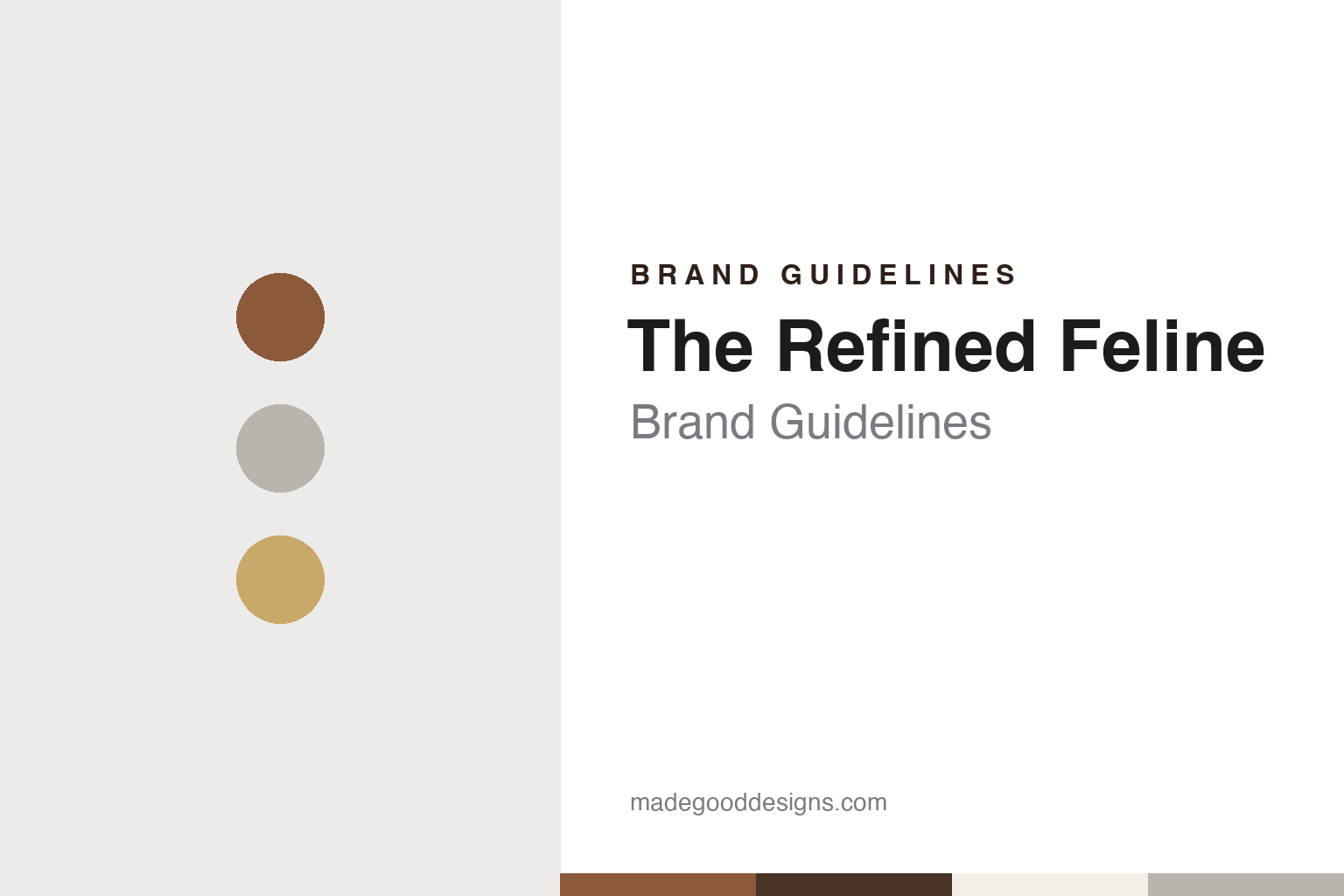
Two constants: a mahogany, espresso and smoke gray palette and a high-contrast display serif register. Abstract homage — not a The Refined Feline product or mark; no furniture, pack or logo is reproduced.
A better-looking cat tree
A New York company that started with a complaint about cat trees.
The Refined Feline is an American maker of cat furniture: cat trees and towers, wall shelves, beds, scratchers and cabinets that hide a litter tray. It was founded by Josh Feinkind, and its early press releases were issued from New York. In a release distributed through PRWeb on 27 June 2006, which the company later republished on its own website, Feinkind explained where the idea came from. He and several friends who also kept cats had come to believe that “cat tree” designs were unnecessarily awkward and unattractive. “We all wondered whoever thought of designing such an ugly product,” he said, “and decided there must be a better way.”
The company gives two dates for its start. Its website today says that in 2004 the team “got tired of unattractive carpeted cat trees and messy plastic litter trays” and decided to take matters into its own hands. A second company release, also republished on its site, says The Refined Feline, “located in New York City, was established in 2005.” The cat design blog Hauspanther marked the company’s 20th anniversary in a post on 12 June 2025.
The 2006 release summed up the ambition in a single comparison. “Imagine the ‘Fancy Feast’ of cat furnishings,” Feinkind said. “With attractive, yet sturdy and practical pieces of furniture, both you and your pet can take the stigma of unsightly litter trays and awkward posts out of your home forever.” The company described its range then as a growing line of wood-constructed towers, scratching posts and litter box cabinets, made to blend in with a home’s decor rather than stand out from it.
The brand also had a mascot from the beginning. The 2006 release called Feinkind’s cat Kerpal “our company model,” and a later release quoted Feinkind recalling how Kerpal used to walk across his keyboard while he typed.
Colour
A bent-wood tower, a litter cabinet and a perch for the desk.
The earliest product named in the company’s releases is the Lotus Cat Tower. According to the June 2006 release, The Refined Feline had introduced the Lotus the year before as a multi-level cat “entertainment and leisure center,” designed for eclectic, modern homes influenced by a minimalist movement. Feinkind said the Lotus line had drawn a strong response and that customers had sent him pictures of it in their living rooms, dining rooms and dens. Nearly two decades later, Hauspanther still described the Lotus as one of the company’s original products, with curving lines, several levels, a hideaway at the base and replaceable scratch pads and cushions, offered in white, espresso, mahogany and smoke gray.
The product the 2006 release was written to announce was: the Refined Litter Box. The company described it as a modified wood cabinet with hinged doors, a large sliding platform holding the litter tray and spare litter, a top drawer for toys and food, and reversible walls so the entrance could sit on the left or the right. It was offered in birch, cherry and mahogany stains. Feinkind called the litter box “the one universal source of inconvenience for cat owners.”
Another release, also republished on the company site, introduced the Kitt-In-Box, an all-wood perch that clamps to the edge of a desk so a cat can sit beside the keyboard rather than on it. It was offered in a range of stains to match desk finishes. In that release Feinkind, by then described as president, said the company visited cat owners’ homes to interview them about what they needed, and that the idea for the perch came from one of those visits. The same release mentioned the Catemporary Cat Box, another enclosure for a litter tray in a small home.
Typography
Design and documentation.
The brands in this group all make furniture, scratchers, toys or other accessories for cats. Cat accessory brands in general sit at many different points in the pet trade, from small workshops run by their founders to names that now belong to much larger pet companies or investment groups, and a single brand can be sold everywhere from a specialty pet shop to an online marketplace.
A cat accessory brand’s identity is usually carried less by one product than by a name, a mark, its packaging and the way its range is organised and described, because the company behind the name may have changed hands, moved its production or grown well beyond its first workshop or catalogue. That makes the questions behind each name worth asking plainly: who started it, who owns it now, and where its products are actually designed and made.
Each guide separates what independent sources record from what the company says about itself — its founding story, its owners over time, where its products are made and how its range and packaging have changed — and marks plainly what rests only on the company’s own word.
Aa
A high-contrast serif for a brand that set out to make cat furniture look like house furniture. (Specimen set in Cormorant Garamond, a serif STAND-IN; NOT The Refined Feline logo.)
The Refined Feline
From wood stains to steel, rattan and brushed gold.
The catalogue has widened since the wood cabinets of the mid-2000s, and so has the choice of materials. Hauspanther’s 2025 anniversary post walked through the current range. The Metropolitan Cat Condo is a multi-level tree on a contemporary metal frame in brushed gold, gray, white or black. The Cat Clouds shelf is a wall-mounted climbing step in powder-coated steel with magnetic cushions, made in right- and left-facing versions, and the Lotus Branch and Lotus Leaf shelves carry the Lotus tower’s four finishes onto the wall. The Kitty Ball and Igloo beds and the Calypso scratcher are made in faux rattan. The Purrrrfect End Table sets sisal scratch pads into a side table, and the litter cabinets now come in several sizes, four finishes and a choice of door designs.
The company’s own description of itself has stayed close to the 2006 release. Its website says its mission is “to bring modern, innovative designs to cat furniture,” and that it wants to change how people view the products they and their cats share. It describes its pieces as designed from sleek metals and solid woods, with raised platforms for cats that like a high view and enclosed hideaways at the bottom for those that prefer to stay low, and it says its first priority when developing a product is the needs of the cat. The site also says the team is now based in Austin, Texas.
The naming has a consistent thread. Products are named for shapes and places rather than functions: Lotus, Calypso, Metropolitan, Cat Clouds, Igloo. Hauspanther listed the same four finishes, white, espresso, mahogany and smoke gray, for the Lotus tower and the Lotus Branch and Lotus Leaf shelves.
For a design guide, The Refined Feline shows how a cat brand can borrow the vocabulary of home furniture, from wood stains and named finishes to product names that read like a furniture collection. Compare Tuft + Paw, another design-led cat furniture brand, and Catit, the Hagen Group’s cat brand. For this guide we use mahogany, espresso and smoke gray with a serif, an unofficial interpretation; no product or logo is reproduced.
Explore & save
Keep The Refined Feline’s identity on hand — save it to a board in the Made Good inspiration library.
The Refined Feline identity set
Pin The Refined Feline mahogany, espresso and smoke gray palette and the high-contrast serif register to your own board.