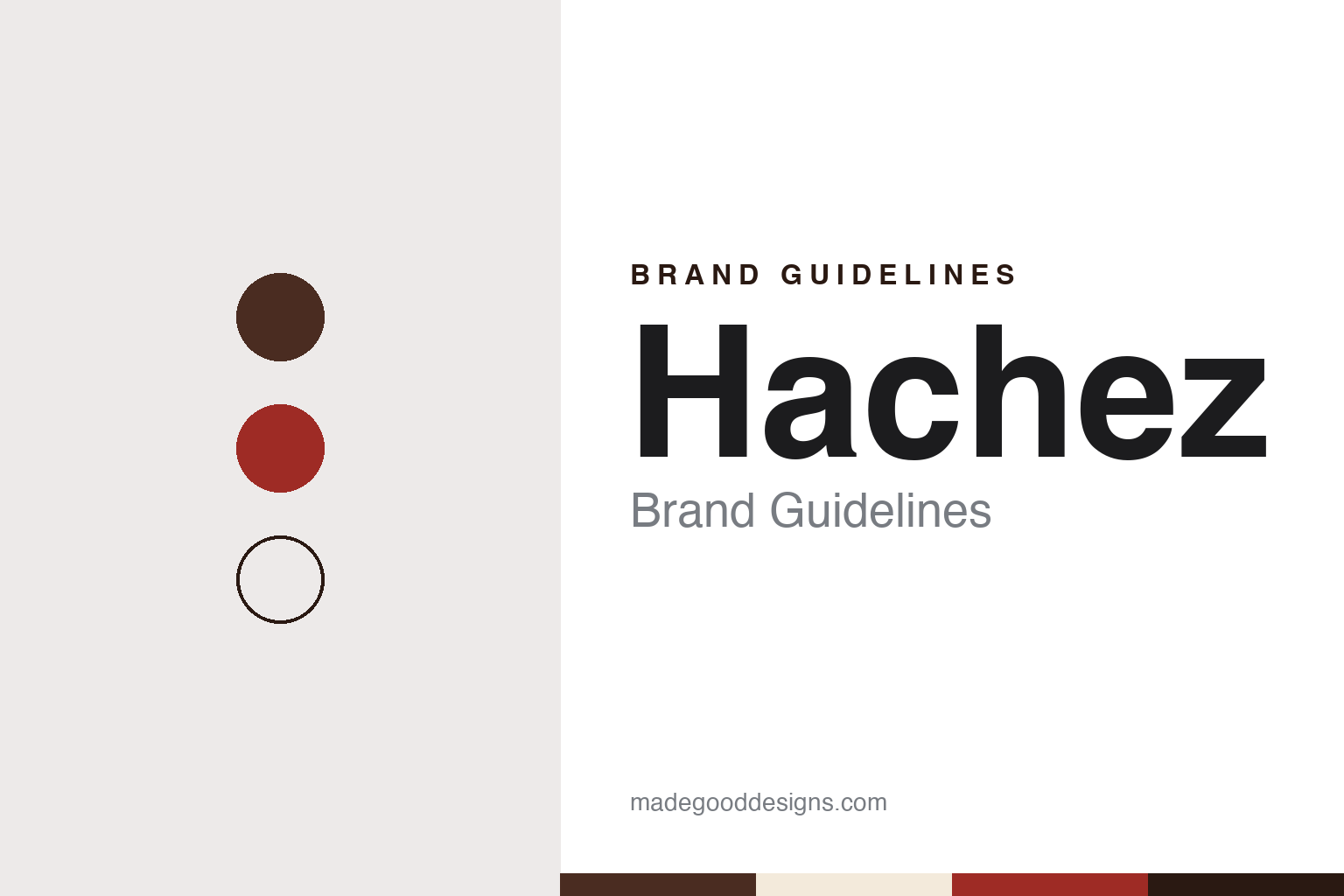
Hachez Brand Guidelines
The Bremen chocolate name that outlived its factory.
Aa
Two constants: a cocoa brown, cream and Hanseatic red palette and a Hanseatic serif register. Abstract homage — not a Hachez product or mark; no wrapper, logo or bar is reproduced.
Bremer Chocolade-Fabrik
A Bruges family name and an Antwerp training.
Hachez began in Bremen in 1890. German Wikipedia says the Antwerp-trained chocolatier Joseph Emil Hachez founded the Bremer Chocolade-Fabrik Hachez & Co that July with a partner, Gustav Linde; its sources give both 1 July and 5 July as the date. The family name came from Flanders. Hachez was the great-grandson of Joseph Johan Hachez, a native of Bruges who settled in Bremen in the eighteenth century and married a merchant’s daughter there in 1785, according to both the German and the English Wikipedia articles. The name is said the French way, “a-SHAY,” though German Wikipedia notes that “ha-SHAY” is also heard.
In the mid-1890s — German Wikipedia says 1895, English Wikipedia 1894 — the firm moved from Bremen’s old town across the Weser to the Alte Neustadt, on the river’s left bank, which would remain its home for well over a century. In 1910 Otto Friedrich Hasse joined as a partner. In 1923 Hasse developed thin chocolate leaves called Braune Blätter, “brown leaves,” which became the product Hachez was best known for, both Wikipedias say, citing the company’s own history and Die Welt. After Joseph Emil Hachez died in 1933, Hasse became the sole owner.
The Second World War left the factory almost completely destroyed. Rebuilding was paid for by selling half the company in 1953 to the Zuckerraffinerie Tangermünde Fr. Meyers Sohn, a sugar refiner that had moved to Hamburg after the war and has been called Zertus since 2002; from then on the two produced chocolate together in Bremen. The Feodora chocolate and praline brand has belonged to the business since the same year. In 1987 Hasse’s grandson Hasso Nauck sold the family’s remaining half, and the Hamburg group owned Hachez outright.
Colour
From a management buyout to Danish ownership.
Nauck came back to run it. In 1990, after heading marketing for Milka at Jacobs Suchard — whose Bremen headquarters stood a few metres from the Hachez factory — he became managing director alongside a former colleague, Wolf Kropp-Büttner. In 2000 the pair bought the company in a management buyout, Nauck taking 60 per cent and Kropp-Büttner 40, according to the taz and Handelsblatt.
In April 2012 they sold Hachez, Feodora included, to Toms, Denmark’s largest confectionery maker, Handelsblatt reported on 19 April 2012. Toms, based at Ballerup near Copenhagen, was founded in 1924 by two pharmacists and also owns Anthon Berg, German Wikipedia says. Nauck stepped down in January 2013 and Kropp-Büttner that September, the Weser-Kurier reported.
The new owner reshaped the business. Hachez lost money after the takeover, and in December 2014 job cuts in Bremen were confirmed. The same year the Hachez and Feodora packaging was relaunched, the trade magazine Markenartikel reported, and at the end of 2014 packing moved to Poland while the chocolate itself was still made in Bremen, according to the taz. In July 2015 the company marked its 125th anniversary with about 360 staff in Germany, the Kreiszeitung reported.
On 28 February 2018 the Weser-Kurier reported that production would leave Bremen for Poland at the turn of 2019 and 2020. Since 2020 Hachez chocolate has been made in Nowa Sól, in western Poland, according to German and English Wikipedia. In September 2019 the city of Bremen secured a right of first purchase on the Neustadt site, where housing is planned as the “Hachez-Quartier,” and in August 2024 the site was sold to Überseeinsel GmbH, the regional broadcaster buten un binnen reported.
Typography
Germany’s chocolate makers.
The seven brands in this group all make chocolate, and they come from three countries: Läderach, Sprüngli, Camille Bloch and Villars from Switzerland, Hachez and Rausch from Germany, and Bernachon from France. Six are Swiss and German chocolate houses; the seventh is a Lyon chocolatier that makes its chocolate from the bean in its own workshop.
Swiss and German chocolate brands tend to reach the public through the bar, the box and the shop window, and their identities are often built on a family name, a home town and a long list of dates. A bean-to-bar chocolatier works the other way round: it buys cocoa beans, roasts and grinds them itself and sells the result over its own counter, so its identity rests on the maker, the recipe and the place where the chocolate is made. Some firms combine the two, running shops while selling bars far beyond them.
Each guide separates what independent sources record from what the company says about itself — who founded it, who owns it now, where its beans come from and where its chocolate is made — and marks plainly what rests only on the company’s own word.
Aa
A Hanseatic serif — a register, not a logo. (Specimen set in Cormorant Garamond, a serif STAND-IN; NOT the Hachez logo.)
Hachez
A Bremen name, made in Poland.
The brand is now handled by Hanseatisches Chocoladen Kontor GmbH & Co. KG of Bremen, a Toms company. In September 2023 the trade paper Lebensmittel Praxis reported that from the start of 2024 the import house Wilms would distribute all of its brands in Germany, alongside a relaunch of the range, the seasonal assortment and the packaging design; German Wikipedia, citing the Kreiszeitung in April 2023, adds that the company’s own Bremen sales office was to close. A factory shop selling broken chocolate in the Neustadt, the last link with the old works, closed at the end of 2024; its operator said better equipment in Poland meant less broken chocolate, the Weser-Kurier and Kreiszeitung reported in January 2025. In the latest reports we checked, from 2023 to 2025, Hachez remained with Toms.
For a decade the brand also had a public face in Hamburg. From 2011 to 2021 the Chocoversum, a chocolate exhibition at the Meßberghof office building, was a Hachez project; since 2021 it has carried on as an independent museum, the Hamburger Abendblatt reported.
On ingredients, the company said in 2013 that its cocoa came mainly from South America, that the beans were roasted in traditional drums and conched for up to 72 hours, and that its chocolate took more than 100 hours to make; those are its claims from before production moved. No official colour values or typeface for the Hachez mark are published.
For a design guide, Hachez shows how a city’s name can stay with a brand after its factory has gone. Compare Rausch, the Berlin family maker that still makes its chocolate in Germany, and Valrhona, an old French house that belongs to a larger food group. For this guide we use cocoa brown, cream and a muted Hanseatic red with a serif, an unofficial interpretation; no product or logo is reproduced.
Explore & save
Keep Hachez’s identity on hand — save it to a board in the Made Good inspiration library.
Hachez identity set
Pin the Hachez cocoa brown, cream and Hanseatic red palette and the Hanseatic serif register to your own board.