Sprüngli Brand Guidelines
The Paradeplatz confiserie that split from Lindt in 1892.
Aa
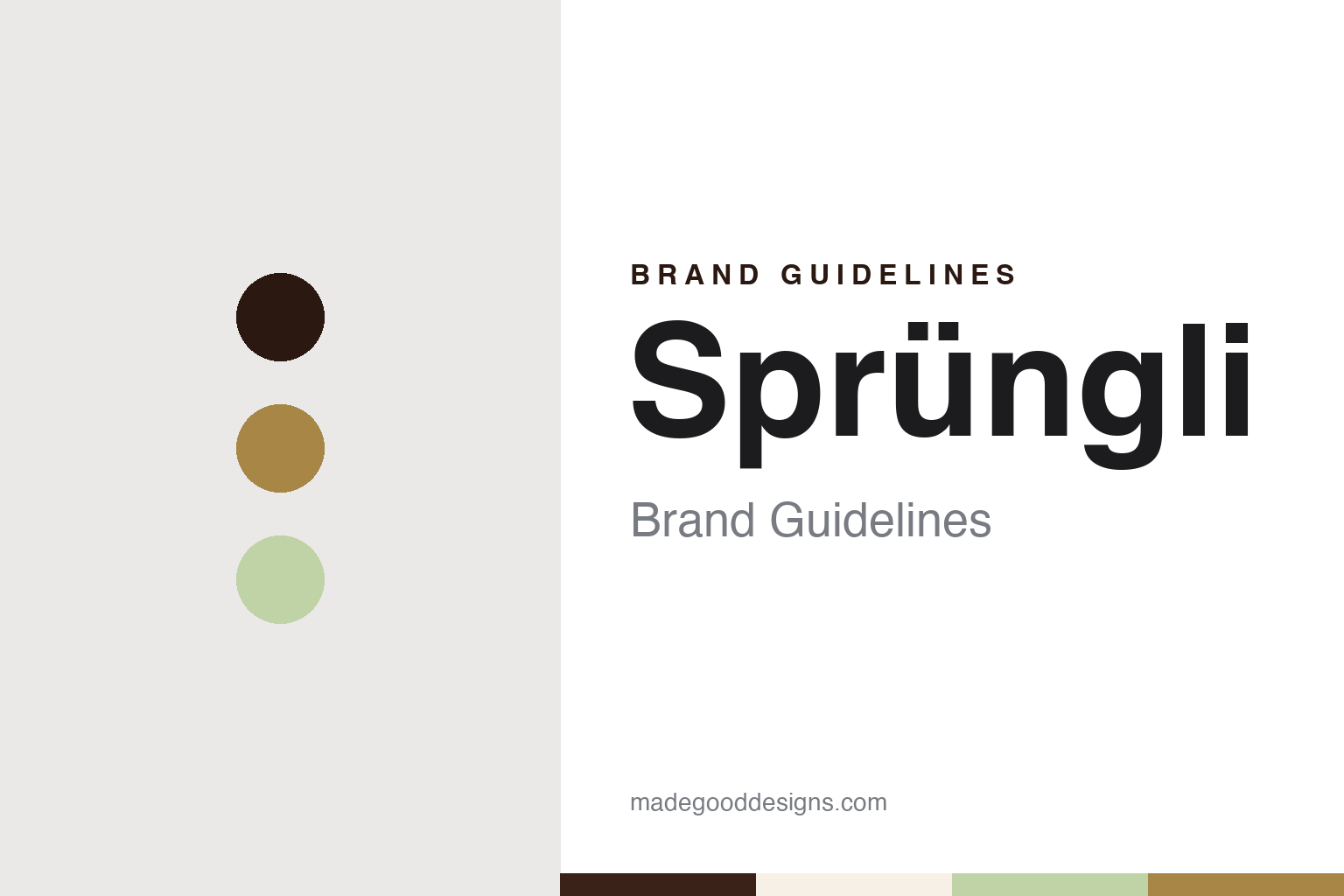
Two constants: a Sprüngli chocolate, pistachio and gold palette and a Salon serif register. Abstract homage — not a Sprüngli product or mark; no product, logo or packaging is reproduced.
Marktgasse, 1836
A confectioner’s shop in old Zürich.
Confiserie Sprüngli is the Zürich confectioner whose name is shared with, but whose business is separate from, the chocolate maker Lindt & Sprüngli. Its history begins in 1836, when David Sprüngli took over the Vogel confectionery and opened “Confiserie Sprüngli & Fils” on the Marktgasse in Zürich’s old town, the company says; German Wikipedia names his son Rudolf Sprüngli-Ammann as co-founder. In 1845, the company says, it began making chocolate, making it one of the early Swiss producers.
In 1859 father and son moved into a new building on what is now Paradeplatz, then called the Neumarkt, at the head of what became the Bahnhofstrasse. German Wikipedia notes that the area was not yet smart — a marshy ditch, the Fröschengraben, ran where Bahnhofstrasse now runs until 1867 — and that the choice proved far-sighted. The shop’s “refreshment room” became a meeting place for Zürich society: German Wikipedia lists the railway pioneer Alfred Escher, the writers Gottfried Keller and Conrad Ferdinand Meyer and the Heidi author Johanna Spyri among its guests, and says the Dada circle gathered there around 1919. The premises were remodelled in Art Nouveau style in 1909–10 and again in 1931, and the café reopened after a renovation in November 2024.
Colour
Two brothers, two companies.
The split that explains the shared name came in 1892. When Rudolf Sprüngli-Ammann retired, he divided the business between his sons: the elder, Johann Rudolf, received the chocolate factory, and the younger, David Robert, the confectionery shops, according to the company and English Wikipedia. Johann Rudolf turned his side into Chocolat Sprüngli AG in 1899 and that year bought the Bern chocolate factory of Rodolphe Lindt, forming the company now known as Lindt & Sprüngli, based at Kilchberg on Lake Zürich. Sprüngli calls the result “two independent companies,” one industrial and one artisanal, and English Wikipedia describes the confiserie as independent of Lindt & Sprüngli since 1892.
The confiserie stayed in the family. David Robert Sprüngli ran it until 1924, followed by Hermann Sprüngli and, from 1956, Richard Sprüngli (1916–2013), who positioned it as a luxury house, the Geneva daily Le Temps reported in 2010. It was a sole proprietorship until 1978, when it became a company limited by shares, German Wikipedia says. Since 1994 it has been run by Milan and Tomáš Přenosil, whom the company describes as Richard Sprüngli’s nephews; German Wikipedia names Tomáš as chief executive and Milan as chairman.
Richard Sprüngli’s era produced the house’s best-known product. The Luxemburgerli, a small macaron about 2.5 centimetres across, went on sale in 1957. German Wikipedia traces it to Camille Studer, a confectioner from Luxembourg who brought a recipe to Zürich and refined it in an in-house competition; the name came from his colleagues’ nickname for him. The company calls it its trademark and sells it as Luxemburgerli®. In 1961 production moved from Paradeplatz to Dietikon, west of Zürich, for lack of space, the Luzerner Zeitung reported in 2011; German Wikipedia says the shops, including the one in Germany, are supplied from there.
Typography
Design and documentation.
The seven brands in this group all make chocolate, and they come from three countries: Läderach, Sprüngli, Camille Bloch and Villars from Switzerland, Hachez and Rausch from Germany, and Bernachon from France. Six are Swiss and German chocolate houses; the seventh is a Lyon chocolatier that makes its chocolate from the bean in its own workshop.
Swiss and German chocolate brands tend to reach the public through the bar, the box and the shop window, and their identities are often built on a family name, a home town and a long list of dates. A bean-to-bar chocolatier works the other way round: it buys cocoa beans, roasts and grinds them itself and sells the result over its own counter, so its identity rests on the maker, the recipe and the place where the chocolate is made. Some firms combine the two, running shops while selling bars far beyond them.
Each guide separates what independent sources record from what the company says about itself — who founded it, who owns it now, where its beans come from and where its chocolate is made — and marks plainly what rests only on the company’s own word.
Aa
A salon serif — a Paradeplatz address since 1859. (Specimen set in Cormorant Garamond, a serif STAND-IN; NOT the Sprüngli logo.)
Sprüngli
Grand Cru on Paradeplatz.
Chocolate remains at the centre of the range. Sprüngli calls itself a pioneer of Grand Cru chocolate in Switzerland, and German Wikipedia dates a selection of truffles made from wild cocoa beans, sold as “Grand Cru,” to 2005. The company says its single-origin cocoa comes from Ghana, Venezuela, Cuba, Bolivia, Mexico and the Dominican Republic, and describes the path from fermented bean through roasting, refining and conching to what it calls Sprüngli’s “characteristic, melt-in-the-mouth couverture”; we give these as its claims. In 2020 it launched Grand Cru Absolu, made, it says, from just two ingredients — Bolivian cocoa beans and the juice of the cocoa fruit — and described by the company as a world first; vegan Grand Cru Bâtons followed in September 2022.
The business has stayed close to Zürich. Most of its shops and cafés are in the city and its suburbs, with others in Swiss cities including Basel, Bern, Lucerne and Zug; abroad it opened in the United Arab Emirates from 2014, at Munich Airport in April 2022 and at Vienna Airport in December 2022, according to Wikipedia. In 2010 it had about 1,000 staff and annual sales of more than CHF 100 million, English Wikipedia says. Since March 2021 it has supplied the buy-on-board range of Swiss International Air Lines, the travel trade site Travelnews reported. The company marks its 190th anniversary in 2026.
Its identity rests on an address and a product more than on any published system: we found no brand guidelines, typeface or colour specification. On packaging, the company says its plastic carrier bags are made from recycled material and can be reused up to 50 times, and its paper bags from FSC-certified paper.
For a design guide, Sprüngli shows how a 19th-century shop can remain a brand’s main asset, and how two companies can share a name for more than a century without sharing an owner. Compare Läderach, another Swiss chocolatier built on its own shops, and Pierre Marcolini, the Brussels haute chocolatier. For this guide we use a deep chocolate, a pistachio and a gold with a serif, an unofficial interpretation; no product or logo is reproduced.
Explore & save
Keep Sprüngli’s identity on hand — save it to a board in the Made Good inspiration library.
Sprüngli identity set
Pin the Sprüngli chocolate, pistachio and gold palette and the Salon serif register to your own board.