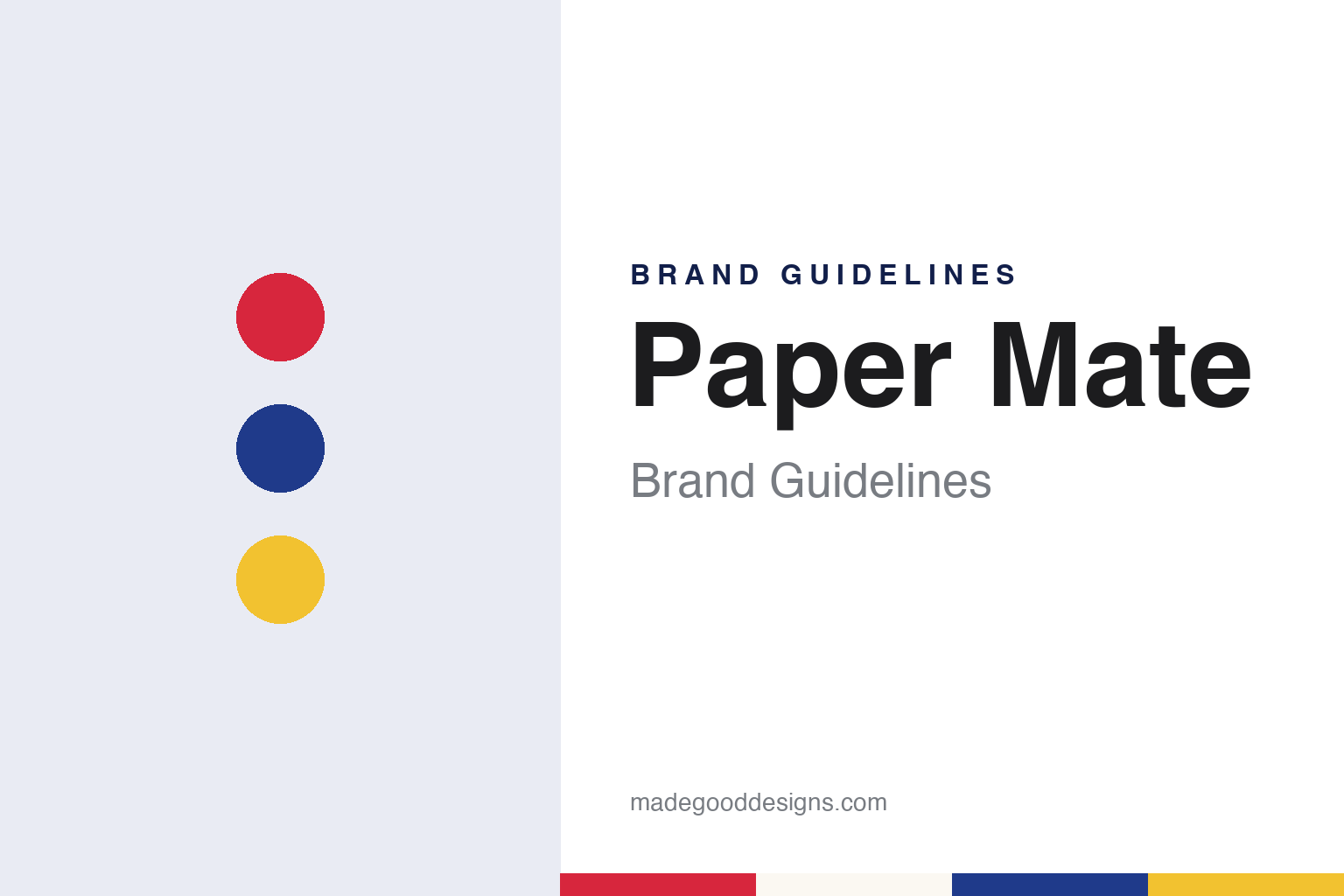
Paper Mate Brand Guidelines
A ballpoint sold on an ink that would not smudge.
Aa
Two constants: a Flair red, ink blue and pencil yellow palette and a handwritten display register. Abstract homage — not a Paper Mate product or mark; no pen, pencil, pack or logo is reproduced.
Frawley’s ink
A pen business built on a dry line.
Paper Mate begins with Patrick J. Frawley. On the history page of its website, the brand says that in the early 1940s Frawley acquired a ballpoint pen parts manufacturer, at a time when the ballpoint industry was struggling with poorly performing products, and set out to find a better ink. In 1949, the company says, a new pen called the Paper Mate arrived with an instant-drying ink that did not leak.
TIME told the story a little differently in September 1955. Its profile, “The Mighty Pen”, said Frawley went into the ballpoint business in 1949, first selling pens made by a Los Angeles aircraft-parts manufacturer, then buying that maker out and renting a factory to make the pens himself. To deal with ink that faded or transferred, the magazine said, he used a new ink that a Hungarian chemist had mixed in a makeshift home laboratory. The two accounts differ on when Frawley’s pen business began.
The same TIME article described how the pens were sold. Frawley, it said, talked two banks into cashing cheques written with his pens and then advertised the pens as carrying “bankers’ approval”. The magazine credited bright, eye-catching counter displays and full-page newspaper advertisements, and it described a push into New York in which salesmen wrote on retailers’ shirts and promised a new shirt if the ink did not wash out. His salesmen also gave pens to school principals and then advertised their approval.
That article was reporting a sale. TIME said that in the previous week Frawley had sold his company to the Gillette Company, which was diversifying beyond razor blades into home permanent kits, shampoo and lipstick, and that Frawley had been hired to run Gillette’s new ballpoint-pen division. In print the magazine spelled the name both as “Paper-Mate” and as “PaperMate”; the brand’s own website now writes it as two words, Paper Mate.
Colour
A timeline told in pens and pencils.
The brand tells most of its later history through products. Its website says that in 1953 Paper Mate advertising featured the television personality George Burns, the comedian Gracie Allen and the actress Zsa Zsa Gabor. The next landmark in its timeline is the Flair felt-tip pen of 1966, which the company describes as using a quick-drying, water-based ink and as having kept its design since launch.
The 1970s added range and a new idea. The company dates the Write Bros. line to 1971, describing it as a reliable everyday pen, and the Eraser Mate erasable ballpoint to 1979, which it says followed more than a decade of research and was meant to write like a pen but erase like a pencil. In 1980, the company says, Liquid Paper correction products joined the family. English Wikipedia, citing a company history in the International Directory of Company Histories, says Gillette acquired Liquid Paper and the pen maker Waterman that year and renamed its Paper Mate division the Stationery Products Group.
Pencils became a larger part of the story from the 1980s. The company dates its “classic yellow” SharpWriter mechanical pencil, which dispenses lead with a twist, to 1984, and the Flexgrip pen, with a soft rubberised barrel, to 1987. It says it developed the Lubriglide refill in 1994 and still uses that ink in several pen lines, and it dates the clear-barrelled Clearpoint mechanical pencil to 2000.
The most recent entries are about ink and colour. The company lists the Profile pen with a 1.4mm point in 2005, the InkJoy line in 2011, which it describes as using a low-viscosity ink, InkJoy Gel in 2016 and Clearpoint Color Lead mechanical pencils, with erasable coloured leads, in 2017. Across the timeline, the product names tend to say what each pen or pencil does: erase, grip, glide or show its lead through a clear barrel.
Typography
Design and documentation.
The brands in this group are everyday office and writing names: the pens, pencils, markers, paper goods and desk tools that sit in drawers, pencil cases and stationery aisles. Office and writing brands in general sit at many different points in the trade, from family firms that still carry a founder’s name to labels that now belong to much larger stationery or consumer-goods groups, and a single brand can be sold everywhere from a corner shop to an art supply store or a corporate supply catalogue.
An office or writing brand’s identity is usually carried less by a single product than by a name, a familiar barrel, cap or colour and a logo printed small on the side, because the company behind the name may have changed hands, moved its production or grown far beyond the place where it started. That makes the questions behind each name worth asking plainly: who started it, who owns it now, and where its products are actually made.
Each guide separates what independent sources record from what the company says about itself — its founding story, its owners over time, where its products are made and how its marks have changed — and marks plainly what rests only on the company’s own word.
Aa
A loose, handwritten display face. (Specimen set in Kalam, a handwriting STAND-IN; NOT the Paper Mate logo.)
Paper Mate
From Gillette to Newell.
Paper Mate spent most of the second half of the twentieth century inside Gillette. The company’s own timeline says the brand was acquired by Newell in 2000. English Wikipedia gives more detail, saying that in late 2000 Gillette’s stationery products business was bought by Newell Rubbermaid and merged with its Sanford division, and it describes Paper Mate today as part of Sanford, a Newell Brands company.
The brand presents itself as a writing company for everyday use. On its history page it talks about helping people where they live, learn, work and play, and its website groups products into pens, pencils, and erasers and correction products, with ballpoint, gel and felt-tip pens and mechanical pencils among the categories.
The name itself has shifted on the page over time. TIME’s 1955 article printed it with a hyphen and as one word, while the brand’s current website uses two words, Paper Mate, and the web address joins them. Several product names follow the same pattern of pairing an everyday word with the brand: Eraser Mate, Write Bros. and SharpWriter all describe what the pen or pencil is for.
For a design guide, Paper Mate shows how a writing brand can be built on a single promise about ink and then carried across decades of pens and pencils with plain, descriptive product names. Compare a Newell sibling in our Sharpie brand guidelines and a French ballpoint brand in our BIC brand guidelines. For this guide we use Flair red, ink blue and pencil yellow with a handwritten display face, an unofficial interpretation; no product or logo is reproduced.
Explore & save
Keep Paper Mate’s identity on hand — save it to a board in the Made Good inspiration library.
Paper Mate identity set
Pin the Paper Mate Flair red, ink blue and pencil yellow palette and the handwritten display register to your own board.