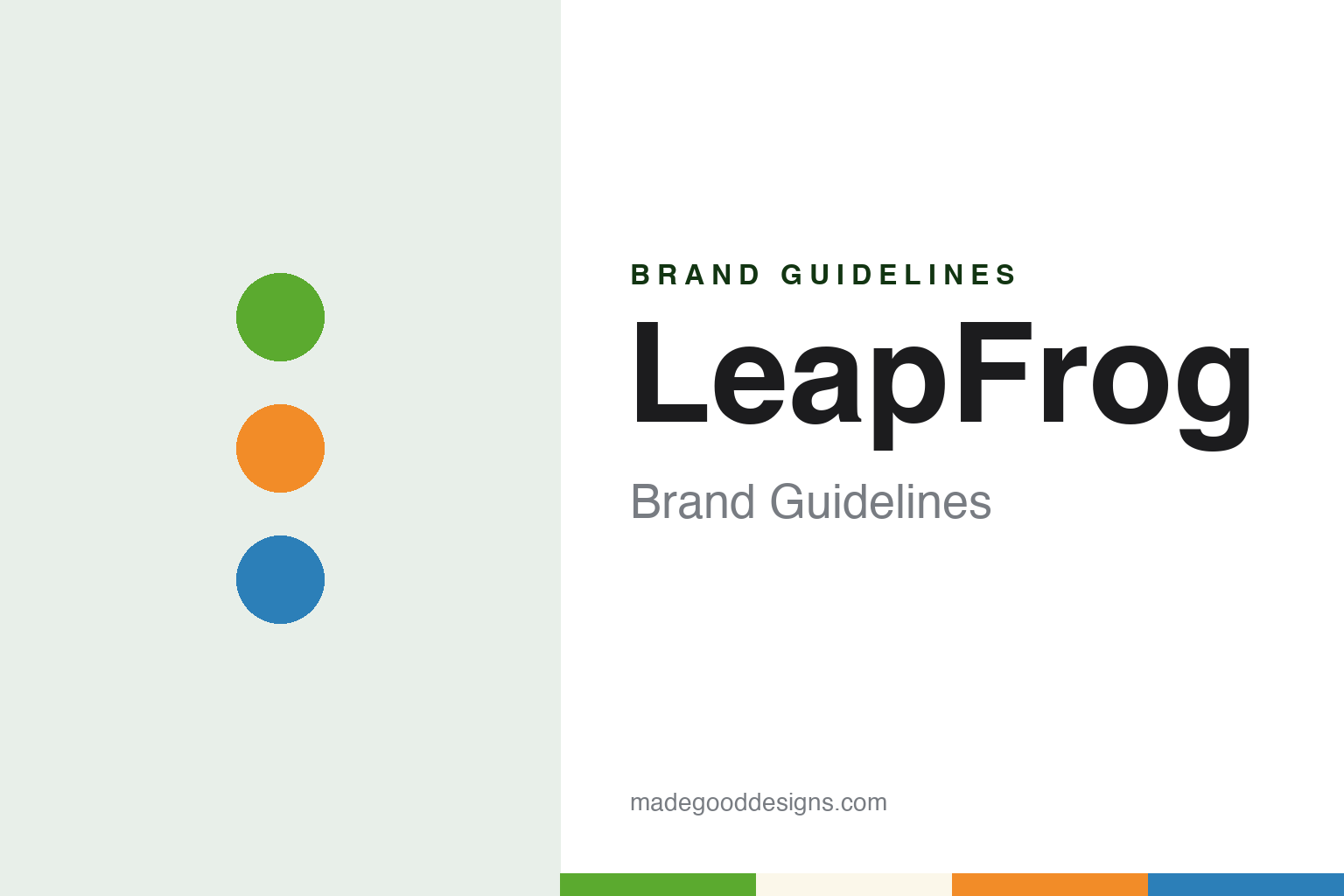
LeapFrog Brand Guidelines
A lawyer’s prototype that became a product family.
Aa
Two constants: a frog green, lily orange and pond blue palette and a rounded display sans register. Abstract homage — not a LeapFrog product or mark; no device, book or logo is reproduced.
A talking desk
The company grew out of a single prototype.
LeapFrog began with one parent’s project. English Wikipedia says its founder, Michael Wood, was an attorney and partner at the law firm Cooley when, in the late 1980s, he struggled to help his son learn to read, and began researching phonics. LeapFrog’s own About page tells the same story in brief, saying the company was “founded in 1995 by a father” who wanted to help his child read.
Wikipedia says that by 1994 Wood had built the first prototype of the Phonics Desk, the product that became LeapFrog’s first, using a Texas Instruments chip that one of his clients had used for talking greeting cards, and that he sought feedback on it from Robert Calfee, a professor at the Stanford Graduate School of Education.
The company followed in 1995. Wikipedia says Wood began manufacturing the Phonics Desk that year, resigned his partnership at Cooley and founded LeapFrog Enterprises with Robert Lally, raising seed money from friends, family and former clients. It says Toys “R” Us became the first major retailer to stock the Phonics Desk shortly before Christmas 1995, followed by FAO Schwarz, Walmart and Target. The company is based in Emeryville, California. Wikipedia describes it as a company that designs, develops and markets technology-based products and related content for children from infancy through grade school.
Colour
A name that became a prefix.
Outside investors arrived early. Wikipedia says that in October 1997 Knowledge Universe, the education company founded by Lowell and Michael Milken, Larry Ellison and Tom Kalinske, took a majority stake, merged its Knowledge Kids division into LeapFrog and made Kalinske, a former Mattel executive, chief executive. Earlier that year, in March 1997, Wikipedia says LeapFrog had hired Brad Crawford, formerly of Little Tikes, to oversee sales and manufacturing.
A purchase shaped the flagship. Wikipedia says LeapFrog bought Explore Technologies, maker of the talking Odyssey Globe, in August 1998, and that its stylus technology went into the LeapPad, a book-based device that sounds out words when a child drags a stylus across a page, launched in 1999. The same year, it says, the company opened its LeapFrog SchoolHouse division to sell directly to schools.
The family then multiplied. Wikipedia dates the handheld Leapster to October 2003; the Tag Reading System, which replaced LeapPad, to June 2008; the Leapster2 and the Didj handheld to August 2008; and the Leapster Explorer to 2010. It says the LeapPad Explorer tablet arrived in August 2011 with a five-inch touchscreen, a camera, a microphone, downloadable apps and cartridge games, and that it could play the existing Leapster Explorer library; the LeapPad2 and LeapsterGS in 2012, the LeapPad Ultra and the LeapReader pen in 2013, and the LeapBand wristband, the LeapPad3 and the LeapTV console in 2014. Wikipedia describes LeapTV as a television console with a camera that tracks both the controller and the player’s body, and the LeapBand as a wristband that issues movement challenges such as “wiggle like a worm”. The Android-based LeapFrog Epic tablet followed in September 2015. Wikipedia says the Epic, announced in August 2015, had a seven-inch multi-touch screen and front and back cameras, and ran the Android KitKat operating system.
Typography
Design and documentation.
The brands in this group all make toys for babies, toddlers and young children, and several also make toys with electronics inside: talking, lighting and learning toys alongside rattles, stacking sets and play vehicles. Early-years and electronic toy brands sit at many different points in the trade, from family firms that still carry a founder’s name to labels that now belong to much larger toy groups, and a single name can be sold in very different ways from one country to the next.
An early-years toy brand’s identity is usually carried less by a single product than by a name, a logo and a familiar set of colours on the box, because the company behind the name may have changed hands, merged with a rival or moved its production far from where it started. That makes the questions behind each name worth asking plainly: who started it, who owns it now, and where its toys are actually designed and made.
Each guide separates what independent sources record from what the company says about itself — its founding story, its owners over time, where its toys are made and how its marks have changed — and marks plainly what rests only on the company’s own word.
Aa
A rounded, friendly display sans. (Specimen set in Baloo 2, a rounded-sans STAND-IN; NOT the LeapFrog logo.)
LeapFrog
From the New York Stock Exchange to a Hong Kong parent.
LeapFrog was a listed company until 2016. Wikipedia says it went public on the New York Stock Exchange in July 2002 under the ticker LF, with Knowledge Universe keeping majority control, and that Sega Toys and Benesse began producing LeapFrog toys localised for Japan that year. Leadership changed often: Wikipedia says Wood became chief executive in early 2002, Kalinske returned to the role in February 2004 with Wood staying on as chief creative officer, Jeffrey Katz took over in 2006, William Chiasson in March 2010 and John Barbour in March 2011.
The ownership change came in 2016. A press release issued from Hong Kong and Emeryville on 4 April 2016 said VTech Holdings had completed its acquisition of LeapFrog through a tender offer and merger, making it an indirect wholly owned subsidiary. VTech has owned LeapFrog since 2016, and LeapFrog’s About page now describes the company as “a member of VTech Group”, still based in Emeryville.
The product naming has carried on under the new parent. Wikipedia says the LeapStart family was announced in 2016, with the LeapStart 3D following in 2018 and the LeapStart Go in 2019, and that an Academy Edition of the Epic tablet arrived in 2017, followed by the LeapPad Academy in 2019. Wikipedia says the LeapStart devices also use a stylus on specially patterned books, but that they are not compatible with the earlier Tag and LeapReader books, and that the LeapPad Academy received a hardware revision in 2021. LeapFrog’s own site lists learning tablets, LeapStart, LeapReader and baby monitors among its current ranges.
For a design guide, LeapFrog shows how a short, physical brand name can become a system: “Leap” prefixes a pad, a reader, a band and a TV console, so each new device announces its family before its function. Compare its Hong Kong parent in our VTech brand guidelines and an American preschool name in our Fisher-Price brand guidelines. For this guide we use frog green, lily orange and pond blue with a rounded display sans, an unofficial interpretation; no product or logo is reproduced.
Explore & save
Keep LeapFrog’s identity on hand — save it to a board in the Made Good inspiration library.
LeapFrog identity set
Pin the LeapFrog frog green, lily orange and pond blue palette and the rounded display sans register to your own board.