Boffi Brand Guidelines
A night-time workshop, a Brianza factory and an art director’s kitchen.
Aa
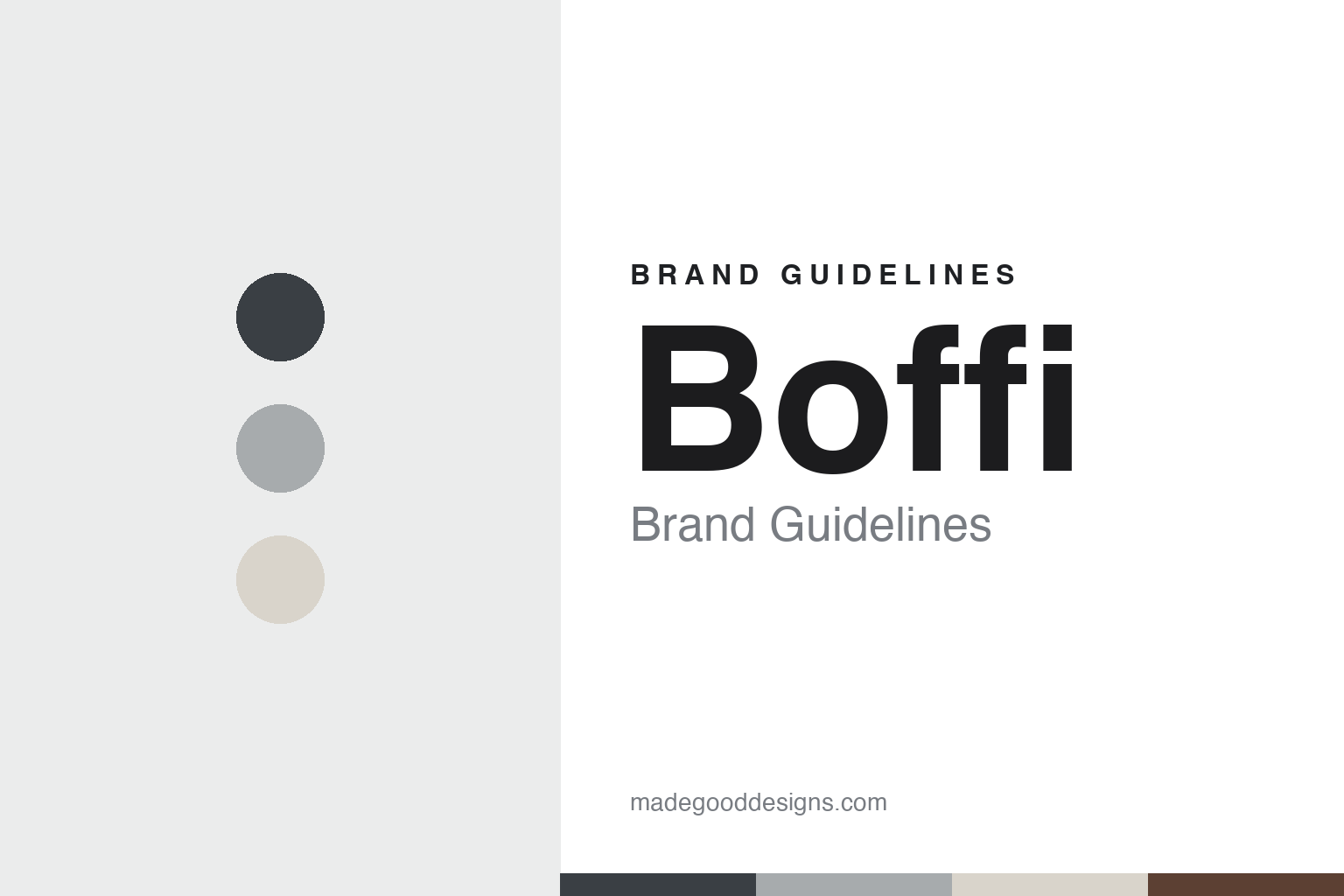
Two constants: a graphite, brushed steel and stone palette and an architectural geometric sans register. Abstract homage — not a Boffi product or mark; no kitchen, bathroom or logo is reproduced.
From Brianza
A workshop beside a house, three sons and a move down the road to Lentate.
Boffi’s own history begins in 1934 in the province of Monza Brianza, north of Milan. The company’s About page says that Piero Boffi worked by day as a craftsman at the aircraft maker Caproni and in the evenings went to a small workshop next to his home to try out furniture ideas. Italian Wikipedia gives the same founder and year and places that first workshop in Cesano Maderno, describing it as a small laboratory for kitchen furniture.
The company dates its first factory, in Cesano Maderno, to 1947. Piero Boffi’s three sons, Dino, Pier Ugo and Paolo, joined him, each, the company says, in a different role. Italian Wikipedia credits Dino Boffi with seeking out collaborations with outside designers, naming Sergio Asti, Luigi Massoni, Sergio Favre and Antonio Citterio among them. The business later moved a short distance to Lentate sul Seveso; Italian Wikipedia places the move in the 1950s, while the company’s timeline says Lentate became its home with the opening of its first warehouse at Via Oberdan 70 in 1966. The headquarters is still at that address.
Two names from this period recur in the company’s account of itself. In 1963 the Boffi brothers worked with the designer Joe Colombo on the Minikitchen, a compact cube on wheels that holds cooking, storage and washing-up functions in one block; Italian Wikipedia notes that an example is in the collection of the Museum of Modern Art in New York. In 1967, the company says, Pier Ugo Boffi and Gian Casé designed the T12 kitchen, and Luigi Massoni joined as creative director, leading to the handleless Xila system and the E15 kitchen. In 1980 Antonio Citterio and Paolo Nava designed a model called Factory, which the company describes as a high-tech kitchen open to the living space.
Colour
A new chief executive, an art director and a group built around the kitchen.
The late 1980s changed who ran Boffi. Italian Wikipedia, citing a 2005 Unioncamere report on the company, says that in 1989 Paolo Boffi bought out his brothers’ shares and brought in a partner with a management background, Roberto Gavazzi, to run the business, and that Gavazzi later became the majority shareholder. The company’s own pages date Gavazzi’s arrival as managing director to 1988 on its About page and to 1989 in its timeline, and a company news item from May 2026 calls him Boffi’s president, chief executive and owner.
The same news item says Paolo Boffi gave creative direction to the architect Piero Lissoni in 1986; the company timeline lists Lissoni’s art direction from 1990. Under Lissoni, the timeline says, Boffi introduced the Esprit system, then Latina and Food Center in 1992, the WK6 system in 1997 and Lissoni’s Case 5.0 in 2002. Bathrooms became a second line of business: the company opened its own Bagno-Boffi Solferino shop on Via Solferino in Milan in 1998, followed by showrooms in Paris and, from 2000, in the United States, starting in SoHo. In 2003 it took over the German kitchen brand Norbert Wangen.
The larger step came in 2015, when Boffi acquired De Padova, a Milan furniture company founded in 1956; the news agency askanews reported in April 2015 that Boffi had bought all of it. De Padova took a majority stake in the Copenhagen shelving company MA/U Studio in 2017, according to Pambianco Design, and Boffi added the door-systems maker ADL in 2019. In a notice on its website, the company announced that Boffi, De Padova and ADL would merge into one company operating as Boffi|DePadova, with each brand keeping its own collections. The company’s website now names Boffi | DePadova S.p.A., headquartered in Lentate sul Seveso.
Typography
Design and documentation.
Kitchen cabinet and kitchen-system brands sit at many different points in the trade, from workshops that build a single kitchen to order to factories that make modular systems sold through showrooms in many countries, and from firms that make the whole room to companies that make only the doors and fronts that fit another maker’s cabinet frames.
A kitchen brand’s identity is usually carried less by one product than by a way of planning a room: a grid, a handle, a finish, a run of named colours, a showroom and the designers whose names are attached to it. Because the company behind a name may have changed hands, moved its workshop or begun buying in parts, the plain questions are worth asking: who started it, who owns it now, and where its cabinets are actually built.
Each guide separates what independent sources record from what the company says about itself — its founding story, its owners over time, where its kitchens are made and how its look has changed — and marks plainly what rests only on the company’s own word.
Bo
A clean, geometric sans in the spirit of an architect’s drawing set. (Specimen set in Jost, a sans STAND-IN; NOT the Boffi logo.)
Boffi
A furniture-district factory and an image shaped by designers.
Boffi presents where it makes things as part of the brand. Its factory page describes the headquarters and production site in the furniture district of Brianza, where it says hand finishing sits alongside modern machinery, and it names glossy polyester lacquer as one of the older techniques it still uses. The same page says the company works with a network of specialist outside suppliers for steel, stone, marble, appliances, plumbing and sanitaryware. Boffi describes its collections as highly customisable, with special finishes and sizes.
The brand’s look has long been the work of named designers and art directors rather than an anonymous house style. The company’s timeline says the graphic designer Giulio Confalonieri shaped Boffi’s image in its early advertising campaigns from 1958. It credits Luigi Massoni, Antonio Citterio and Piero Lissoni in turn with its artistic direction, and it describes Lissoni’s work as covering both the products and the way they are communicated. In its May 2026 article marking four decades of that partnership, the company says Lissoni and Gavazzi brought the scale and technology of professional kitchens into the home, with large islands and a formal rigour, a line it traces to its current XPL kitchen model.
Showrooms carry much of the identity. The company describes its Solferino shop in Milan’s Brera district as an icon of that neighbourhood, and its timeline says the London showroom in Chelsea became Boffi|DePadova Chelsea in 2021, a single space showing all of the group’s collections. Kitchens, bathrooms, wardrobe and shelving systems and furniture now sit together on one website under the Boffi|DePadova name.
For a design guide, Boffi shows how a kitchen maker can build its image through the designers and architects it hires and the showrooms it opens, from Minikitchen to the island kitchen. Compare bulthaup, the Bavarian kitchen maker, and Smeg, another Italian name in the kitchen. For this guide we use graphite lacquer, brushed steel, Brianza stone and walnut with a sans, an unofficial interpretation; no product or logo is reproduced.
Explore & save
Keep Boffi’s identity on hand — save it to a board in the Made Good inspiration library.
Boffi identity set
Pin the Boffi graphite, steel and stone palette and the architectural sans register to your own board.