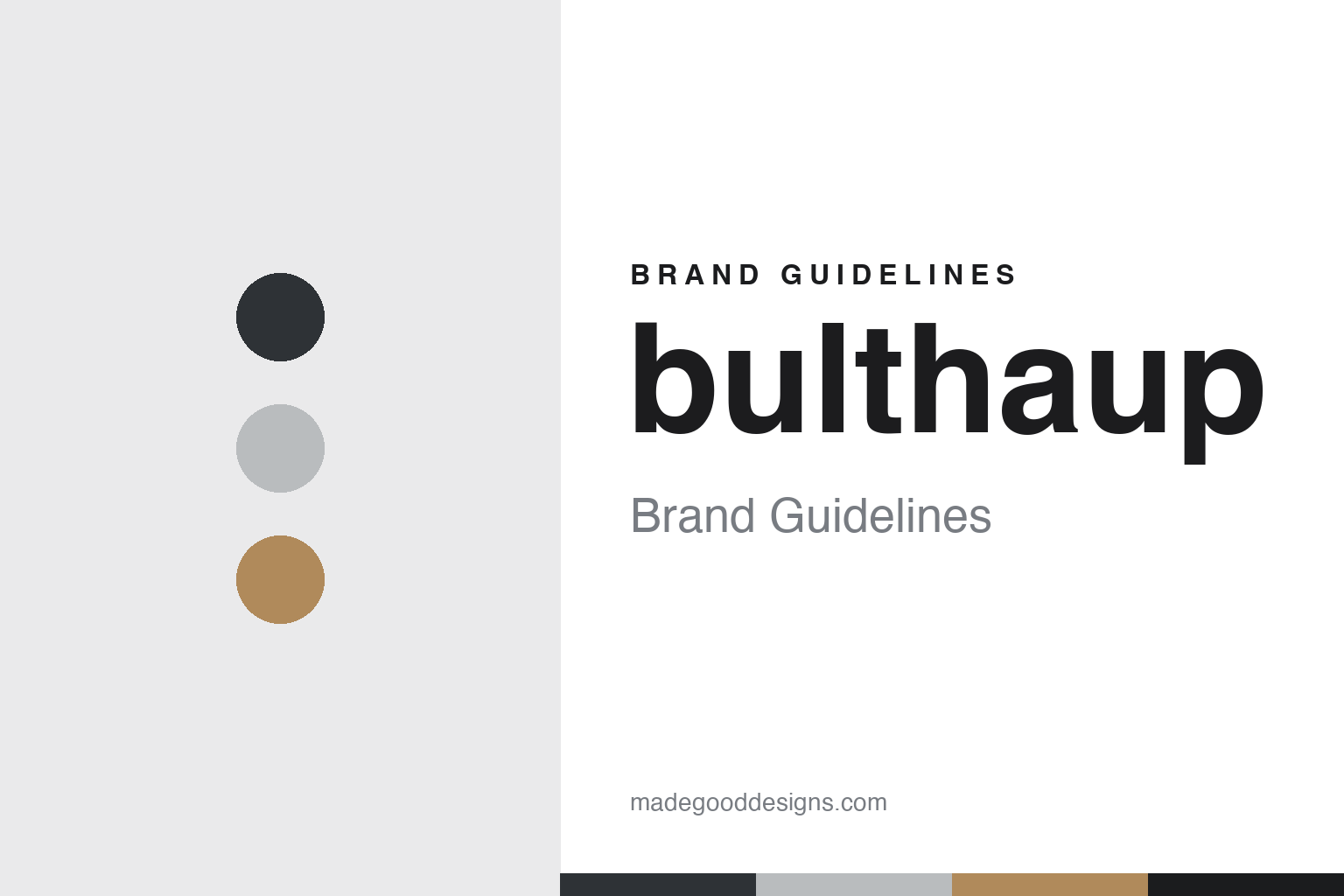
bulthaup Brand Guidelines
A Bavarian sawmill, a designer’s book and a kitchen built like a workbench.
Aa
Two constants: a graphite, stainless and oak palette and a lower-case functional sans register. Abstract homage — not a bulthaup product or mark; no kitchen or logo is reproduced.
From Bodenkirchen
A post-war furniture factory, a sawmill and a kitchen sideboard.
bulthaup began as the Martin Bulthaup Möbelfabrik, a furniture factory founded in 1949 by Martin Bulthaup. English Wikipedia, citing WirtschaftsWoche in 2022, says Bulthaup came from East Westphalia and set the business up in Bodenkirchen, near Landshut in Lower Bavaria. The company’s history page says that in 1951 he bought a sawmill in Bodenkirchen, which began operating on 1 May that year with a team of seven, and that its first products were kitchen sideboards. Wikipedia, citing the German Design Council’s magazine ndion in 2019, describes the first product as a kitchen buffet with hand-sewn curtains.
The factory grew through the 1950s and 1960s. Wikipedia says a plant was built in Bodenkirchen in 1953 and enlarged in 1963, when assembly-line production was introduced. In 1969 the company launched a range called Stil 75; its history page quotes a brochure of the time explaining the name as a prediction that such kitchens would be commonplace by 1975. The company says the foundation stone of a new works at Aich, a district of Bodenkirchen, was laid in 1971 and that production there began in March 1972. Aich remains the company’s headquarters. Wikipedia, citing the Süddeutsche Zeitung of January 1972, says exports to the countries of the European Economic Community followed in 1973.
In 1974 bulthaup introduced Concept 12, a kitchen range that Wikipedia says was planned on a 12-centimetre grid. The founder’s son, Gerd Bulthaup, and his twin sister, Ingeborg Eckert, joined the management board in 1976, according to the company, and from 1979 Gerd Bulthaup led the business as its second generation.
Colour
Otl Aicher, a book about cooking and a kitchen that left the wall.
In 1980, the company says, Gerd Bulthaup persuaded the designer Otl Aicher, whom it introduces as the design commissioner of the Munich Summer Olympics, to work with him. The company says the two men made more than fifty trips together to study how people cooked and ate before drawing up new kitchens. Aicher set out the ideas in a book, “Die Küche zum Kochen” (“The Kitchen for Cooking”), published in 1982. English Wikipedia summarises its argument as a kitchen in which people prepare meals together, with tools kept within reach and in view.
The first range drawn from that work was system b, which the company dates to 1984; English Wikipedia places it in 1982. It was followed in 1988 by the kitchen workbench, a freestanding stainless-steel unit combining cooking area, sink and work surface, which Wikipedia says borrowed from professional kitchens. The modular system 25 arrived in 1992, named after the 25-millimetre grid it was built on, and the mobile system 20, with units on wheels that could stand anywhere with water and power, in 1997.
Gerd Bulthaup stepped back from day-to-day management in 2003, and Wikipedia says outside managers ran the business for the next few years. The b3 range, developed with the designer Herbert H. Schultes, came in 2004, built around a wall that carries units, appliances and lights; b1 and b2, the latter a workshop-style kitchen of workbench and cabinets, followed in 2008. The founder’s grandson, Marc O. Eckert, took sole management in 2010, and the company calls itself an independent family business. Wikipedia, citing WirtschaftsWoche in April 2022, says Eckert holds most of the shares. The freestanding b Solitaire line followed in 2017, the room concept b.architecture in 2018, and in 2024 a new kitchen system shown at the Milan furniture fair.
Typography
Design and documentation.
Kitchen cabinet and kitchen-system brands sit at many different points in the trade, from workshops that build a single kitchen to order to factories that make modular systems sold through showrooms in many countries, and from firms that make the whole room to companies that make only the doors and fronts that fit another maker’s cabinet frames.
A kitchen brand’s identity is usually carried less by one product than by a way of planning a room: a grid, a handle, a finish, a run of named colours, a showroom and the designers whose names are attached to it. Because the company behind a name may have changed hands, moved its workshop or begun buying in parts, the plain questions are worth asking: who started it, who owns it now, and where its cabinets are actually built.
Each guide separates what independent sources record from what the company says about itself — its founding story, its owners over time, where its kitchens are made and how its look has changed — and marks plainly what rests only on the company’s own word.
bu
A plain, upright sans in the spirit of a technical manual, set in lower case. (Specimen set in Archivo, a sans STAND-IN; NOT the bulthaup logo.)
bulthaup
A lower-case name, a Bavarian works and a workshop idea of the kitchen.
The brand writes its name in lower case. English Wikipedia gives the registered company as Bulthaup GmbH & Co. KG and notes that it is stylised as bulthaup, and the company keeps that lower-case form throughout its own pages, in product names such as bulthaup b3 and even at the start of sentences. Its brand page describes kitchens and living spaces as places where people come together and make things with their own hands, and it sets out its products as systems rather than as single pieces of furniture.
That idea of the kitchen as a working tool runs back to Aicher. The company’s history page quotes the Bauhaus principle “form follows function” as central to how its products are designed, and it describes the kitchen workbench as a unit built on the duality of fire and water. Materials are part of the look: the company’s description of b Solitaire stresses an open, matt-black aluminium frame in three sizes, a solid wooden table and bench, and naturally tanned leather on the seats.
Production stays in Lower Bavaria. The company’s headquarters and main works are at Aich in Bodenkirchen, and English Wikipedia, citing Küchen&Design Magazin in May 2024, says that in the summer of 2023 bulthaup opened its own steel and aluminium workshop in Bodenkirchen. The same magazine article, as summarised by Wikipedia, says the 2024 system moved away from the earlier seamless, neutral construction towards solid wood and stainless steel, with accessories hung on a metal rail along the furniture, and that the kitchen workbench of the 1980s was reissued. Wikipedia, citing BauNetz in 2024, says the brand is sold through its own stores and through partner stores around the world.
For a design guide, bulthaup shows how a single designer’s study of how people cook, written down as a book, can become the logic of a whole product range and of a lower-case name. Compare Boffi, the Italian kitchen maker, and Gaggenau, the German appliance brand. For this guide we use Aich graphite, stainless, oak and matt-black aluminium with a sans, an unofficial interpretation; no product or logo is reproduced.
Explore & save
Keep bulthaup’s identity on hand — save it to a board in the Made Good inspiration library.
bulthaup identity set
Pin the bulthaup graphite, stainless and oak palette and the lower-case functional sans register to your own board.