Playskool Brand Guidelines
A classroom aid, a toy-box name.
Aa
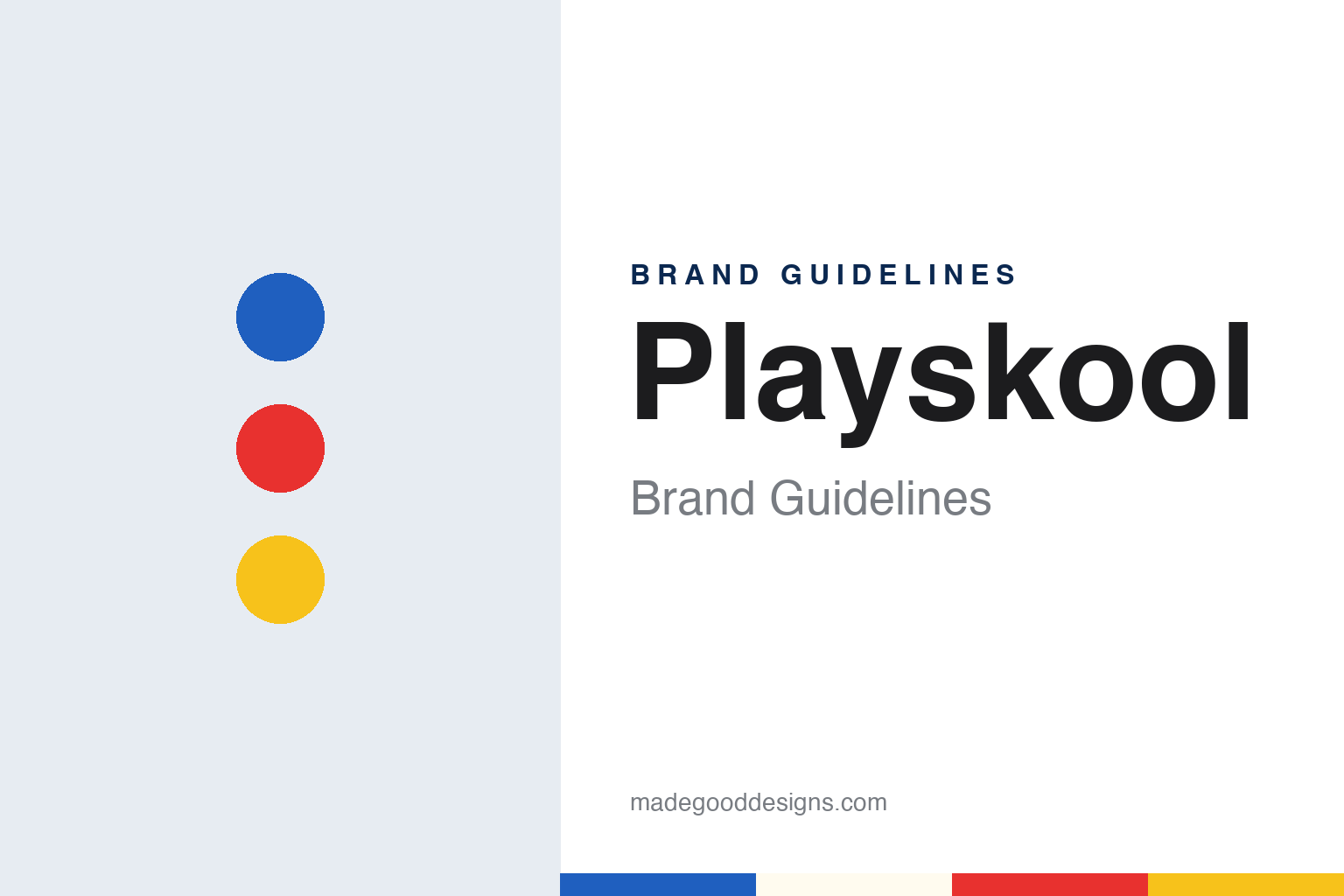
Two constants: a school blue, block red and bead yellow palette and a rounded display sans register. Abstract homage — not a Playskool product or mark; no toy, package or logo is reproduced.
An institute in a lumber company
Teaching aids before toys.
Playskool started as a classroom idea. English Wikipedia says the Playskool Institute was established in 1928 by Lucille King as a division of the John Schroeder Lumber Company in Milwaukee, Wisconsin, and that King, an employee of the lumber firm, developed wooden toys to be used as teaching aids in classrooms. Hasbro’s own Playskool history page, as archived in 2012, tells the founding differently: it says the brand was created in 1928 by two schoolteachers in Milwaukee, and it framed the brand around that “learning through play” idea.
The same company page lists the first products. It says the first toys launched in 1929 were the Build at Will Dollhouse and the Home Kindergarten, followed by Playskool Blocks of natural wood in 1935 and a Bead Counter for grouping coloured beads in 1937. In 1940, it says, came the Nok-Out Bench, a pounding toy, and the Ring Stack.
The business changed hands several times in its first decade. Wikipedia says the Playskool Institute became a division of Thorncraft, Inc. in 1935 and opened offices in Chicago; that in 1938 it was bought by the Joseph Lumber Company, which put Manuel Fink in charge of operations; and that in 1940 Fink and Robert Meythaler bought Playskool and set up the Playskool Manufacturing Company. Wikipedia draws that sequence from a company guide in the Lehman Brothers Collection at Harvard Business School.
Colour
Growth by acquisition, then a Hasbro brand.
Chicago became the company’s base, and it grew by buying other wooden-toy makers. Wikipedia says Playskool bought the J.L. Wright Company, maker of Lincoln Logs, in 1943; Hasbro’s archived history dates the addition of Lincoln Logs to the Playskool line to 1948 and credits the toy’s design to John Lloyd Wright, son of the architect Frank Lloyd Wright. Wikipedia adds that Playskool merged with Holgate Toys, a wood-products firm in Kane, Pennsylvania, in 1958, and bought the Halsam Company, a maker of wooden blocks, checkers, dominoes and construction sets, in 1962.
The parent companies followed. Wikipedia says Playskool became a subsidiary of Milton Bradley in 1968, and that both companies were acquired by Hasbro in 1984, a deal The New York Times reported on 5 May 1984. Wikipedia says Playskool’s last plant in Chicago closed the same year and that the brand then operated from Pawtucket, Rhode Island, as a division of Hasbro.
Under Hasbro the name spread across a wider range. Wikipedia says Playskool launched a line of infant products under the Tommee Tippee name in 1985, that Hasbro preschool products including Play-Doh and Tonka were rebranded with the Playskool name, and that Playskool made licensed toys for Barney, Arthur, Teletubbies and Nickelodeon, among others. Hasbro’s archived page dates Play-Doh joining Playskool to 1991, and lists its own milestones: the Play Telephone in 1957, the Tyke Bike in 1965, Weebles in 1972, the Sit ’n Spin in 1973, Alphie in 1978, the Gloworm in 1980 and Busy Gears in 1990. Wikipedia names Mr. Potato Head, Tonka, Alphie, Weebles, Play-Doh, Sesame Street toys and Glo Worm among the brand’s signature lines.
The name also travelled beyond toys. Wikipedia says Hasbro licensed Playskool to other vendors for books, baby-care supplies, video games and children’s clothing, and that in the 1970s the brand sold a Familiar Places series of toy buildings with vehicles and figures, among them a McDonald’s restaurant and a Holiday Inn hotel. Hasbro’s archived page adds the Playskool Heroes range of 2011, which scaled characters from older children’s brands down for younger hands.
Typography
Design and documentation.
The brands in this group all make toys for babies, toddlers and young children, and several also make toys with electronics inside: talking, lighting and learning toys alongside rattles, stacking sets and play vehicles. Early-years and electronic toy brands sit at many different points in the trade, from family firms that still carry a founder’s name to labels that now belong to much larger toy groups, and a single name can be sold in very different ways from one country to the next.
An early-years toy brand’s identity is usually carried less by a single product than by a name, a logo and a familiar set of colours on the box, because the company behind the name may have changed hands, merged with a rival or moved its production far from where it started. That makes the questions behind each name worth asking plainly: who started it, who owns it now, and where its toys are actually designed and made.
Each guide separates what independent sources record from what the company says about itself — its founding story, its owners over time, where its toys are made and how its marks have changed — and marks plainly what rests only on the company’s own word.
Aa
A rounded, friendly display sans. (Specimen set in Sniglet, a rounded-sans STAND-IN; NOT the Playskool logo.)
Playskool
A Hasbro name, made under licence.
Hasbro still owns the Playskool name, but other companies now make the toys. In a press release dated 30 March 2023, PlayMonster, a toy and game company in Beloit, Wisconsin, announced an expanded global partnership with Hasbro under which it would bring the entire Playskool brand onto its roster in 2024. The release said PlayMonster would take over lines including Glo Worm, Sit ’n Spin, Busy Gears and Elefun, and planned to relaunch Weebles in autumn 2023 with new figures and playsets. Wikipedia describes the agreement as part of a wider Hasbro restructuring that year towards licensing, digital games and core brands.
A second licensee followed. The Toy Book reported on 4 September 2025 that Just Play had partnered with Hasbro to relaunch Playskool alongside Easy-Bake, with a collection including a Sit ’N Spin and Explore ’N Grow Busy Gears sold exclusively at Walmart.
The name has stayed constant through each of these changes. It began as the Playskool Institute in 1928, became the Playskool Manufacturing Company in 1940, passed with Milton Bradley to Hasbro in 1984, and now appears on toys made by licensees, while Hasbro’s archived page still framed the brand in 2012 around the idea that play and learning go together.
For a design guide, Playskool shows how a brand name can outlast its factories: the institute, the Chicago plants and the in-house manufacturing have gone, but the name, a handful of long-running toys and a primary-colour register carry on under licence. Compare its Hasbro stablemate in our Play-Doh brand guidelines and its long-time preschool rival in our Fisher-Price brand guidelines. For this guide we use school blue, block red and bead yellow with a rounded display sans, an unofficial interpretation; no product or logo is reproduced.
Explore & save
Keep Playskool’s identity on hand — save it to a board in the Made Good inspiration library.
Playskool identity set
Pin the Playskool school blue, block red and bead yellow palette and the rounded display sans register to your own board.