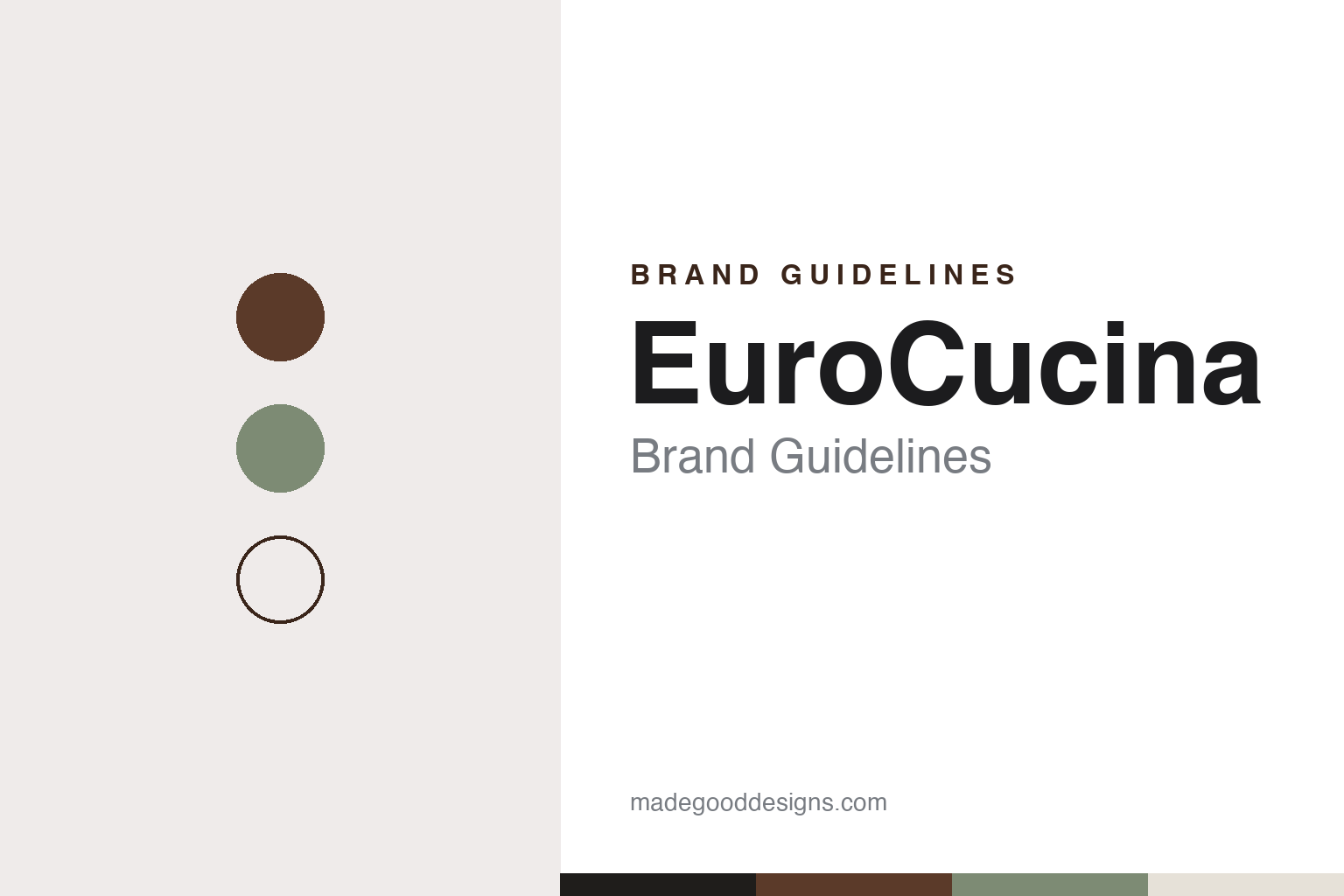
EuroCucina Brand Guidelines
The Milan kitchen biennial within the Salone.
Aa
Two constants: a walnut, sage and worktop stone palette and a warm display serif register. Abstract homage — not a EuroCucina or Salone del Mobile.Milano asset; no logo or key visual is reproduced.
A kitchen show inside the Salone
Born in 1974, alongside Milan’s furniture fair.
EuroCucina is the kitchen exhibition of Salone del Mobile.Milano, the furniture fair held in Milan every April. It is not a separate fair with its own dates: it is one of several exhibitions gathered under the Salone, and it runs only in even years. The Salone’s own pages say EuroCucina was first held in 1974, and the British trade magazine kbbreview gave the same year in its report on the 2026 edition, published on 1 June 2026.
The Salone itself is older. The organiser says it was launched in 1961 to promote Italian exports of furniture and furnishings; Italian Wikipedia dates the first edition to September 1961, in the pavilions of Milan’s old trade-fair grounds, and says it was organised by Cosmit, a committee formed by furniture makers. Today the organiser’s pages carry the name of Federlegno Arredo Eventi, the events company of the Italian wood and furniture federation.
Over the years the Salone added further exhibitions around the main furniture fair. Italian Wikipedia lists EuroCucina in 1974, Euroluce, the lighting show, in 1976, and later exhibitions for workspaces, furnishing accessories, young designers and bathrooms. The organiser now describes a fixed rhythm: Euroluce in odd years, EuroCucina and the International Bathroom Exhibition in even years, with the furniture fair and the furnishing-accessories exhibition every year. Since 2005, Italian Wikipedia says, the Salone has been held at the newer fairground at Rho, outside Milan.
Inside EuroCucina sits a second event. FTK – Technology For the Kitchen, which the organiser says was set up in 2004, gathers about 50 exhibitors at each edition and is given over to built-in appliances and cooker hoods. The organiser describes EuroCucina itself as bringing together around a hundred exhibitors in each even year.
Colour
Two halls at Rho, every other April.
The 2026 edition ran from 21 to 26 April 2026 at Fiera Milano in Rho, in halls 2 and 4. The organiser’s timetable shows how the week is divided: trade visitors on all six days, furniture-industry suppliers and students from the fourth day, and the general public only on the closing weekend of 25 and 26 April. In its press release for the 2026 exhibitions, the Salone said EuroCucina with FTK had 106 exhibitors from 17 countries, 38.6 per cent of them from abroad, including 35 brands making their debut or returning. The release named the themes it highlighted: open-plan kitchens that merge with living areas, concealed induction hobs, integrated hoods and tall units that close away, along with what it called biophilic design.
Independent reviewers read the 2026 floor in their own terms. Stylepark, in a review by Susanne Maerzke published on 29 April 2026, called the Salone and EuroCucina a “biennial double bill” and found kitchens becoming brighter, calmer and more organic, while noting that the fairs offered little that was new in content or design, with grooves, grids and curves recurring across stands. kbbreview, in George Dean’s report of 1 June 2026, picked out rounded forms on cabinets, islands and worktops, mirrored and steel cabinet fronts, handle-free kitchens with built-in lighting and appliances in new colours rather than matt black.
The Salone’s own editorial team took a similar line. An article on its site described the kitchen at EuroCucina 2026 as no longer a closed technical room but a space open to, and connected with, the rest of the home.
Because EuroCucina shares the Salone’s week, much of its audience arrives for the wider event. kbbreview placed it as part of the wider Salone del Mobile programme across the city; Stylepark described kitchen makers also showing in museums and gardens around Milan during the same days.
Typography
How the category presents itself.
Home, interiors and building trade fairs tend to go by short names. Some are a single word, some an acronym or a coined compound, and many are written entirely in lower case or entirely in capitals; a city name is often added, sometimes in its English form, sometimes in the local one. Behind each name stands an organiser: an exhibition company owned by a city or a region, a trade association that sponsors the event, or, in the case of some American furniture markets, a market authority.
Most of these fairs are held for the trade. Their visitors are retailers and buyers, architects, interior designers, installers, contract and hospitality buyers, and the purchasing groups that supply large chains. A few keep public days at the end of the run or are built for the public from the start, with show homes and room sets for people planning their own homes. Many follow a fixed calendar, annual or every two years, tied to the ordering seasons of their trade.
Inside the halls, the fairs are arranged by product group. One may cover tableware, kitchenware, gifts and home accessories; another furniture and lighting; others floor coverings, ceramic tiles, kitchens, bathrooms or heating and building systems. Most add trend areas, special shows and talk programmes, and several now group suppliers from abroad into sourcing sections or country pavilions.
The identity of such a fair usually rests on a wordmark that is kept from edition to edition, while a key visual, colour or theme changes each year. The guides in this collection describe those names, organisers, dates and formats as dated sources give them, and treat the colours and type shown here as our own interpretation rather than any fair’s official material.
Aa
A warm display serif for a show named in one compound word. (Specimen set in Fraunces, a serif STAND-IN; NOT the EuroCucina or Salone del Mobile.Milano logo.)
EuroCucina
One compound name, under the Salone’s umbrella.
EuroCucina’s name joins “Euro” to the Italian word for kitchen, and the organiser writes it as one word with a capital C. It follows the pattern of its sibling, Euroluce, the lighting biennial, and both sit beneath the identity of Salone del Mobile.Milano, whose name and site carry the exhibition pages, the timetable and the exhibitor catalogue. On those pages the kitchen show appears as EuroCucina / FTK – Technology For the Kitchen, so the appliance event is presented as part of the same title rather than as a separate fair.
The rhythm is part of the identity. Because EuroCucina runs only in even years, each edition comes two years after the last, and the Salone’s 2026 press release framed the show as returning after its 2024 edition. In odd years its place in the Rho halls is taken by Euroluce, so the two biennials alternate around the annual furniture fair.
The organiser’s own copy for the show speaks of trends in forms, materials, colours and technologies, and of the kitchen as the domestic hearth. The independent reports of 2026 point the same way in plainer words: rounded edges, steel and mirror, hidden handles and lighting, and calmer colour.
For a design guide, EuroCucina shows how an exhibition can keep its own name while living inside a larger fair’s identity and calendar. Compare Salone del Mobile.Milano, the fair it belongs to, and Fiera Milano, the company behind the Rho fairground. For this guide we use walnut, sage and worktop stone with a serif, an unofficial interpretation; no product or logo is reproduced.
Explore & save
Keep EuroCucina’s identity on hand — save it to a board in the Made Good inspiration library.
EuroCucina identity set
Pin the EuroCucina walnut, sage and worktop stone palette and the warm display serif register to your own board.
Source & notes
Frequently Asked Questions
What font can I use to match the EuroCucina look?
This guide describes EuroCucina’s type as “A warm display serif for a show named in one compound word”. Its type specimen is set in Fraunces from Google Fonts as a stand-in; Fraunces is not EuroCucina’s own lettering.
What colours are in the EuroCucina palette?
This guide’s EuroCucina palette is Walnut #5B3A29, Sage front #7D8B74, Brushed steel #8E9396, Worktop stone #E6E1D8 and Range ink #1F1D1B. The tones are the guide’s own unofficial interpretation, not official EuroCucina hex codes.