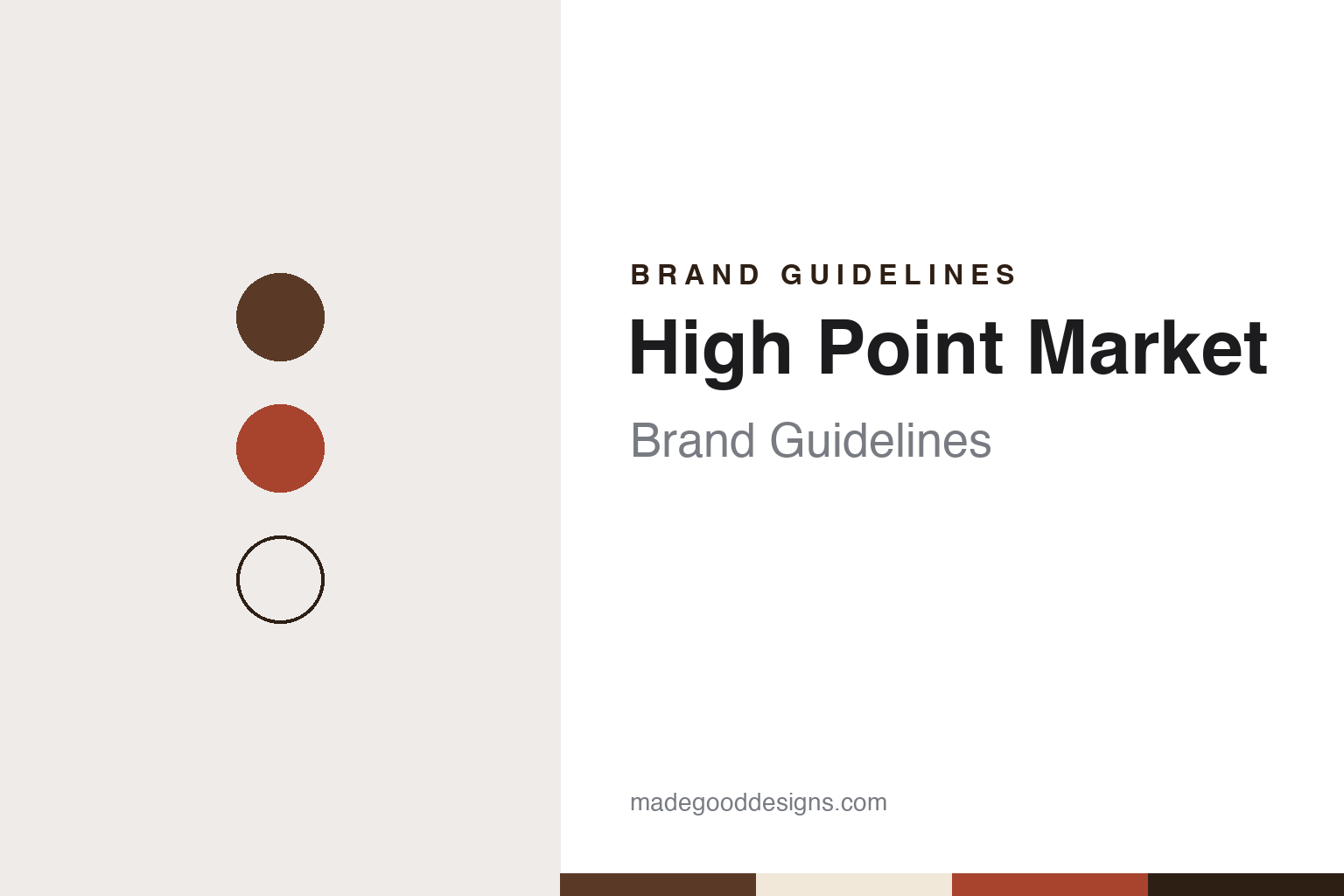
High Point Market Brand Guidelines
The North Carolina furniture fair that grew into a city of showrooms.
Aa
Two constants: a walnut, brick and cream palette and a grotesque sans register. Abstract homage — not a High Point Market mark; no logo, building or product is reproduced.
Southern Furniture Market
Furniture factories, a salesman and a ten-storey hall.
High Point Market is a trade fair for the home-furnishings business, held twice a year, in April and October, in the city of High Point in North Carolina’s Piedmont. Its roots lie in the city’s furniture factories. The North Carolina Department of Natural and Cultural Resources, in the text of its historical marker J-117 (cast in 2013), says High Point emerged as a furniture-making centre around 1900 thanks to nearby supplies of lumber, with thirty-three furniture plants in the city in 1900 and 107 by 1904.
Those factories needed a place to meet buyers. According to a history in the Federal Reserve Bank of Richmond’s magazine Econ Focus (summer 2007), a High Point furniture salesman, D. Ralph Parker, announced the High Point Furniture Exposition Company in 1905 and turned the second floor of an office building into showroom space for local makers; a rival company opened a larger showroom a year later. In 1909 the two companies joined forces to hold High Point’s first formal furniture markets, one for two weeks in March and one from late June to early July, Econ Focus says; English Wikipedia dates the first formal Southern Furniture Market to 1–15 March 1909. Attendance was only moderate, the Richmond Fed history adds, and plans for a twice-yearly market were dropped.
The idea returned. In 1913 local manufacturers formed the Southern Furniture Exposition Company and staged another market across eight buildings, and a further market followed in January 1914 before the First World War suspended the event, Econ Focus says. The state marker text says the war delayed plans for an exposition hall, and that in 1919 members of the local Chamber of Commerce travelled to Jamestown, New York, to visit that city’s exposition building.
The result was the Southern Furniture Exposition Building. The marker text says the market was reorganised in 1921 as the Southern Furniture Exposition, and that the ten-storey building, designed by the architect William P. Rose, opened on 20 June 1921 with 249,000 square feet of space, built without outside capital. Through the interwar years markets were held each January and July, mirroring the schedule of markets in the Northeast and Midwest, according to Econ Focus. The market was suspended during the Second World War; Econ Focus says formal markets resumed in 1947 after a four-year break.
Colour
From January and July to April and October.
After the war the calendar shifted. In 1950 the exposition building gained a large addition, and in 1955 major manufacturers set up the Furniture Factories’ Marketing Association of the South to give the market more structure, Econ Focus reports. In 1956, responding to buyers who were visiting between the January and July markets, that association added two more formal markets, in April and October; the same year a twelve-storey exhibition building was completed across the street. English Wikipedia says the mid-season markets began to outgrow the January and July shows in the 1960s. In 1982 the January and July markets ended, leaving the spring and autumn markets that continue today.
The name changed with the scope. In 1989 the Southern Furniture Market was renamed the International Home Furnishings Market, according to the state marker text; the Richmond Fed history dates the change to 1988–89 and says the exposition building became the International Home Furnishings Center at around the same time, while the manufacturer-funded group that ran the market became the International Home Furnishings Marketing Association.
Sources differ on when the present name arrived. The state marker text, and a 2016 post on the department’s blog, say the fair has been known simply as High Point Market since 2001. Econ Focus says that in 2001 a non-profit corporation formed by the city, the High Point International Home Furnishings Market Authority, took over the promotion and operation of the market, and that in 2006 the fair was renamed High Point Market and its organiser became the High Point Market Authority.
The Authority remains the organiser. Its website, read in November 2026, names Tammy Covington as president and chief executive. It says the market is open to the trade only, and lists more than 11.5 million square feet of showroom space. The site also lists keynotes, market tours, seminars and trend features among the events that run during each market.
Typography
Fairs for the home and the building.
Home, interiors and building trade fairs tend to go by short names. Some are a single word, some an acronym or a coined compound, and many are written entirely in lower case or entirely in capitals; a city name is often added, sometimes in its English form, sometimes in the local one. Behind each name stands an organiser: an exhibition company owned by a city or a region, a trade association that sponsors the event, or, in the case of some American furniture markets, a market authority.
Most of these fairs are held for the trade. Their visitors are retailers and buyers, architects, interior designers, installers, contract and hospitality buyers, and the purchasing groups that supply large chains. A few keep public days at the end of the run or are built for the public from the start, with show homes and room sets for people planning their own homes. Many follow a fixed calendar, annual or every two years, tied to the ordering seasons of their trade.
Inside the halls, the fairs are arranged by product group. One may cover tableware, kitchenware, gifts and home accessories; another furniture and lighting; others floor coverings, ceramic tiles, kitchens, bathrooms or heating and building systems. Most add trend areas, special shows and talk programmes, and several now group suppliers from abroad into sourcing sections or country pavilions.
The identity of such a fair usually rests on a wordmark that is kept from edition to edition, while a key visual, colour or theme changes each year. The guides in this collection describe those names, organisers, dates and formats as dated sources give them, and treat the colours and type shown here as our own interpretation rather than any fair’s official material.
Aa
A grotesque sans for a short, stacked name. (Specimen set in Archivo, a sans STAND-IN; NOT the High Point Market logo.)
HPMKT
A city of showrooms, not one hall.
High Point Market does not take place in a single exhibition centre. The state marker text says the market is housed in about 180 buildings across the city, with the original 1921 building and its many additions still at its core, that major renovations have taken place about every five years, and that the market runs for six days each April and October. English Wikipedia says showrooms have nearly filled what was once the historic downtown. Econ Focus says the International Home Furnishings Center added a twelfth floor in 2001, bringing it to 3.5 million square feet, and English Wikipedia says a downtown transport hub, the Mendenhall Transportation Center, opened in 2005 to anchor the market.
Much of the downtown showroom space is privately owned. English Wikipedia says that in May 2011 the main downtown showroom buildings, including the International Home Furnishings Center and Market Square, were combined with the World Market Center in Las Vegas into a new firm, International Market Centers, backed by funds from Bain Capital and Oaktree Capital; that Blackstone and Fireside Investments bought the company in September 2017; and that it has since changed its name to Andmore.
The identity rests on a name and an abbreviation. The Authority’s website says HIGH POINT MARKET, HPMKT and a version with HPMKT over HIGH POINT MARKET are registered trademarks of the High Point International Home Furnishings Market Authority Corporation. The same site plans a visit around downtown neighbourhoods, shuttle routes and showroom hours, and calls its visitor app HPMKT.
For a design guide, High Point Market shows how a fair can be a place as much as an event: a downtown of permanent showrooms that fills twice a year under one short name. Compare NeoCon, the Chicago fair for commercial interiors, and ICFF in New York. For this guide we use a walnut brown, a brick red and a warm cream with a sans, an unofficial interpretation; no product or logo is reproduced.
Explore & save
Keep High Point Market’s identity on hand — save it to a board in the Made Good inspiration library.
High Point Market identity set
Pin the High Point Market walnut, brick and cream palette and the grotesque sans register to your own board.
Source & notes
Frequently Asked Questions
What font can I use to match the High Point Market look?
This guide describes High Point Market’s type as “A grotesque sans for a short, stacked name”. Its type specimen is set in Archivo from Google Fonts as a stand-in; Archivo is not High Point Market’s own lettering.
What colours are in the High Point Market palette?
This guide’s High Point Market palette is Walnut brown #5A3A26, Dark oak #2E1F15, Brick red #A8442E, Warm cream #F1E8DA and Linen #FAF6EF. The tones are the guide’s own unofficial interpretation, not official High Point Market hex codes.