Play-Doh Brand Guidelines
A Cincinnati cleaner, rolled into colour.
Aa
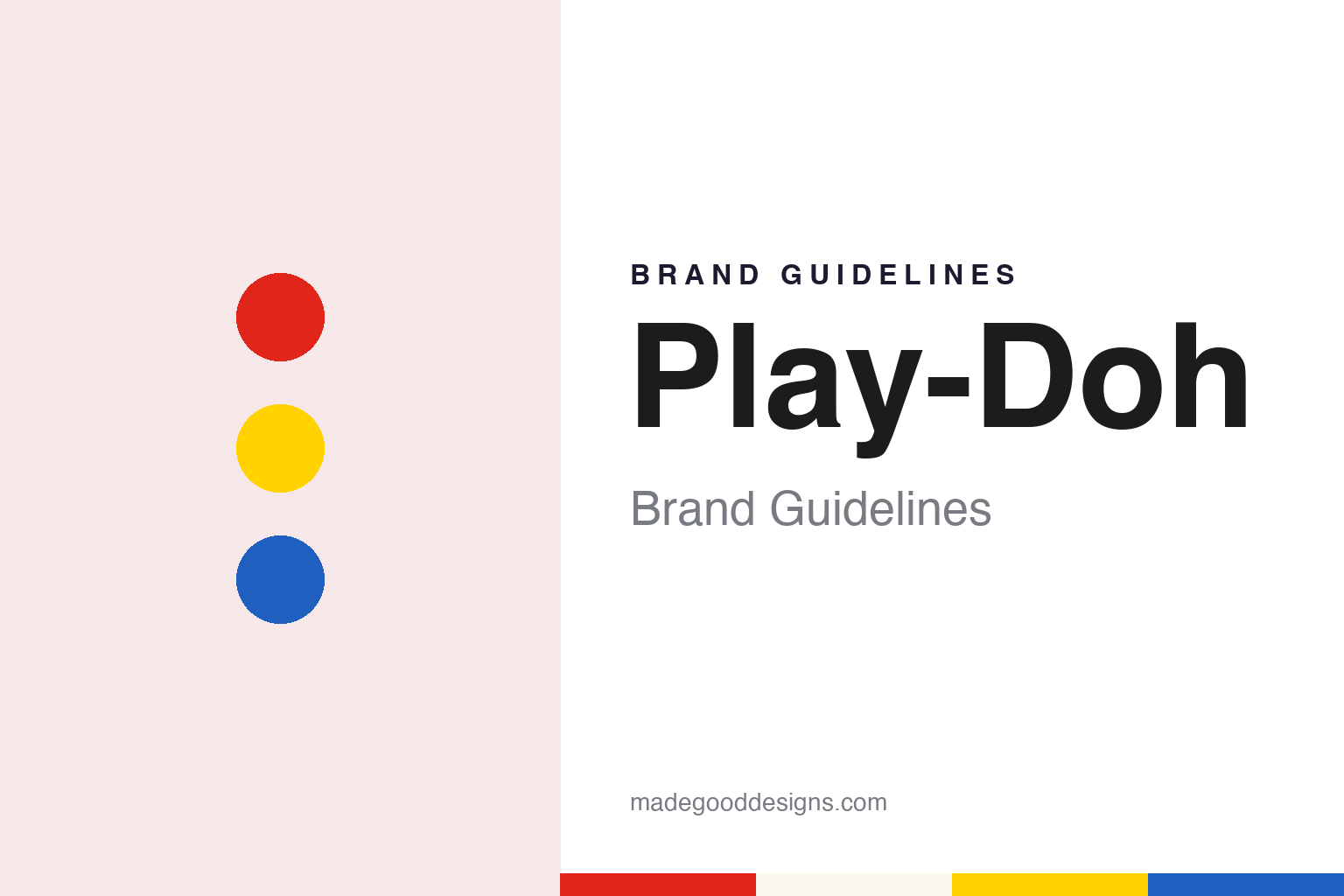
Two constants: a can red, dough yellow and dough blue palette and a rounded display sans register. Abstract homage — not a Play-Doh product or mark; no can, compound or logo is reproduced.
A cleaner before a toy
The compound came from a Cincinnati soap maker.
Play-Doh began as a household product rather than a toy. English Wikipedia says the pliable, putty-like compound was devised by Noah McVicker of Kutol Products, a soap maker based in Cincinnati, Ohio, and that it was first manufactured there as a wallpaper cleaner in the 1930s. According to the same account, the putty was made at the request of the Kroger grocery company, which wanted something that could lift coal soot from wallpaper in homes heated by coal fires.
That market shrank after the Second World War. Wikipedia attributes the decline to the spread of natural-gas heating, which reduced indoor soot, and to the arrival of washable vinyl wallpaper. Noah McVicker’s nephew, Joe McVicker, joined Kutol with the task of keeping the company afloat. His sister-in-law, Kay Zufall, was a nursery-school teacher who had read a newspaper article about using the cleaning putty for art projects; her pupils enjoyed it, and she persuaded the two McVickers to make it as a children’s product. Wikipedia credits Zufall and her husband with the name Play-Doh, and says the McVickers had wanted to call it Rainbow Modeling Compound.
The National Toy Hall of Fame at The Strong museum in Rochester, New York, tells a parallel version on its own Play-Doh page: Joe McVicker heard from a teacher that children found modelling clay too hard to work, sent his cleaning product to her school as a substitute, and, after a positive response, offered to supply schools across Cincinnati. The museum says he showed the material at a national education convention in 1955 and that, by 1956, the wallpaper cleaner had been renamed Play-Doh.
Colour
Primary colours, a cartoon boy and a registered smell.
The product reached shops quickly. Wikipedia says the McVickers formed the Rainbow Crafts Company in 1956 to make and sell Play-Doh, and that Woodward & Lothrop in Washington, DC, then Macy’s in New York and Marshall Field’s in Chicago, took it on after in-store demonstrations; The Strong likewise names Macy’s and Marshall Field’s. The museum says a softer version in primary colours followed in 1957, and that children could blend those colours to make others.
Characters have carried the packaging. Wikipedia says the cans were briefly illustrated with children in the mid-1950s, then with an elf known as the Play-Doh Pixie, before Play-Doh Pete, a cartoon boy in a smock and beret, took over; The Strong dates Pete’s arrival on the cans to 1960. Wikipedia says Pete’s beret later became a baseball cap, that he was retired in 2003, and that a set of characters called the Doh-Dohs have been the mascots since 2012. It also notes that the original cardboard can with a metal base gave way to a plastic container in the 1980s. The Fun Factory, a press that pushes the compound out in shapes, is credited by Wikipedia to Bob Boggild and Bill Dale in 1960.
The brand has also treated its smell as part of its identity. The Associated Press reported on 25 May 2018 that Hasbro had announced that the US Patent and Trademark Office had recognised Play-Doh’s distinctive scent with a registered trademark, something the AP said is rarely issued for a smell. Hasbro described the scent as a sweet, slightly musky vanilla fragrance with slight overtones of cherry, combined with the smell of a salted, wheat-based dough, and said the registration protected a point of connection between the brand and its fans.
Typography
Design and documentation.
The brands in this group are classic toys: simple objects and materials whose names have outlasted the people who first sold them. Classic toy brands in general sit in an unusual place in the trade, because a name that began with a single maker, a small workshop or an inventor’s idea can pass through several owners and end up as one line among many in a much larger toy or craft group.
A toy brand’s identity is often carried less by the object itself, which can be simple to describe, than by a name, a container, a colour and the advertising that first made it familiar. The company behind that name may have changed hands, moved its production or widened the range far beyond the original product, so the useful questions stay plain: who started it, who owns it now, and where it is made.
Each guide separates what independent sources record from what the company says about itself — its origin story, its owners over time, where its products are made and how its packaging and marks have changed — and marks plainly what rests only on the company’s own word.
Aa
A rounded, heavy display sans. (Specimen set in Baloo 2, a rounded-sans STAND-IN; NOT the Play-Doh logo.)
Play-Doh
From Rainbow Crafts to Hasbro, via three owners.
Play-Doh changed hands several times before settling with its current owner. English Wikipedia says the food company General Mills bought Rainbow Crafts in 1965 and bought the toy maker Kenner Products in 1967; that Rainbow Crafts and Kenner were merged in 1971; that the Tonka Corporation bought the two in 1987; and that Hasbro acquired Tonka in 1991, placing Play-Doh under its Playskool brand. Hasbro has owned Play-Doh since 1991. The Associated Press described Hasbro in 2018 as a toymaker based in Pawtucket, Rhode Island.
Where the compound is made has also moved. Wikipedia says Play-Doh was made in the United States until 2004, when Hasbro ended production in East Longmeadow, Massachusetts, and shifted it to China and Turkey. On 1 March 2017 the Belgian card and game maker Cartamundi, headquartered in Turnhout, announced that it and Hasbro had agreed to begin making certain Play-Doh products at Cartamundi’s factory in East Longmeadow, which Cartamundi had acquired in 2015, for distribution in North America. Cartamundi’s chief executive, Chris Van Doorslaer, said in the release that adding Play-Doh production would further intensify the cooperation between the two companies. Wikipedia says some Play-Doh manufacturing returned to East Longmeadow in 2018 under that partnership.
The museum world has recognised the brand. The Strong lists Play-Doh as inducted into the National Toy Hall of Fame in 1998, and its page records later additions such as glitter and glow-in-the-dark versions, and four colour names chosen by public vote in 2000.
For a design guide, Play-Doh shows how a material can become a brand: a few primary colours that mix into others, a soft rounded wordmark tradition, a long line of cartoon mascots on the can, and even a registered scent. Compare another Ohio-born toy name in our Little Tikes brand guidelines and a fellow classic toy brand in our Wham-O brand guidelines. For this guide we use can red, dough yellow and dough blue with a rounded display sans, an unofficial interpretation; no product or logo is reproduced.
Explore & save
Keep Play-Doh’s identity on hand — save it to a board in the Made Good inspiration library.
Play-Doh identity set
Pin the Play-Doh can red, dough yellow and dough blue palette and the rounded display sans register to your own board.