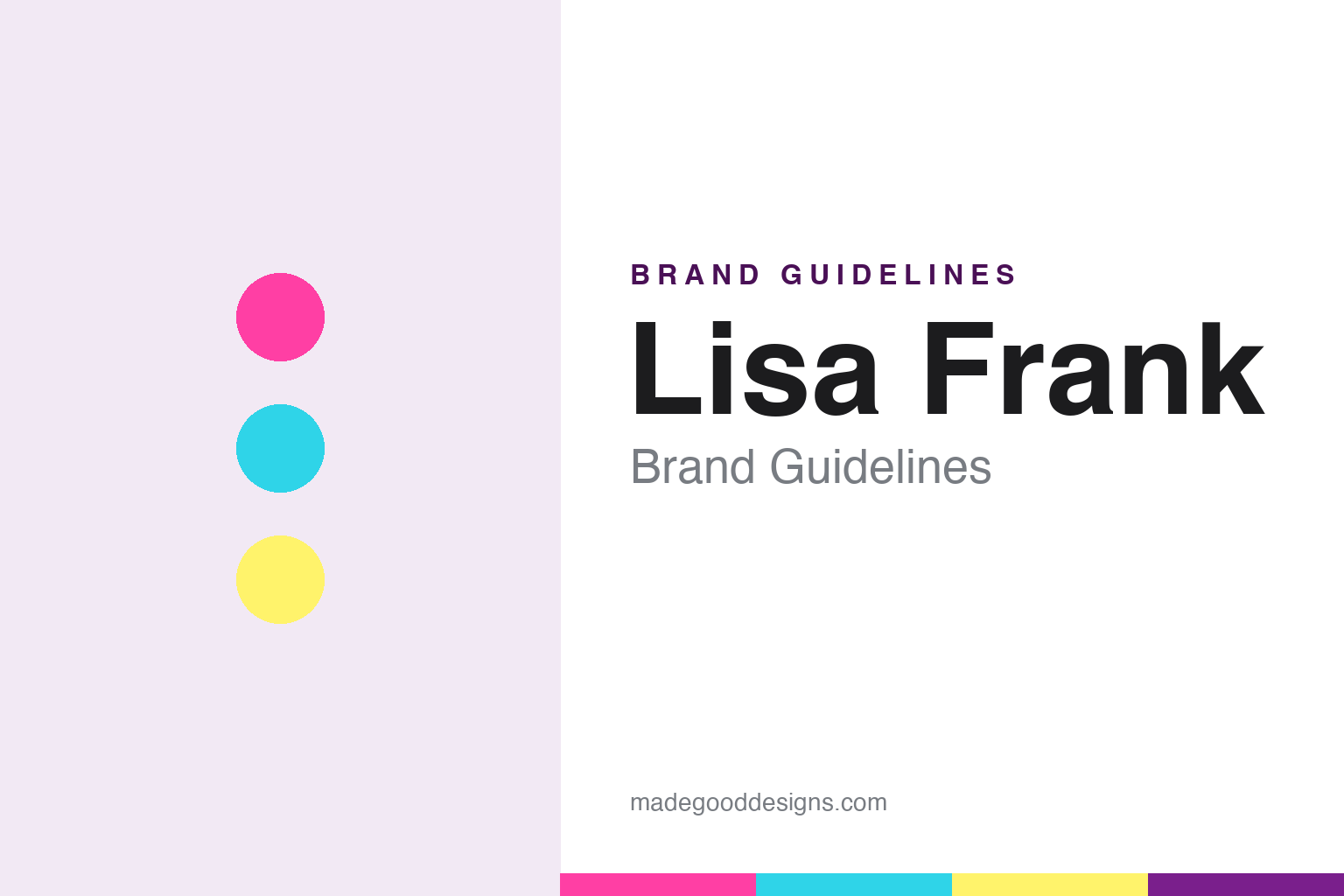
Lisa Frank Brand Guidelines
Rainbow manes, surfing dolphins and neon on every page.
Aa
Two constants: a neon pink, lagoon turquoise and sunshine yellow palette and a bubbly, rounded sans register. Abstract homage — not a Lisa Frank artwork or mark; no character, sticker, folder or logo is reproduced.
From Sticky Fingers to Stickers
An art student in Tucson.
Lisa Frank Inc. grew out of an art student’s jewellery business in Tucson. Testifying in federal court in Tucson in May 2018, as reported by the Arizona Daily Star on 18 May 2018, Lisa Frank described moving from Detroit to Tucson in the 1970s to study art at the University of Arizona. There she founded a company called Sticky Fingers to make jewellery for children, which, she testified, she renamed Lisa Frank Inc. around 1980.
Sources differ slightly on the year. An earlier Arizona Daily Star report, published on 24 January 2006, described Lisa Frank Inc. as the privately held company Frank founded in 1979, while English Wikipedia dates the company to around 1980. English Wikipedia adds that Sticky Fingers specialised in colourful plastic pendants in fruit and novelty-character shapes, and that the jewellery line led Frank to make her own set of colourful stickers.
Stickers launched the brand. In her 2018 testimony, the Star reported, Frank said a large order from Spencer Gifts led to “mountains of stickers” and a craze among children; leftover stickers of large-eyed creatures and unicorns were handed out at Halloween. English Wikipedia says the company made only stickers at first, featuring Frank’s own characters, and that every design through 1989 was coloured by airbrush, starting from a concept and a pencil sketch before being worked up as a painting. In 1989, the same article says, the studio switched from hand airbrushing to computer software, which allowed more complex and intricate patterns.
The look itself is the brand. English Wikipedia describes Frank’s artwork as built on rainbow and neon colours and stylised animals, including dolphins, pandas and unicorns, and names one of the anthropomorphic characters, “Panda Painter.” The Star’s 2018 report listed the kinds of creatures at stake in court: purple-eared tigers, black-and-white puppies wearing tiaras, and unicorns with rainbow manes and tails.
Colour
School supplies, a boardroom dispute and a move to licensing.
School supplies made Lisa Frank a fixture of the classroom. Frank testified in 2018, the Arizona Daily Star reported, that she started selling school supplies at the request of retailers, at a time when those supplies were “just solid colors.” English Wikipedia dates the move into school supplies to 1987 and says the company’s slogan, “You Gotta Have It,” debuted in the late 1980s. Its range of folders, pencil cases, erasers, notebooks and Trapper Keepers carried the characters; the Star’s 2006 report, citing court filings, said the company began with stickers and branched into clothing, backpacks and stationery, sold through retailers including Wal-Mart and Target.
The company’s leadership was tested in court in 2005. According to the Arizona Daily Star report of 24 January 2006, James A. Green was president and chief executive of Lisa Frank Inc. from 1990 until October 2005. In September 2005, the paper reported, Frank filed suit in Pima County Superior Court to remove Green from the company’s management and board, and in October he agreed to step aside as president; the case then turned on whether a contract between the two required Green to sell his shares back to Frank. English Wikipedia says the court found in Frank’s favour under a 1995 buy-sell agreement, and that Frank resumed the role of chief executive.
Frank defended the designs as well as the company. The Star reported in May 2018 that she had sued the Nova Scotia toy company Orb Factory in U.S. District Court in Tucson, claiming it had copied characters from her copyrighted portfolio; Orb Factory’s lawyers told the jury the company had no need to copy Lisa Frank Inc., that the creatures differed in detail, and that its packages were clearly marked with its own logo.
The same testimony recorded a turning point in how the business works. Frank told the court, the Star reported, that the company had employed people in Tucson for many years but stopped manufacturing around 2012 and moved entirely to a licensing model, in which other companies put her dolphins, gumball machines and tigers on their own products.
Typography
Design and documentation.
School-supply brands sit in an unusual corner of design. Their products are bought in a short season, often by parents for children, and are then carried, opened, dropped and swapped for months in classrooms and lockers. A pencil, a binder or a notebook has to work at the scale of a box on a shelf as well as a cover held in the hand, and its look often changes from one school year to the next.
The identity of a school-supply brand is often carried less by a logo than by a colour, a cover design or a familiar format, because the company behind the name may have merged, changed owners or moved its production far from where it began. That makes the plain questions worth asking: who started it, who owns it now, and where its products are made.
Each guide separates what independent sources record from what the company says about itself — its founding story, its owners over time, where its products are made and how its look has changed — and marks plainly what rests only on the company’s own word.
Aa
A bubbly, rounded display sans. (Specimen set in Fredoka, a sans STAND-IN; NOT the Lisa Frank logo or lettering.)
Lisa Frank
Nostalgia, collaborations and a documentary.
Licensing turned the brand into a run of collaborations. English Wikipedia says Urban Outfitters began selling Lisa Frank vintage merchandise, including 1990s stickers and Trapper Keepers, in 2012, and that the company keeps copies of every product it has made. The same article records two limited-release Reebok Classic Leather shoes with Lisa Frank designs in 2017, and later partnerships with Morphe on an eyeshadow palette in 2020 and Pillsbury on unicorn-shaped cookie dough in 2021.
The Los Angeles Times, writing on 21 September 2023 about brands from the 1980s and 1990s returning for grown-up fans, described Lisa Frank partnerships with Crocs, with BlendJet blenders and with the children’s clothing maker Posh Peanut. English Wikipedia credits the company’s renewed reach to Forrest Green, Frank’s son, who became director of business development and began running the company’s Instagram account, presenting Lisa Frank as a lifestyle brand.
The company’s history has also reached the screen. In 2024, English Wikipedia records, Amazon Prime Video released a four-part documentary series, Glitter and Greed: The Lisa Frank Story, featuring interviews with journalists and former employees, including James Green.
The company remains based in Tucson, Arizona, English Wikipedia says, and says Frank continued to lead it as of 2019.
For a design guide, Lisa Frank shows how far an identity can travel on colour and character alone: rainbow gradients, neon brights and big-eyed animals that made a folder or a sticker sheet instantly recognisable,. Compare the binder its art once covered in our Trapper Keeper brand guidelines and another colour-led classroom brand in our Crayola brand guidelines. For this guide we use neon pink, lagoon turquoise and sunshine yellow with a sans, an unofficial interpretation; no artwork or logo is reproduced.
Explore & save
Keep Lisa Frank’s identity on hand — save it to a board in the Made Good inspiration library.
Lisa Frank identity set
Pin the Lisa Frank neon pink, lagoon turquoise and sunshine yellow palette and the bubbly rounded sans register to your own board.