STATE Bags Brand Guidelines
A Brooklyn bag company built around a give-back promise to American kids.
Aa
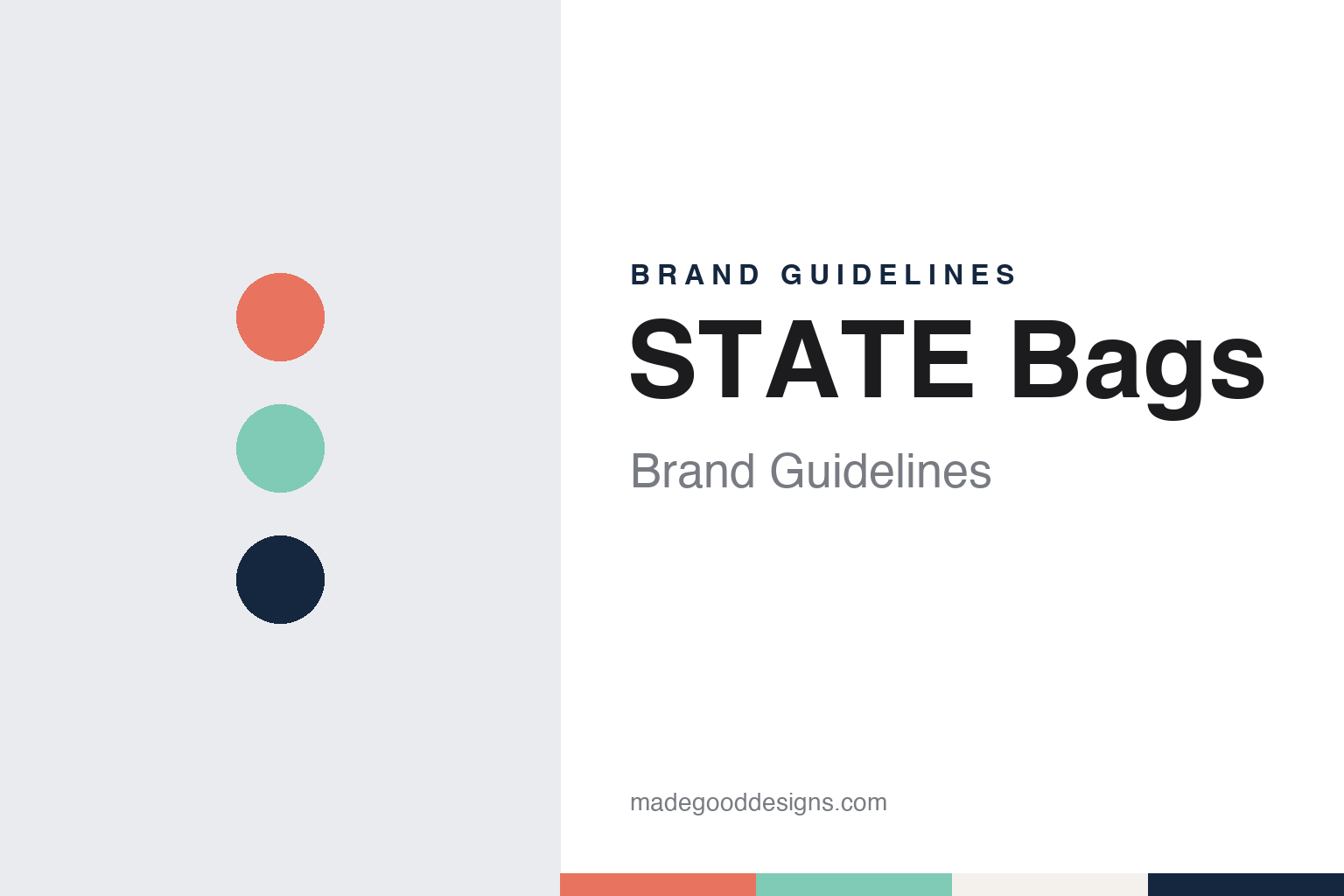
Two constants: a Brooklyn navy, coral and mint palette and a bold capital sans register. Abstract homage — not a STATE Bags product or mark; no backpack, bag or logo is reproduced.
A bag company with a camp behind it
A for-profit brand built by two nonprofit founders.
STATE Bags is an American company that makes backpacks, lunch bags, totes and travel bags, and writes its own name in capitals: STATE. The company tells its origin story in the frequently-asked-questions section of its website. There it says that STATE “began as a partnership between husband and wife team, Scot and Jacq Tatelman”, and that the couple created it “as a for-profit company with a nonprofit pedigree”. It calls them “Brooklyn-based social entrepreneurs” whose hearts “have always been with kids growing up in America’s most underfunded neighborhoods”.
That nonprofit pedigree comes first in the timeline. The company says that in 2009 the Tatelmans founded the Country Roads Foundation, a nonprofit organisation that has served New York City children through its signature programme, Camp Power. STATE’s own explanation of how the bag business began goes back to that camp. “After watching countless kids carrying their possessions in ripped trash bags,” the site says, “Scot and Jacq formed STATE — a company that promises to not only deliver much needed supplies, but to also provide youth with the tools to reach their fullest potential and better their communities.” The same answer ends with a phrase that sums up the brand’s tone: “And to always have their backs.”
The company also explains why it chose to give at home. Its co-founders, it says, saw children carrying their belongings in ripped garbage bags at their nonprofit summer camp and wanted to do more for local kids in challenging situations. “While other companies were doing fantastic work for people overseas,” the site says, “they wanted to take the one-for-one model back to the US”.
Colour
An early storefront with named bags and badges.
The earliest capture of statebags.com in the Internet Archive, saved on 12 January 2013, shows that the online shop was already open. Its menu was short — Shop, Blog, Our Mission and a section called “What’s in Your Bag?” — and its products were named rather than numbered. The page listed bags called The Garfield, The Durham and The Mercer, together with badges, snaps and pins.
Captures from 2014 show that naming habit growing. Product pages archived that year carried names such as Ashton, Bedford, Clinton, Henry, Smith and Kane, each sold in several colourways, and a Kane in a coral and mint combination appears among them. By the end of 2014 the Durham was being offered in a run of two-tone combinations such as navy and red or green and orange.
The giving side of the business has its own vocabulary. STATE’s website describes bag drop rallies, at which donated, fully-packed backpacks are handed out, and says these events are led by people it calls PackMen and PackWomen — child development specialists, performers and role models “that have successfully risen from similar communities as the ones we serve”. Their signatures, the company says, are on every bag it donates, “both figuratively and literally”, because children ask for autographs at the end of each event. In 2016, according to the company, it launched #WhatDoWeTellTheKids, a platform for raising questions about social injustice by asking “what do we tell the kids?”
Typography
Design and documentation.
Backpack brands sit at many different points in the bag trade, from small workshops that still carry a founder’s name to labels that now belong to much larger luggage and outdoor groups, and a single name can be sold everywhere from a school-supply aisle to a specialist travel shop.
A backpack brand’s identity is usually carried less by any one bag than by a name, a logo patch, a colour range and a story about where the brand began, because the company behind the name may have changed hands, moved its production or widened its range to shoes, luggage or accessories far beyond the pack it started with. That makes the questions behind each name worth asking plainly, whatever the size or age of the business: who started it, who owns it now, and where its bags are actually designed and made.
Each guide separates what independent sources record from what the company says about itself — its founding story, its owners over time, where its bags are made and how its marks and labels have changed — and marks plainly what rests only on the company’s own word.
Aa
A heavy capital sans for a brand that writes its name as STATE. (Specimen set in Archivo Black, a sans-serif STAND-IN; NOT the STATE Bags logo.)
STATE Bags
A “family bag company” with a giving programme.
On its current About page STATE calls itself “the family bag company that’s carrying everyone, everywhere, through the journey of life with open hands.” It describes its work as making “beautiful, well-made, inclusively cool product while using the power of business to give back and shift narratives around social injustices.” The page states the core promise plainly: “For every STATE bag purchased, we’ll support American children and families in need.” The company says this takes several forms, from donating fully-packed backpacks to funding projects with partner charities and schools, and that it carries out giving initiatives twelve months a year.
The FAQ adds that these initiatives fund the work of schools, organisations and causes the company believes in, and that, as STATE’s platform has grown, it has come to view that platform “as a responsibility and vehicle to shed light around social injustices happening every day here in the US.” The About page describes each giving effort as “led by listening”, with a focus on making a measurable impact where it counts, and it groups the work under the same question that names the 2016 platform: “What do we tell the kids?” A programme called Words for White Americans is listed there alongside the tutoring and travel projects.
The About page also names individual programmes. One is a Travel Academy, which the company says it launched in July 2022 with Puzzle Academy to fly students from Brooklyn and West Oakland to California and Hawaii. Others listed on the page include a virtual tutoring programme and a long-running tradition called Spread the Love. The current range also includes an adaptive kit that the company describes as compatible with power and manual wheelchairs and with its Kane bags. On where its products are made, STATE’s FAQ says its bags are “primarily manufactured in Vietnam and Philippines”.
For a design guide, STATE Bags shows how a bag company can make its giving model part of the brand itself, from the named bags to the signed backpacks handed out at its rallies. Compare JanSport, the American backpack brand, and High Sierra, the Illinois backpack and luggage brand. For this guide we use Brooklyn navy, coral and mint with a sans, an unofficial interpretation; no product or logo is reproduced.
Explore & save
Keep STATE Bags’s identity on hand — save it to a board in the Made Good inspiration library.
STATE Bags identity set
Pin the STATE Bags Brooklyn navy, coral and mint palette and the bold capital sans register to your own board.