Skip Hop Brand Guidelines
A New York diaper bag from 2003 that grew into a family of baby and toddler gear.
Aa
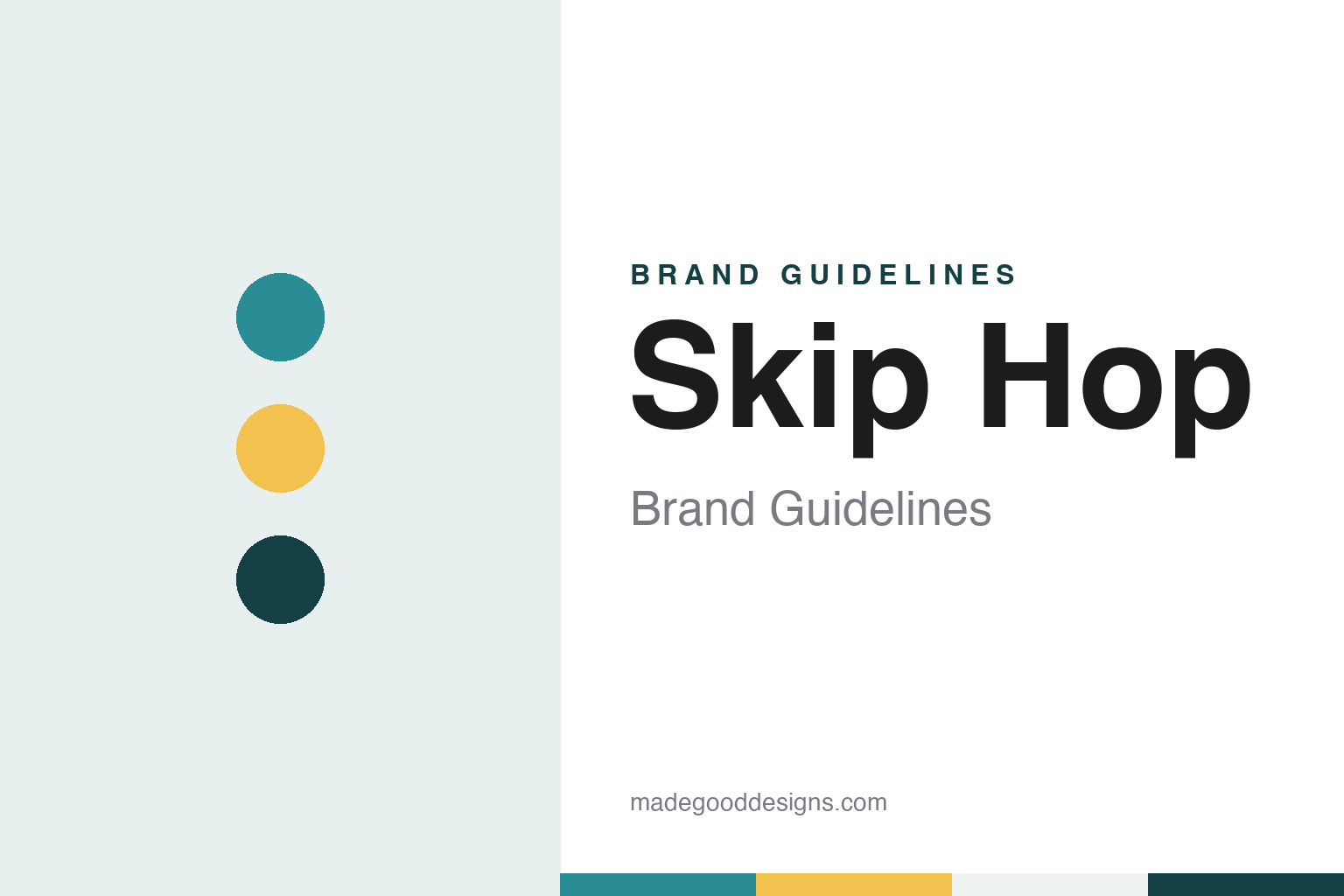
Two constants: a city teal, deep teal and sunny yellow palette and a rounded friendly sans register. Abstract homage — not a Skip Hop product or mark; no bag, backpack or logo is reproduced.
A bag for city parents
Two new parents in New York and one diaper bag.
Skip Hop is an American brand of bags, toys and everyday gear for babies and toddlers, and it began with a single bag. The company’s own “About the Founders” page, captured by the Internet Archive in 2007, says that “Skip Hop was founded in 2003 by Ellen and Michael Diamant.” The couple, it says, were new parents living in New York City and were “surprised by how few products resonated with the urban lifestyle they were used to.”
An earlier version of the site, captured in 2004, gave more detail. It said the company was “founded in the summer of 2003” and that its first product “was born of necessity.” The Diamants, it said, wanted “a traditional diaper bag that would also attach to their stroller’s handlebars,” one that would “look hip, stylish and unisex,” and, finding nothing suitable on the market, “decided to develop their own. Skip Hop and the Skip Hop duo were born!” The same page said the company was located in New York City and that its focus was products “well designed, affordable” and suited to “the everyday needs of modern parents.” Its footer credited the website’s design to ElizabethK Studio.
The 2007 page sets out a division of labour. It describes Ellen Diamant as a design executive from the fashion and publishing world who “started applying her design skills to creating new products,” and Michael Diamant as “a veteran Internet entrepreneur” who saw an opportunity to build “products and a brand that spoke to parents just like themselves.” A company page from the same year described Skip Hop as “a New York City company devoted to designing” products “for a new generation of parents.”
By 2015 the About Us page told the story with a named product. “In 2003,” it said, the Diamants “realized that their diaper bag options were limited. Surrounded by pink and blue baby bags, Ellen sketched a bag that was fashion-savvy and super functional,” suited to “the on-the-go city life they led.” The result, the company says, was the Duo Diaper Bag. The page added that neither founder came from the baby industry, and it credited Ellen Diamant’s background as an art director in luxury goods marketing and branding with shaping what it called “that special Skip Hop vision.”
Colour
From a diaper bag to a lifestyle range.
The diaper bag remained the anchor, but the range widened. The 2015 version of skiphop.com organised its shop into diaper bags, on-the-go accessories, baby gyms and toys, clothes, nursery, mealtime, bathtime, and backpacks and school. Its signature family of designs was the Zoo collection, which the site sold by animal — a unicorn, a dog, a giraffe, a butterfly, a monkey and an owl — across lunch boxes, tableware, bottles and children’s backpacks. Other named collections on the same site included Treetop Friends, Alphabet Zoo and the Moby bathtime range.
The bags themselves multiplied. Skip Hop’s 2013 website listed diaper bags named Duo, Duo Double, Grand Central, Versa, Via, Studio and Dash, together with a bag credited as “Jonathan Adler ♥ Skip Hop,” a collaboration with the New York designer. The same site sold the Playspot floor tiles, Hug & Hide stroller toys and the Zoo straw bottle and tableware, and grouped its nursery bedding into prints such as Giraffe Safari and Mod Dot. Many of those names describe what the product does or where it goes, in short, plain words.
The company gave its approach a slogan. Its 2015 About Us page called Skip Hop “a global lifestyle brand” whose “core philosophy begins and ends with “Must-Haves Made Better”,” and described “an unwavering passion for well-curated, smartly designed essentials for parents, babies and toddlers.” It also said the company had “in-house Design and Creative studios,” and it closed with a section headed “From New York City with Love.”
The brand’s early pages also linked purchases to charity. In 2007 the company said a portion of each purchase supported the Pediatric AIDS Foundation and the Ovarian Cancer Research Fund; by 2015 it named Baby Buggy and the Ovarian Cancer Research Fund as partners.
Typography
Design and documentation.
Baby-gear brands sit at a crowded and closely watched point in family life, between the hospital bag, the nursery and the car. Some began with a parent’s own improvised solution to a problem at home; others grew out of established nursery companies or were later folded into larger groups, and a single name can be sold everywhere from a department store to a registry list to its own website.
A baby-gear brand’s identity is usually carried less by a logo than by the products themselves — their names, their fabrics and colours, the shapes parents learn to recognise and the way a range is presented on a shelf or a screen. The companies behind these names may have changed hands, widened their ranges or moved where their products are made since they started.
That makes the plain questions worth asking: who started each brand, who owns it now, and where its products are actually made. Each guide separates what independent, dated sources record from what the company says about itself — its founding story, its owners over time and the way its products and packaging have changed — and marks plainly what rests only on the company’s own word.
Aa
A rounded sans for a brand built on friendly animal characters. (Specimen set in Nunito, a sans-serif STAND-IN; NOT the Skip Hop logo.)
Skip Hop
From private equity to Carter’s.
Skip Hop changed hands twice in four years. English Wikipedia, citing The Boston Globe, records that the private equity firm Fireman Capital Partners acquired a majority stake in Skip Hop Inc. in November 2013. In February 2017, it records, citing the Atlanta Business Chronicle of 23 February 2017, Carter’s, Inc., the Atlanta children’s clothing company, acquired Skip Hop, which Wikipedia describes as “an infant and child product company based in New York.” FashionNetwork reported on 1 March 2017 that Carter’s had bought the business from Fireman Capital Partners. Carter’s has owned Skip Hop since 2017, and Wikipedia lists it among Carter’s brands alongside OshKosh B’gosh, the American childrenswear label Carter’s bought in 2005.
The change shows on the web. In October 2026 the old skiphop.com About page redirected to a Skip Hop section of carters.com, so the brand is now presented inside its owner’s shop rather than on a site of its own.
For a design guide, Skip Hop shows how a single, well-defined first product — a city parent’s bag — can give a brand a voice that stretches across toys, tableware and school gear. Compare Ergobaby, another American baby brand built around one carrying product, and Graco, another American baby gear name. For this guide we use a city teal and a sunny yellow with a rounded sans, an unofficial interpretation; no product or logo is reproduced.
Explore & save
Keep Skip Hop’s identity on hand — save it to a board in the Made Good inspiration library.
Skip Hop identity set
Pin the Skip Hop city teal, deep teal and sunny yellow palette and the rounded friendly sans register to your own board.