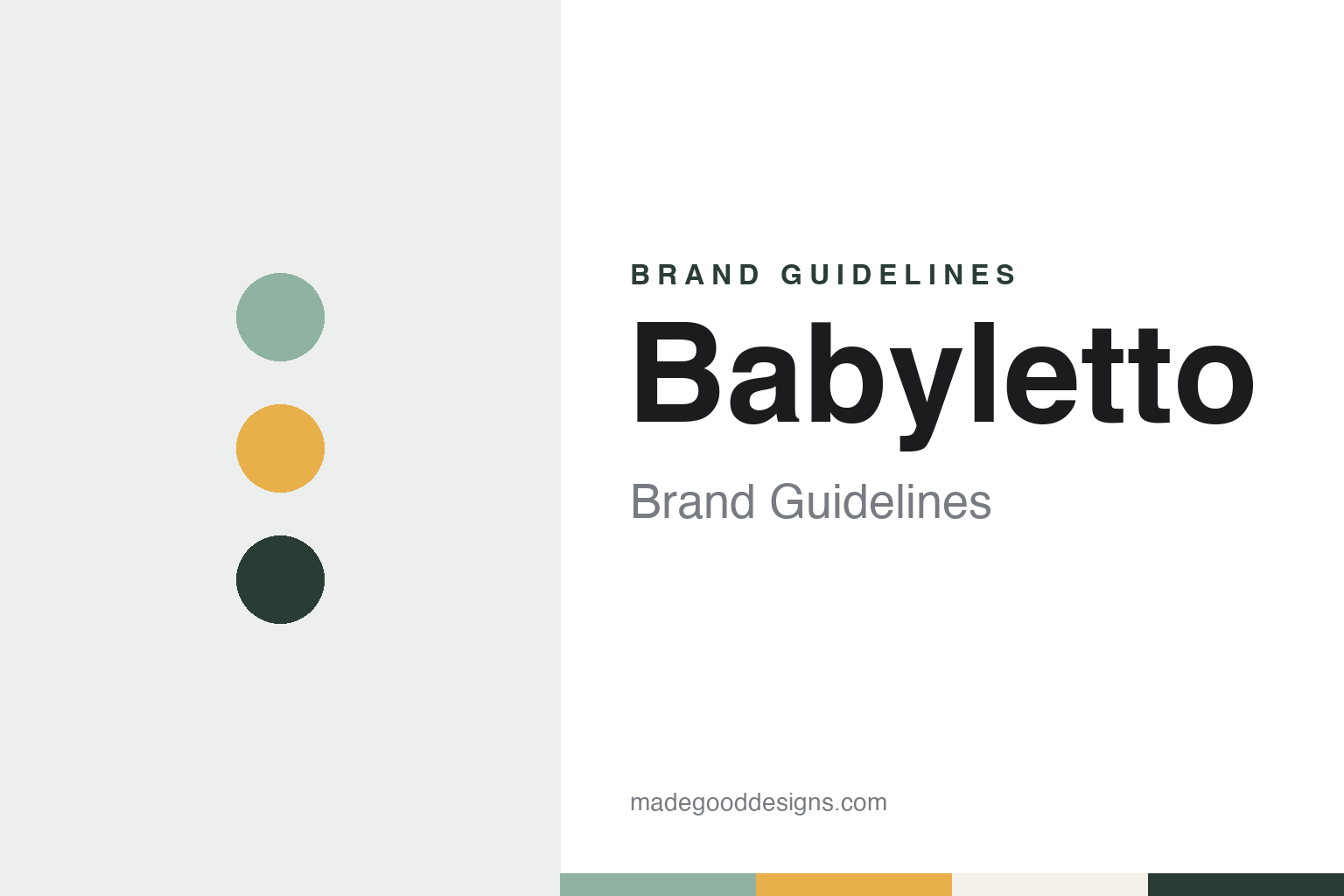
Babyletto Brand Guidelines
A modern crib label launched in 2009 by a Los Angeles family furniture company.
Aa
Two constants: a sage, eucalyptus and honey palette and a clean geometric sans register. Abstract homage — not a Babyletto product or mark; no crib, chair or logo is reproduced.
A modern label inside a family firm
A Los Angeles crib company and the son who added a modern line.
Babyletto is an American brand of modern nursery furniture, and it sits inside an older family business. That business is Million Dollar Baby Co. of Los Angeles. Its own “Our Story” page says: “We started back in 1990 in Los Angeles when Daniel and Maryann had a simple idea. New parents, like themselves, should have better choices when it comes to their baby’s first home.” With “one crib, a van, and a few more family members in tow,” the page says, the couple “started selling cribs all around California.” The crib they began with, the company says, was the classic Jenny Lind, a turned-spindle design that is still part of its range.
Babyletto came almost two decades later. The retail trade site Retail Boss reported on 24 September 2024 that the brand was “Founded in 2009 by Teddy Fong” and that it “quickly found a niche in the market for modern, accessibly priced cribs.” The same article described Million Dollar Baby Co. as “the family-run company” established in 1990 by Daniel and Maryann Fong, and “now helmed by their children, CEO Teddy Fong and CRO Tracy Fong.” A Mann Report newswire item in October 2026 gave the same account: “Launched in 2009, Babyletto is part of Million Dollar Baby Co., established by Fong’s parents in 1990,” and it named Teddy Fong as founder of Babyletto and chief executive of the parent company.
Inside the group, Babyletto has a defined role. Million Dollar Baby Co.’s “Our Brands” page lists it next to DaVinci, Carter’s by DaVinci, Namesake, Monogram and Nursery Works, and describes it as the label that “designs everything modern parents need to create their own fun and functional nursery space.” DaVinci, by contrast, is presented there as the group’s long-running everyday line. The parent company says that all of its products “are designed by our talented in-house design team.”
Colour
Short names, convertible frames.
Babyletto’s catalogue reads like a list of nicknames. On babyletto.com in October 2026 the cribs carried short, two-syllable names — Hudson, Lolly, Pogo and Yuzu among them — with Palma, Rolli and Swell alongside. Each name is followed by a plain description of what the frame converts into: a 3-in-1 crib with a toddler bed conversion kit, or a larger “All-Stages” crib sold with bassinet and toddler bed kits. The company uses All-Stages as a registered product name, and the idea it describes is the one that runs through the whole range: a single nursery piece that changes shape as a child grows.
The brand’s own site presents its work under the heading “Designed in Los Angeles.” It describes the furniture as “stylish and versatile modern nursery furniture that is well-made, consciously crafted,” and says the team thinks through “all the details, like which materials are remarkably durable.” Another line on the same page sets the tone of the voice: “We believe there’s no set way to create your nursery.” The company also describes itself there as “a minority-owned and operated business.”
Packaging has become part of the presentation. Several products on babyletto.com carry a “Styrofoam-Free Packaging” label, and the parent company’s story page says Million Dollar Baby Co. introduced Styrofoam-free packaging for a number of its collections and sources FSC-certified wood “whenever possible.” Those are the company’s own descriptions.
The range has also widened through partners. In October 2026 babyletto.com sold a Nate Berkus by Babyletto collection, led by the Astre convertible crib, named for the American interior designer, and its shop listed products from other makers such as Mushie, Gathre and Pehr beside its own furniture.
Typography
Design and documentation.
Nursery-furniture brands sit at a particular point in family life: they make the pieces that fill a room before a child arrives, and some go on to make the beds, desks and chairs that follow. Some began as family workshops or wholesalers; others started as design studios, online shops or offshoots of older companies, and a single name can be sold everywhere from a department store to a registry list to its own website.
A nursery-furniture brand’s identity is usually carried less by a logo than by the furniture itself — the names given to its cribs and collections, its wood finishes and fabrics, and the way a whole room is styled and photographed. The companies behind these names may have changed hands, widened their ranges or moved where their furniture is made since they started.
That makes the plain questions worth asking: who started each brand, who owns it now, and where its furniture is actually made. Each guide separates what independent, dated sources record from what the company says about itself, and marks plainly what rests only on the company’s own word.
Aa
A clean geometric sans for a brand of short names and simple frames. (Specimen set in Poppins, a sans-serif STAND-IN; NOT the Babyletto logo.)
Babyletto
From the web to Melrose Avenue.
For most of its life Babyletto was sold through other shops and online, and in the mid-2020s it began to open rooms of its own. Retail Boss reported in September 2024 that the brand had opened a store “in its hometown of Los Angeles,” on Melrose Avenue, with modern cribs, recliners, gliders and dressers on show. In October 2026 the Mann Report newswire reported a further Babyletto showroom at South Coast Collection, the home furnishings and design centre in Costa Mesa, California. Million Dollar Baby Co.’s brand page also lists a “Babyletto Boutique” among the places its products can be found.
Ownership has stayed in the family throughout. Million Dollar Baby Co. has owned Babyletto since 2009, and the trade reports name Teddy Fong as both the brand’s founder and the parent company’s chief executive. The parent company describes itself as a family business and lists its wider network of retailers and countries where its brands are sold. “As a family business, we treat our community like our family,” its story page says, adding that it partners “with exceptional suppliers and retailers from around the world who share our values.” It also describes branding and marketing teams whose job, it says, is to keep its brands “relevant and fresh.”
For a design guide, Babyletto shows how a family company with a traditional crib line can create a separate modern label with its own names, voice and showrooms, while keeping it inside the same family company. Compare DaVinci, its sister brand inside Million Dollar Baby Co., and Hatch, another American nursery brand. For this guide we use a sage and a honey yellow with a geometric sans, an unofficial interpretation; no product or logo is reproduced.
Explore & save
Keep Babyletto’s identity on hand — save it to a board in the Made Good inspiration library.
Babyletto identity set
Pin the Babyletto sage, eucalyptus and honey palette and the clean geometric sans register to your own board.