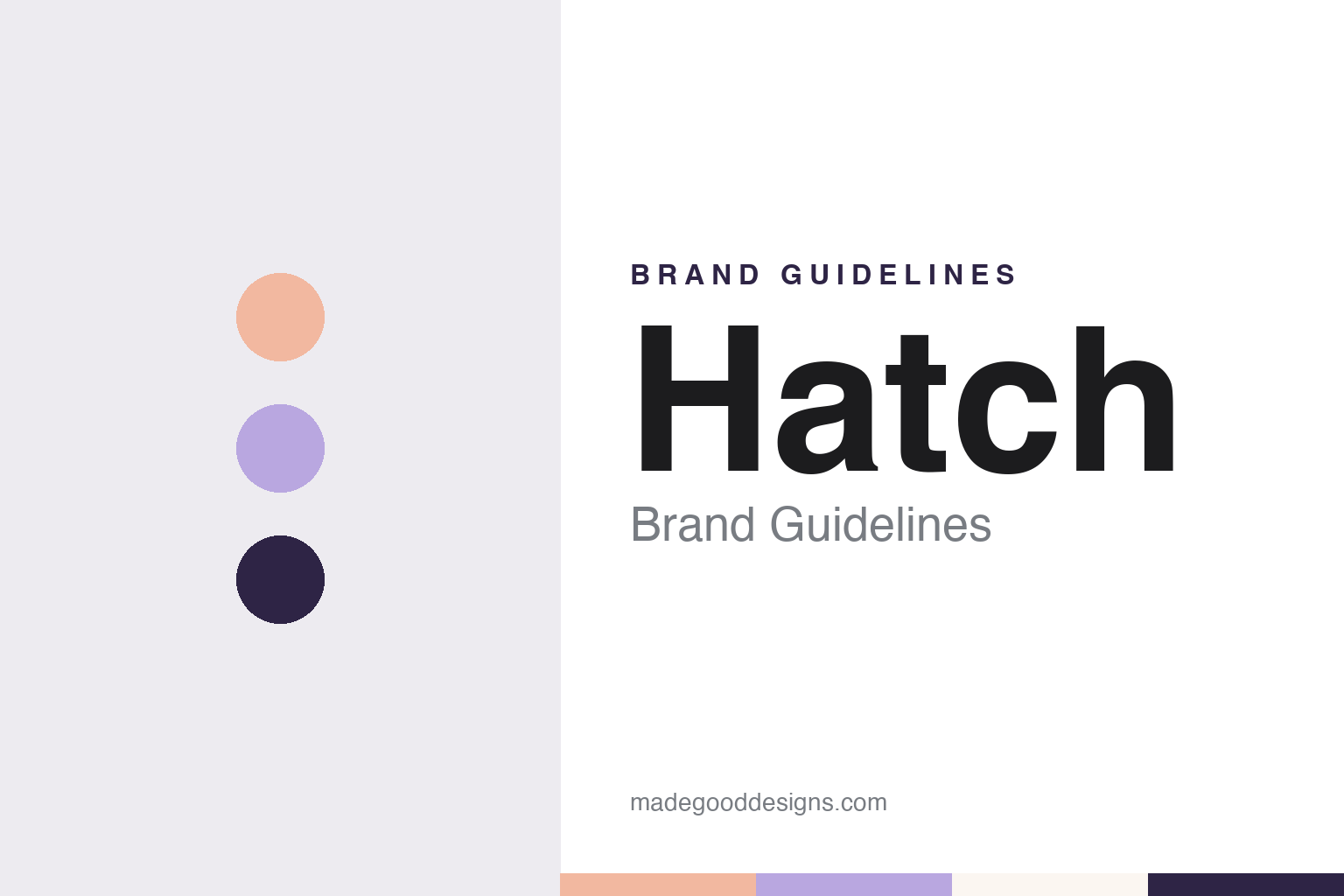
Hatch Brand Guidelines
A smart changing pad that became a family of sleep devices.
Aa
Two constants: a night-light peach, lavender and dusk violet palette and a soft modern sans register. Abstract homage — not a Hatch product or mark; no device, app screen, pack or logo is reproduced.
Two founders from BabyCenter
A husband-and-wife team and a changing pad with a scale.
Hatch is an American brand of sleep devices, run by Hatch Baby, Inc. and known for the Rest sound machine and night light and the Restore range for adults. It was started by a married couple, Ann Crady Weiss and Dave Weiss. The company’s About page introduces them under the heading “Say hey to Ann and Dave”. It says Ann Crady Weiss, now the company’s chief executive, was previously the senior vice president of consumer experience at BabyCenter, the parenting website, and that she met her husband and co-founder at work. Between the two of them, the page says, they ran product, engineering, editorial, design, community and marketing teams, but “they were entrepreneurs at heart”.
Hatch was not Ann Crady Weiss’s first company. TechCrunch, in an article by Catherine Shu dated 15 October 2015, reported that she had earlier founded Maya’s Mom, a social networking site for parents that was acquired by BabyCenter in 2007. The same article reported that Hatch Baby had raised a Series A round from True Ventures, which had also invested in Maya’s Mom, and named her as the new company’s co-founder and chief executive officer.
The first product was not a sleep device at all. TechCrunch described Hatch Baby’s first offering as the Smart Changing Pad: a diaper-changing pad with a wireless scale built in, paired with a companion app that parents could also use without the pad. In October 2015 it was taking pre-orders and was scheduled to ship in December. The article quoted Ann Crady Weiss explaining the idea in an email, and said the company planned to use its new funding to develop the pad and services for its users before “eventually launching other products”.
Colour
From the nursery to the nightstand.
The early website shows how the company first presented itself. A capture of hatchbaby.com saved by the Internet Archive on 3 January 2016 carried the page title “Hatch Baby | The Smart Changing Pad” and a single sentence of mission: “At Hatch, we’re reinventing the nursery starting with the Smart Changing Pad.” The page described the pad as an “innovative and modern twist on the traditional changing pad” that let parents keep a record of their baby’s growth, feedings, diapers and sleep on a smartphone. It said the first shipment had sold out and that new orders were shipping in January, and it ran a short quotation from a mother about watching her baby’s weight change day by day. The menu was simple — details, overview, FAQ and a pre-order button — because the company had, at that point, one product to sell.
The name on that page is worth noting. Even in 2016 the company called itself simply “Hatch” in its own sentence, while the website, the page title and the company name all used Hatch Baby. That short form later became the brand.
The product that followed moved the company from the changing table to the bedside. The About page today describes the founders’ motivation in personal terms: it says the couple’s own sleepless nights, beginning with long nights awake with their first baby, “sent them on a quest to make sleep easier”, beginning with Rest and Rest+ for little ones and then expanding to adults with Restore. The company also says it was featured on “Shark Tank” in 2016. An Amazon Alexa developer blog post by Kellie Garnett, dated 11 February 2021, profiled Ann Crady Weiss as Hatch’s chief executive. It said the couple had taken the smart changing pad to Shark Tank about five years earlier, and described Hatch Rest as an Alexa-enabled smart device that came next.
Typography
Design and documentation.
Baby-gear brands sit at a crowded and closely watched point in family life, between the hospital bag, the nursery and the car. Some began with a parent’s own improvised solution to a problem at home; others grew out of established nursery companies or were later folded into larger groups, and a single name can be sold everywhere from a department store to a registry list to its own website.
A baby-gear brand’s identity is usually carried less by a logo than by the products themselves — their names, their fabrics and colours, the shapes parents learn to recognise and the way a range is presented on a shelf or a screen. The companies behind these names may have changed hands, widened their ranges or moved where their products are made since they started.
That makes the plain questions worth asking: who started each brand, who owns it now, and where its products are actually made. Each guide separates what independent, dated sources record from what the company says about itself — its founding story, its owners over time and the way its products and packaging have changed — and marks plainly what rests only on the company’s own word.
Aa
A soft modern sans for a brand that dropped “Baby” from its name. (Specimen set in DM Sans, a sans-serif STAND-IN; NOT the Hatch logo.)
Hatch
Hatch, formerly Hatch Baby, and a range for every age.
Today the brand trades simply as Hatch. The company’s About page describes itself as “Hatch (formerly Hatch Baby)”, while the legal name in the footer of hatch.co still reads “© 2026 Hatch Baby, Inc.” The page now sets out a wider mission: to “make sleep easier than ever for everyone” with what it calls all-in-one products “for newborns through adults”.
The shop menu shows how far the range has moved from the nursery. It lists the Hatch Sleep Clock, Restore 3, a Baby section and Hatch Go, alongside gift options, refurbished devices, accessories and wholesale orders, and a link to download the Hatch Sleep app. A separate section of the menu, headed Original Audio, links to a listening room and to audio series made by the company, and a membership offer sits alongside it. The baby range remains part of the business, but the name no longer limits it.
One episode in the product history is documented by the US Consumer Product Safety Commission: on 3 July 2024 it announced a recall, with Hatch Baby, of AC power adapters sold with some Rest 1st Generation sound machines. The company’s footer carries a link to the adapter recall page.
For a design guide, Hatch shows how a company can outgrow the word in its own name — keeping “Hatch Baby” for the legal entity while the shorter “Hatch” carries devices for babies, children and adults. Compare HALO, the American brand behind the SleepSack wearable blanket, and Nuna, the Dutch-designed baby-gear brand. For this guide we use night-light peach, lavender and dusk violet with a sans, an unofficial interpretation; no product or logo is reproduced.
Explore & save
Keep Hatch’s identity on hand — save it to a board in the Made Good inspiration library.
Hatch identity set
Pin the Hatch night-light peach, lavender and dusk violet palette and the soft modern sans register to your own board.