Oeuf Brand Guidelines
A Brooklyn studio named for the French word for egg, making children’s furniture since 2002.
Aa
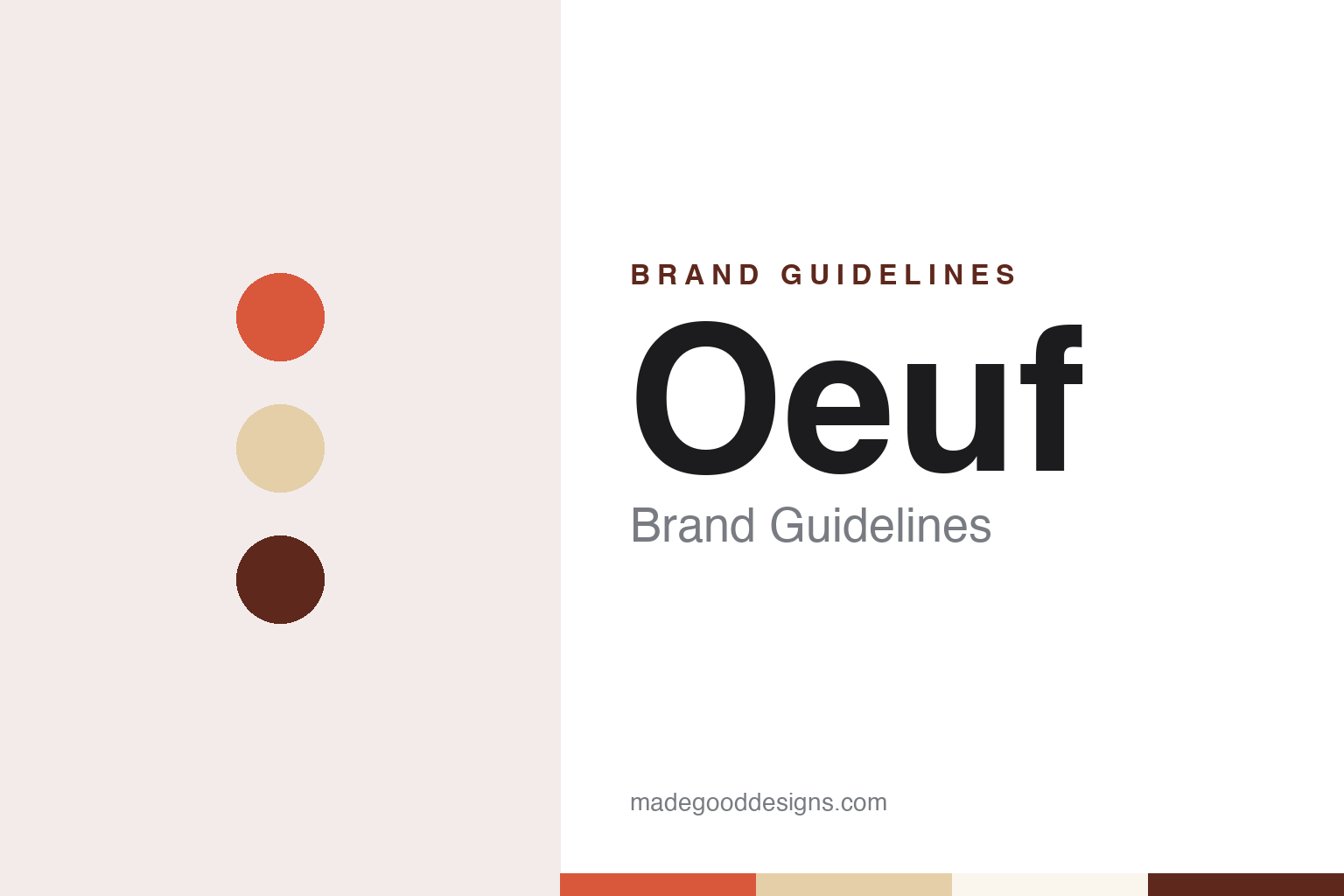
Two constants: a tomato, birch and eggshell palette and a soft display serif register. Abstract homage — not an Oeuf product or mark; no crib, bed or logo is reproduced.
A crib two parents made for themselves
A Brooklyn couple, a first child and a crib they could not find.
Oeuf is a children’s furniture and lifestyle brand based in Brooklyn, New York, and it is run by the couple who started it. The company’s founders page says that Michael Ryan and Sophie Demenge “are the husband-and-wife team behind Oeuf,” and that “the birth of their first child in 2002 turned the couple’s talents to children’s design, and together they founded Oeuf.” The same page opens with the line “Pioneering children’s furniture standards since 2002” and describes Oeuf as “a sustainable children’s lifestyle brand.”
The company tells its origin as a problem it had to solve at home. Its “About Us” page says: “Oeuf began out of necessity: When Sophie and Michael were expecting their first child, they couldn’t find a crib that was well-designed, well-made and produced ethically. So they created one themselves.” It describes the business today as “a family-run studio” and says that “Oeuf still designs everything in-house.”
The name is part of the identity. The company says that Oeuf, pronounced “uhf,” means “egg” in French — “a symbol of simplicity, beauty, and strength.” It adds that the word is “a reminder of care and protection, much like a maman poule,” the French phrase for a hen that the company glosses as a nurturing parent. The egg idea also shapes how it describes its own process: “Like oeufs (eggs) themselves, ‘good’ ideas take time to incubate,” the About page says, and the studio says it embraces “trial and error” and gives itself “the freedom to fail and try again.”
Colour
Birch, colour and named collections.
Oeuf names its furniture by collection rather than by single product. In October 2026 the company’s site grouped its pieces into the Moss, Perch, Sparrow and River collections, together with lines called Classic and Rhea, and sorted them by room — nursery, kids’ bedroom, and playroom and study. Within a collection, the same design language runs from a crib to a toddler bed, a bunk bed, a desk or a table and chairs, so a family can add pieces as a child grows. Colour is named plainly too: the Moss crib, table and chairs were offered in a finish called Tomato as well as birch.
Wood is central to the look. The company’s “Made in Europe” page says that Oeuf furniture is produced in Latvia, which it describes as “a forest-rich country in Eastern Europe with a deep woodworking tradition and home to our beloved birch hardwood.” It says Oeuf has worked with the same factory for many years, that the factory is FSC certified, and that Latvia’s locally harvested lumber means the furniture “is made where it’s sourced.” Those are the company’s own descriptions.
Textiles follow a different route. The founders page says that Oeuf baby alpaca goods “are produced in South America by a knitting collective,” and the range of pillows, blankets, mobiles, lamps and costumes sits in a décor and gifts section beside the furniture. The site sums up the arrangement in one line: “Designed in Brooklyn, by parents for kids.”
The company’s manifesto, titled with the motto “Be Good,” says its designers aim for products “designed with a European sensibility that is thoughtful and timeless.” The About page describes the result as “American optimism, French je ne sais quoi.”
Typography
Design and documentation.
Nursery-furniture brands sit at a particular point in family life: they make the pieces that fill a room before a child arrives, and some go on to make the beds, desks and chairs that follow. Some began as family workshops or wholesalers; others started as design studios, online shops or offshoots of older companies, and a single name can be sold everywhere from a department store to a registry list to its own website.
A nursery-furniture brand’s identity is usually carried less by a logo than by the furniture itself — the names given to its cribs and collections, its wood finishes and fabrics, and the way a whole room is styled and photographed. The companies behind these names may have changed hands, widened their ranges or moved where their furniture is made since they started.
That makes the plain questions worth asking: who started each brand, who owns it now, and where its furniture is actually made. Each guide separates what independent, dated sources record from what the company says about itself, and marks plainly what rests only on the company’s own word.
Aa
A soft display serif for a studio that pairs Brooklyn with French wordplay. (Specimen set in DM Serif Display, a serif STAND-IN; NOT the Oeuf logo.)
Oeuf
Still family-run, still in Brooklyn.
Unlike many nursery brands, Oeuf has not been folded into a larger group. The company’s own pages in October 2026 still described it as a family-run studio led by its two founders, and still placed it in Brooklyn, more than two decades after that original crib. Its values are set out in a short manifesto under the motto “Be Good,” which the company applies to its designers, to its people and to the business as a whole. The same manifesto asks its designers for “streamlined, intuitive products” made “with quality craftsmanship,” and the company presents the motto as one meant for the children, the founders and the firm alike.
The company also explains how it decides what to make. Its About page says that “when we first started Oeuf there weren’t that many companies offering ethically produced modern kids’ products,” and that a busier market now pushes the studio to ask whether families need a product, whether it can be made well and whether it can be made sustainably. It says it values quality over quantity and does not rush design. The phrase it uses for its furniture — “made to be loved hard and handed down” — appears across the site. The founders page adds that the designs are “inspired by our own kids and the evolving needs of 21st century families,” and that Oeuf has combined “playful modernism with ethical production and simple, intuitive designs” since 2002.
For a design guide, Oeuf shows how a small studio can build a recognisable identity from a single word, a single wood and a consistent set of collection names, with the founders’ own story doing the work that advertising does for larger firms. Compare Babyletto, a modern nursery label from a Los Angeles family company, and Skip Hop, another New York baby brand begun by two parents. For this guide we use a tomato red and a birch cream with a serif, an unofficial interpretation; no product or logo is reproduced.
Explore & save
Keep Oeuf’s identity on hand — save it to a board in the Made Good inspiration library.
Oeuf identity set
Pin the Oeuf tomato, birch and eggshell palette and the soft display serif register to your own board.