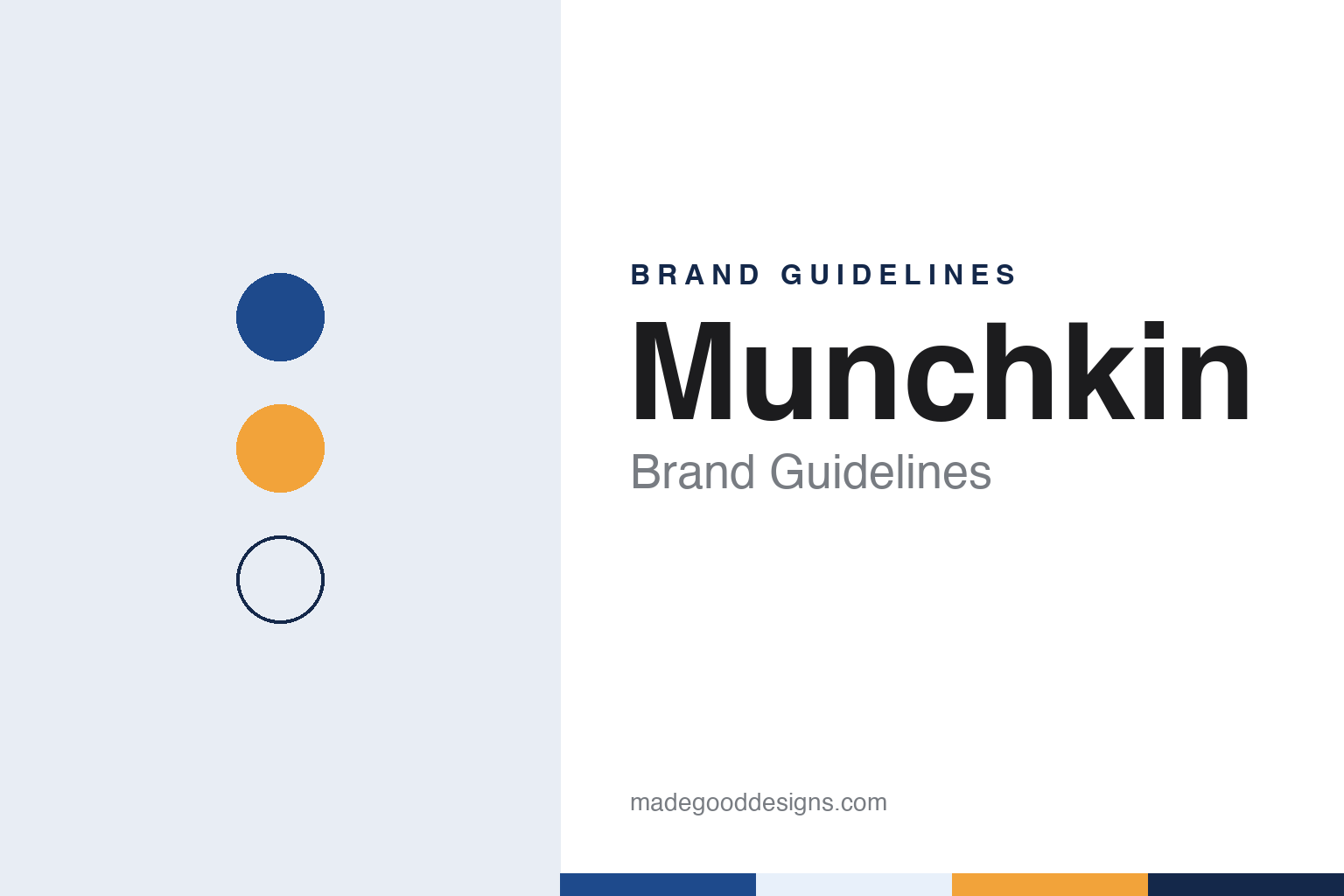
Munchkin Brand Guidelines
Steven Dunn’s 1991 Van Nuys baby-bottle company.
Aa
Two constants: a blue and orange nursery palette and a rounded sans register. Abstract homage — not a Munchkin product or mark; no bottle, cup, logo or packaging is reproduced.
A Soda Bottle
A father, a soft drink and a borrowed logo.
Munchkin began in 1991 in the San Fernando Valley. The Los Angeles Times, in a profile datelined Van Nuys and published on 28 March 1995, told the founding story: Steven Dunn, a onetime venture capitalist with a Harvard MBA who had never run a company, noticed that his baby daughter kept reaching for the Diet Cokes he drank. He fitted a nipple to an empty soda bottle, filled it with formula, and saw a business. In 1991 he founded Munchkin Inc. with his own money and that of a few partners, the paper reported.
The idea was licensing. Dunn secured the rights to use the Pepsi, Seven-Up and Dr Pepper logos and hired a manufacturer to produce plastic baby bottles shaped like pop bottles, the Times said. Within a short time the bottles and other children’s products were on sale at Wal-Mart, Kmart and Toys R Us. Other early products the paper named were baby utensils carrying Crayola logos and teethers shaped like cookies.
The Times profile also recorded a setback. The company was based in Van Nuys, and in 1994 it sustained heavy damage in the Northridge earthquake,. Dunn told the paper his sales fell that year. By early 1995 he described the company as recovering, and the Times reported that it was trying to move from novelty baby bottles to a full line of infant-feeding products.
Dunn’s background was in finance. The paper said he had held corporate-finance roles at Bear Stearns and in Smith Barney’s venture-capital group in New York, had been a partner at the venture firm Idanta Partners, and had then run a Los Angeles real-estate investment group. His father, David Dunn, was Munchkin’s chairman at the time.
English Wikipedia describes Munchkin as a privately held company headquartered in Van Nuys that designs, develops, manufactures and distributes products for infants and toddlers, founded in 1991 by Steven B. Dunn, who serves as its chief executive.
Colour
From novelty bottles to a full line.
The 1995 Los Angeles Times profile caught Munchkin at a turning point, and it named the products the company was then betting on. One was a disposable bottle liner called “1 Step,” about to ship to stores. Another was a line of silicone nipples coded by colour, so that a parent could tell flow rates apart at a glance; the paper said Wal-Mart, Kmart and Toys R Us were already selling them. A Munchkin marketing executive, John Call Jr., a veteran of Mattel and Parker Brothers, told the paper that there was “no reason to come out with a me-too product.”
The same article described the company’s offices as decorated in bright colours, with stuffed animals and prototypes of possible new products, among them children’s toothbrushes, a holder for disposable feeding products and a line of dental floss. Claudia DeSimone, editor of the New York trade journal Juvenile Merchandising, told the paper that a company like Munchkin “has to keep innovative or it will be knocked off.”
Munchkin then grew by acquisition. English Wikipedia, citing Insider Media in January 2010, says Munchkin bought Lindam, a baby-safety brand from Harrogate in the UK, that year. Citing the Charlotte Business Journal in January 2014, it says Munchkin bought Brica, a Charlotte, North Carolina maker of travel accessories for babies and toddlers. Citing NOSH in September 2016, it says Munchkin bought Milkmakers, a maker of lactation cookies. Today the lindam.com and brica.com addresses lead to Munchkin’s own website.
Among the products the company is known for, English Wikipedia, citing Fortune in March 2023, names the Miracle 360 sippy cup, for which Munchkin holds a patent. Wikipedia also says Dunn is the lead inventor on many of the company’s products. In 2026 Munchkin’s home page was promoting Munchkin Infant Formula, a newer category for the company.
In January 2022, Wikipedia says, citing Environmental Leader, Munchkin announced it was working with the polymer-additive company Smart Plastic Technologies. Wikipedia, citing The Week in September 2022, also reports that Munchkin redesigned the packaging of some of its drinking cups after a pet-rescue group in Missouri told the company that packaging material had injured one of its cats.
Typography
Design and documentation.
Baby-feeding brands sell some of the most closely handled objects in a household: bottles, teats, cups, soothers and the containers and pails that sit beside them. Some of these names began as small family firms or around a single product, and some now belong to much larger consumer-goods or electronics groups, so the name on the pack and the company behind it are often not the same.
A feeding brand’s identity can rest on a short name, a recognisable product shape and its packaging as much as on any single logo, and the same name may pass through several owners while the products on the shelf look much the same. That makes the plain questions behind each name worth asking: who started it, who owns it now, and where its products are actually made.
Each guide separates what independent, dated sources record from what the company says about itself — its founding story, its owners over time and where it makes its products — and makes no claims about what any product does.
Aa
A rounded, friendly sans — the register of a nursery shelf. (Specimen set in Nunito, a sans STAND-IN; NOT the Munchkin logo.)
Munchkin
A Van Nuys company that became a house of brands.
Munchkin’s structure has changed in recent years. In 2026 the footer of its website reads “Munchkin, a Why Brands Inc. company,” so the brand now sits inside a parent company of that name. The website runs storefronts for the United States, Canada, the United Kingdom, Germany, the Netherlands, Spain and France, and it hosts a parenting podcast and a section on the company’s social-responsibility work.
The documented record of Munchkin’s design is a record of objects. The 1995 Times profile described bottles shaped like soft-drink bottles and carrying licensed Pepsi, Seven-Up and Dr Pepper logos, utensils with Crayola logos, teethers shaped like cookies and nipples coded by colour so that flow rates could be told apart. Later sources add the Miracle 360 cup. The palette and type in this guide are an interpretation for designers, not an official specification.
Munchkin also shows how a baby brand can absorb other brands. Lindam, a British name, and Brica, an American one, now lead to Munchkin’s own website, and Milkmakers sits alongside them.
For a design guide, Munchkin shows how a baby-products company can be built on a stream of small, distinctive objects rather than one signature item. Compare Skip Hop, a New York baby brand Carter’s has owned since 2017, and Ubbi, a Brooklyn brand that began with a steel nappy pail. For this guide we use a nursery blue and a soft-drink orange with a rounded sans, an unofficial interpretation; no product or logo is reproduced.
Explore & save
Keep Munchkin’s identity on hand — save it to a board in the Made Good inspiration library.
Munchkin identity set
Pin the Munchkin nursery blue and orange palette and the rounded sans register to your own board.