Douglas Brand Guidelines
A family toy company from a New England town.
Aa
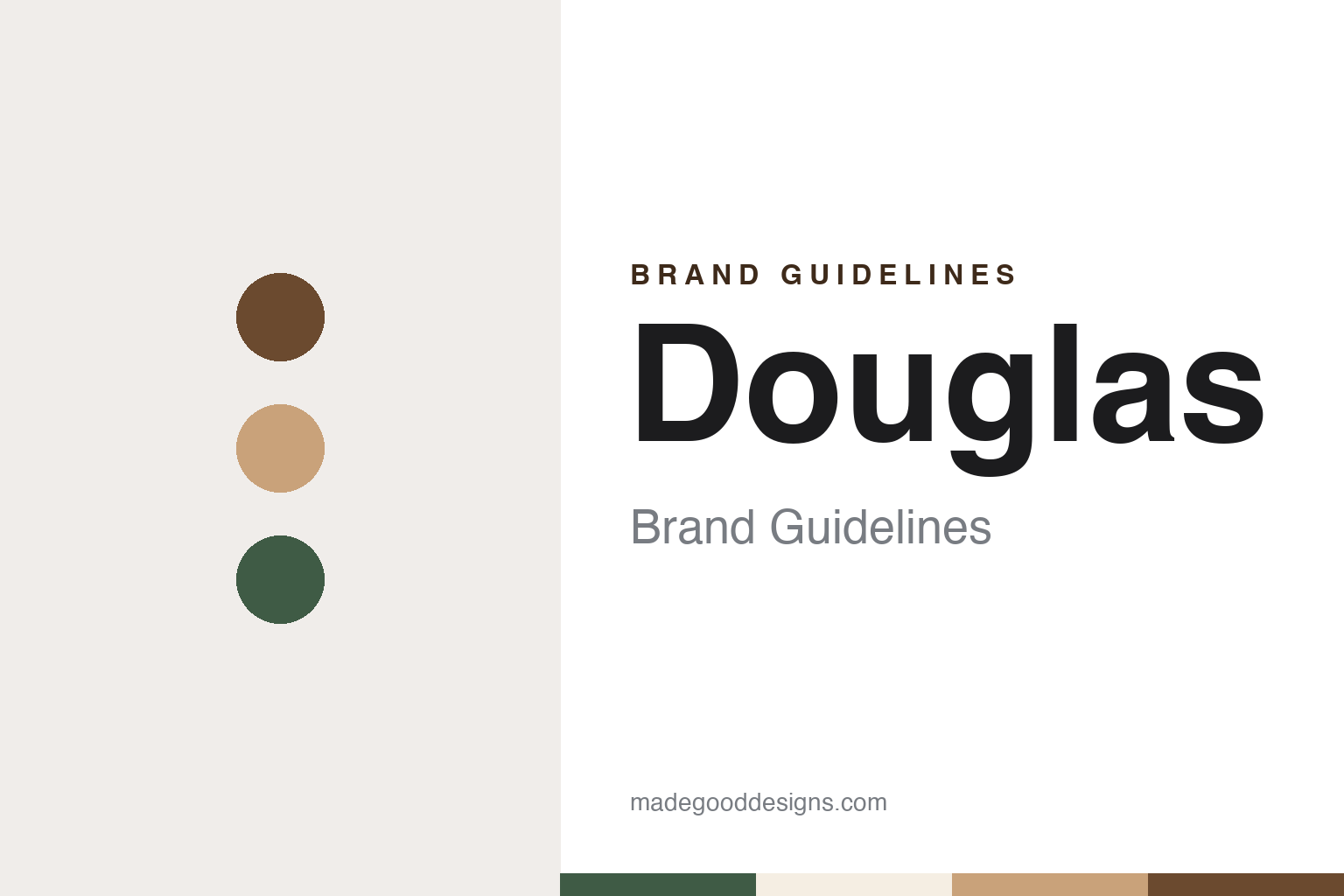
Two constants: a bear brown, fawn and pine green palette and a soft-cornered serif register. Abstract homage — not a Douglas product or mark; no toy or logo is reproduced.
A family business in Keene
It started with toys for babies.
Douglas is a plush toy company based in Keene, New Hampshire. The company says it has been a family-owned and operated business since 1956, and its contact page lists the corporate offices and United States distribution of the Douglas Company in Keene. The name on the label and on its website is Douglas Cuddle Toys, but the company’s own copy usually sets the name in capitals as DOUGLAS, and that single word is the brand most shoppers meet on a swing tag.
The company traces its start to babies rather than to the gift shop. Its about page describes the business as having begun in 1956 as an “Infant Toy Producer”, and it presents its present-day baby range as a return “full circle” to those beginnings. The trade magazine Gifts & Decorative Accessories made the same point in a profile published on 26 February 2020, quoting the company’s president, Scott Clarke: “We used to be in the baby market.”
The same profile, written by senior editor Alex Herring, describes Clarke as the president of Douglas and the son of its co-founders. It says he was one of the company’s first product testers as a child, that the business was a regular subject of conversation at the family dinner table, and that he officially joined the family-run company in 1982 after college. A photograph in the piece shows Penny Clarke and her son Scott with the company’s 40th Anniversary Mohair Bear in 1996, an anniversary that lines up with the 1956 start the company gives. The online piece pointed readers to a longer “Backstory” feature on the company’s history of more than 60 years and its family ties, published in the magazine’s February 2020 print issue.
Colour
A decade of change in the 1980s.
According to Gifts & Decorative Accessories, the 1980s were a decade of growth and change for Douglas once Scott Clarke was at the helm. The magazine says that this was when the company moved its manufacturing to Asia, to stay competitive with other toymakers that had already made the shift, and that it was also the period in which Douglas entered the gift industry. Clarke told the magazine that the gift trade “really became a wonderful expansion” because Douglas did not yet have that customer base, and that by working with sales representatives and going to different trade shows, the company found retailers who were willing to give it a try.
That arrangement still describes the business. The company says that today Douglas designs are created in New Hampshire and manufactured in Asia, and it refers to “our in-house USA design team”.
The catalogue is organised around animals. The Douglas website sorts its plush into groups such as dogs, cats, farm animals, horses, wildlife, sea life, dinosaurs and birds, and keeps separate sections for its baby range and for what it calls fun fashion accessories. The company describes its classic animals as having “gestures and expressions” that mark them out as Douglas, and it calls its bags and purses “saks”. Its baby line, Douglas Baby, is described by the company as offering cuddle toys and activity toys for babies.
Typography
Design and documentation.
The brands in this group all make plush or collectible toys: soft animals and characters, small figures and dolls, and ranges designed to be gathered one piece at a time. Toy brands of this kind sit at many different points in the trade, from family firms that still carry a founder’s name to lines that belong to much larger toy companies, and a single name can appear on shelves in gift shops, museum stores and toy aisles alike.
A toy brand’s identity is usually carried less by one product than by a name, a character style and a package, because the company behind it may have changed hands, moved its design or manufacturing, or added new ranges over the years. That makes the plain questions behind each name worth asking: who started it, who owns it now, and where its toys are designed and made.
Each guide separates what independent sources record from what the company says about itself — its founding story, its owners over time, where its toys are made and how its look has changed — and marks plainly what rests only on the company’s own word.
Aa
A warm, soft-cornered display serif. (Specimen set in Fraunces, a serif STAND-IN; NOT the Douglas logo.)
Douglas
A Keene company with distributors abroad.
Douglas sells well beyond New Hampshire. The company says it has grown into an international business with distribution in Canada, Europe, Asia and Australia, and its contact page lists a Canadian distributor in Bolton, Ontario and a European distributor, NoaPoa Trading, alongside its own United States distribution from Keene. It also points buyers to the industry trade shows where it shows its animals, fashion accessories and Douglas Baby range, the same route into the gift trade that Clarke described in 2020.
The company is also part of a long local story. In November 2019 the Historical Society of Cheshire County opened an exhibit in Keene called “Toys: The Story of Toy Manufacturing in the Central Connecticut River Valley”. The society’s event page says the exhibit ran in Keene until 18 April 2020 before moving to Brattleboro, Vermont, and Peterborough, New Hampshire, and it names Douglas Cuddle Toys among the sponsors, together with Whitney Brothers and The Toadstool Bookshop of Keene. The society describes the show as a collaboration with the Brattleboro Historical Society, the Marlborough Historical Society and individuals with personal links to the region’s toy-making history, looking at the technology, play theory, popular culture and national and international forces that shaped the industry.
The company’s own description of its range keeps returning to faces and poses, the “gestures and expressions” of the classic animals, and to softness in the baby line, which it describes as offering “the softest, most endearing designs” for babies. The single word DOUGLAS covers the plush animals, the fashion “saks” and the baby toys. No official colour code or typeface for the Douglas name has been published.
For a design guide, Douglas shows how a small, family-run plush company can keep one plain name across baby toys, gift animals and accessories while its design work stays in one New England town. Compare it with Gund, another long-running American plush maker, and with Jellycat. For this guide we use bear brown, fawn and pine green with a soft-cornered serif, an unofficial interpretation; no product or logo is reproduced.
Explore & save
Keep Douglas’s identity on hand — save it to a board in the Made Good inspiration library.
Douglas identity set
Pin the Douglas bear brown, fawn and pine green palette and the soft-cornered serif register to your own board.