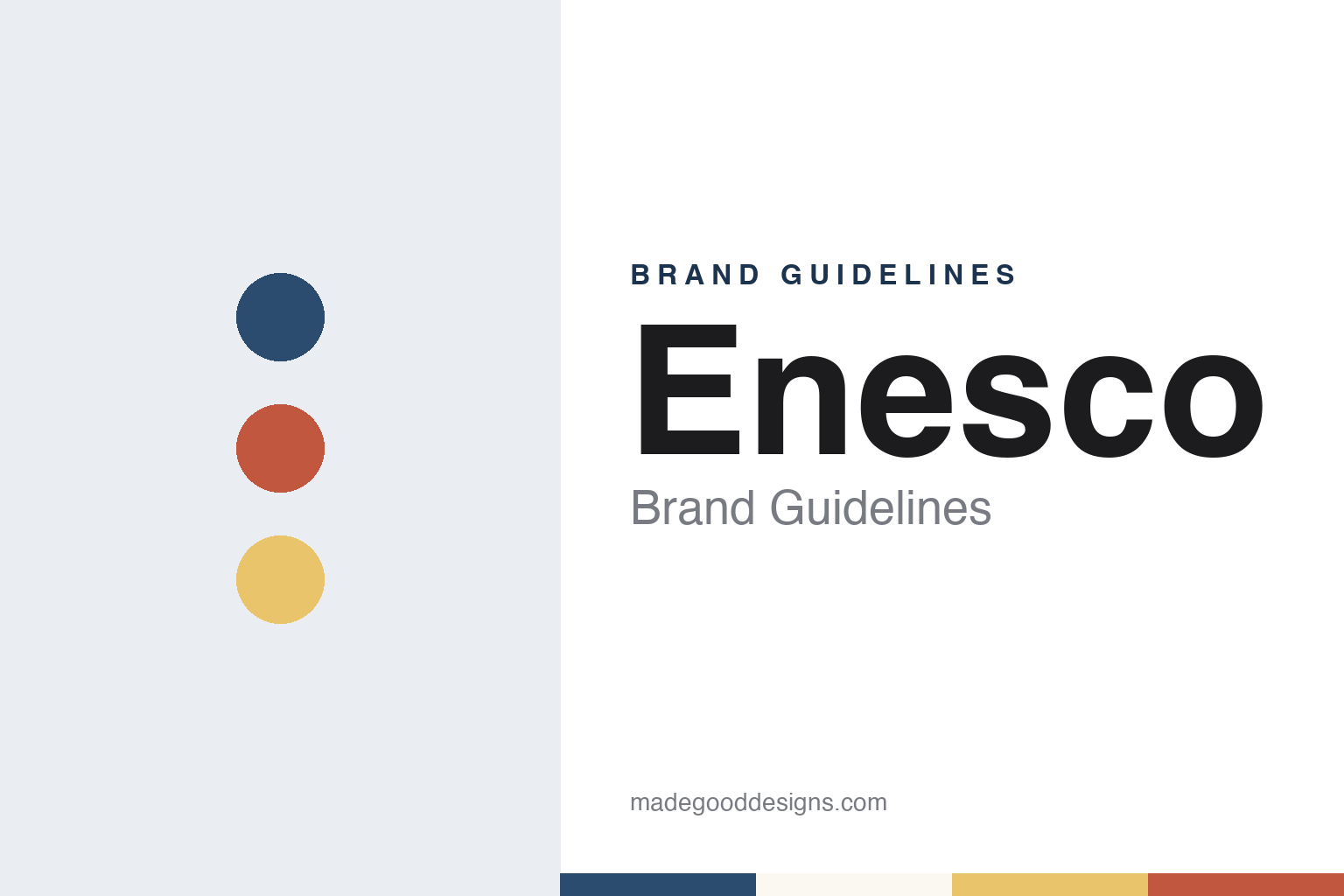
Enesco Brand Guidelines
A name made of three letters, a business made of licences.
Aa
Two constants: a giftwrap navy, ribbon red and folk-art gold palette and a giftware serif register. Abstract homage — not an Enesco product or mark; no figurine, package or logo is reproduced.
N S Co, said out loud
An import division that kept its parent’s initials.
Enesco’s name is a pronunciation. English Wikipedia says the company began in 1958 as the import division of the N. Shure Company, and that it was founded by its first president, Louis R. “Bob” Miller Jr. When N. Shure was sold to Butler Brothers, the import division was spun off as a company of its own. Wikipedia, citing an archived version of Enesco’s own “about us” page, says the name came from the parent firm’s abbreviation, “N S Co”, spelled out phonetically as En-Es-Co.
The company is a private American giftware business. Wikipedia gives its headquarters as Itasca, Illinois, and Enesco’s own press releases, such as one issued in July 2014, carry an Itasca dateline. Wikipedia describes its products as gift, garden and home decor items and lists subsidiaries including Department 56, the Gregg Gift Company, and Enesco companies in the United Kingdom, Canada and France. Among the brands it says Enesco owns or licenses are Heartwood Creek, created with the artist Jim Shore, and the holiday village maker Department 56.
Enesco’s path through owners has been long. Wikipedia says the company was sold several times after the spin-off and in 1983 became part of Stanhome, Inc., separating from it in 1998. On 12 January 2007 Enesco filed for Chapter 11 protection, Wikipedia says, citing Home Accents Today, and in February 2007 the business was bought by Tinicum Capital Partners and became Enesco, LLC, a deal the company announced in a press release that month.
Colour
Artists’ work, made into figurines.
Much of what carries the Enesco name is the work of named artists, licensed and turned into figurines, ornaments and gifts. One long-running partnership is with the folk-art painter and carver Jim Shore. In a press release dated 22 July 2014, Enesco said that it and Jim Shore had created and introduced the Heartwood Creek brand in 2002, with each product reflecting Shore’s roots in American and European folk art, and that the two had renewed their agreement to run to the end of the decade. The same release said Shore had also worked on Enesco products for its licensors Disney, the Wizard of Oz and Peanuts. Wikipedia, citing Gifts & Decorative Accessories in January 2023, says the Jim Shore agreement has since continued on an open-ended basis.
The 2014 announcement was framed as a partnership between a company and an artist. Enesco’s then chief executive, Tom Bowles, was quoted calling it a successful partnership with Jim Shore Designs, and Shore said he looked forward to the next five years. Enesco’s chief merchandising officer at the time, Kathi Lentzsch, said the renewal would let Shore evolve his art and keep it as relevant as when the two first started working together.
Enesco is also tied to an American figurine line of the late twentieth century. Wikipedia names Precious Moments, the teardrop-eyed porcelain figures drawn from the art of Sam Butcher, among the brands Enesco formerly handled.
The 2014 release gives a snapshot of the portfolio at the time, listing Jim Shore, Disney, Gund, Department 56, BRITTO and Our Name Is Mud among Enesco’s gift brands, and describing customers that ranged from specialty card and gift shops and home decor boutiques to department stores.
Typography
Design and documentation.
Figurine and collectable brands work with a small object and a long memory. A piece may be cast in porcelain, moulded in resin, carved from wood or shaped in felt, and it is usually made to be kept, displayed and added to rather than used up. That gives the brand behind it an unusual job: its name has to live on the underside of the piece as well as on a shop shelf.
Much of the identity of a collectable is carried by marks rather than advertising: a backstamp or base mark, a signature or sculptor’s credit, a dated series name, a box and a catalogue. Collectors use those details to tell one period or one workshop from another, so the way a maker marks its pieces can matter as much as the figure itself. The company behind a name may also have changed owners, moved its studio or changed where its pieces are made.
Each guide separates what independent sources record from what the company says about itself — its founding story, its owners over time, where its pieces are made and how its marks have changed — and marks plainly what rests only on the company’s own word.
Aa
A soft, warm display serif. (Specimen set in Fraunces, a serif STAND-IN; NOT the Enesco logo.)
Enesco
Villages, plush and a new owner.
Enesco has added and sold businesses under each owner. In 2009 it acquired the holiday village maker Department 56 from Lenox, a deal reported by the Minneapolis/St. Paul Business Journal in April that year, and Enesco has owned Department 56 since 2009. Wikipedia says the Los Angeles private equity firm Balmoral Funds acquired Enesco, LLC in 2015, and a March 2018 press release from the toy company Spin Master, announcing its purchase of the plush brand Gund from Enesco, described Enesco as a Balmoral Funds portfolio company. In that release Spin Master dated Gund to 1898 and quoted Enesco’s chief executive, Todd Mavis, wishing the Gund team well with its new owner.
Department 56 brought Enesco a second Midwestern collectables tradition. English Wikipedia says that business began in 1976 as the wholesale gift imports division of the Minneapolis florist Bachman’s, which numbered its departments, and that its lit Original Snow Village houses appeared that year, followed by the porcelain Dickens’ Village in 1984. It gives Department 56’s headquarters as Eden Prairie, Minnesota.
Enesco also spent a few years in retail. Wikipedia says it bought most of the personalised gift chain Things Remembered in 2019, later closed its stores, and sold the brand to 1-800-Flowers in January 2023. That same month, Wikipedia says, citing the trade title Gift Shop Plus, the holding company Ad Populum acquired Enesco. Ad Populum has owned Enesco since January 2023.
For a design guide, Enesco shows how a company can build a recognisable house name while letting artists and licensed characters lead on the shelf. Compare it with its own Department 56 and with Jim Shore. For this guide we use giftwrap navy, ribbon red and folk-art gold with a serif, an unofficial interpretation; no product or logo is reproduced.
Explore & save
Keep Enesco’s identity on hand — save it to a board in the Made Good inspiration library.
Enesco identity set
Pin the Enesco giftwrap navy, ribbon red and folk-art gold palette and the giftware serif register to your own board.


